• Fri frakt över 249 kr
  • •
  • Snabba leveranser
  • •
  • Billiga böcker
Kundservice

Du är på sajten för privatpersoner.

Företag, bibliotek eller offentlig verksamhet?

Du handlar på classic.bokus.com, där alla dina funktioner finns intakta.
Till classic.bokus.com
Bokus logotyp. Gå till startsidan.
  • Erbjudanden
  • Nyheter
  • Student
  • Topplistor
  • Barn & ungdom
  • Bokus Play
  • E-böcker
  • Pocketböcker
  • Spel & pussel

10% rabatt på allt med kod: NYSTART10 →

Sidfot

Mina sidor

    Hjälp

    • Kundservice
    • Vanliga frågor och svar
    • Frakt och leverans
    • Retur vid ångerrätt
    • Reklamera vara
    • Betalning
    • Köpvillkor
    • Allmänna villkor
    • Information om webbplatsens tillgänglighet

    Om Bokus

    • Om oss
    • Pressrum
    • För studenter
    • För företag
    • För bibliotek och offentlig verksamhet
    • För leverantörer
    • Hållbarhet

    Populärt

    • Aktuella erbjudanden
    • Presentkort
    • Studentlitteratur
    • Nya böcker
    • Topplistor
    • Signerade böcker
    • Engelska böcker

    Inspiration

    • Boktips
    • BookTok
    • Populära bokserier
    • Barnbokskaraktärer
    • Populära författare
    Logotyp för Bokus
    Följ oss på Facebook (extern länk)Följ oss på Instagram (extern länk)Följ oss på YouTube (extern länk)Följ oss på TikTok (extern länk)
    bokus @ CookiesAnpassa cookiesIntegritetspolicyKöpvillkor
    Till Citymail hemsida (extern länk)Till Budbee hemsida (extern länk)Till Postnord hemsida (extern länk)Till Schenker hemsida (extern länk)Till Early Bird hemsida (extern länk)Till Walleys hemsida (extern länk)
    1. Samhälle och politik
    2. Samhälle och kultur
    3. Kultur och medier
    4. Referensverk och tvärvetenskap

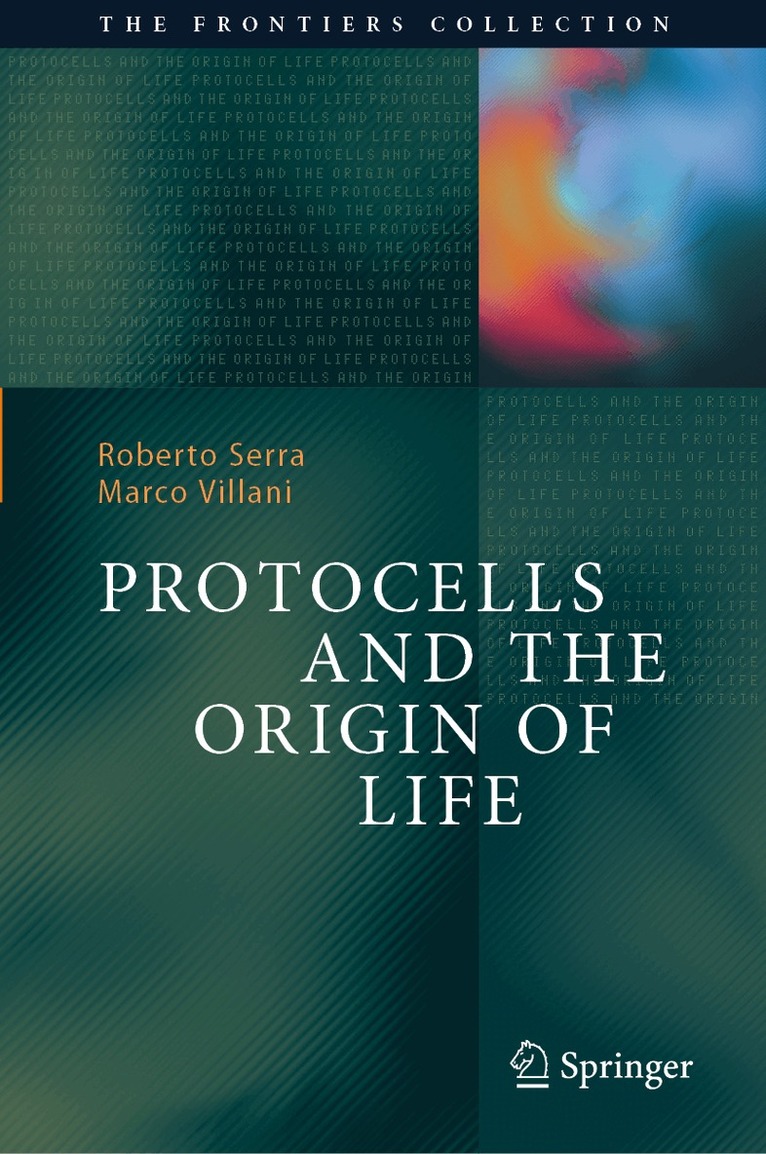
    Protocells and the Origin of Life

    AvRoberto Serra,Marco Villani

    Inbunden, Engelska, 2025

    Del i serien Frontiers Collection

    762 kr

    Beställningsvara. Skickas inom 10-15 vardagar. Fri frakt över 249 kr.

    Beskrivning

    How life can emerge in a lifeless environment is one of the major open scientific challenges. This book pays particular attention to self-organization phenomena that might have led to the appearance of the first protocells, i.e. cell-like structures, much simpler than present-day cells, endowed with some primitive kinds of metabolism and heredity. After a brief description of the known facts and main hypotheses, mathematical and computational models of protocells are discussed: they should complement laboratory experiments, allowing rapid explorations of the dynamical properties of several alternative types of protocell architectures. Given the great uncertainties about the actual origin of life, it seems impossible to provide a detailed and complete reconstruction of the first life forms. It is therefore necessary to identify plausible pathways, highlighting the main physical and chemical processes “towards life” that can take place. Generic models, which are abstract enough to encompass different specific hypotheses, are particularly relevant, as they allow one to identify properties which are common to several different detailed scenarios. They are widely discussed, and a particular case is described in detail, namely that of synchronization between the rate of molecular replication and that of reproduction of the whole protocell, which is a necessary condition for sustainable growth of a population and a prerequisite for further evolution. Using generic models, it is shown that such synchronization spontaneously emerges in successive generations, under very general assumptions.  The book also contains extensive descriptions of the emergence of long polymers, of autocatalytic sets and of the interactions between protocells and their environments. The book is not meant only for specialists, but also for scientists working in different fields, as well as for laymen with an interest in science. It requires a basic knowledge of chemistry and biology, and an interest in simulation models.

    Produktinformation

    • Utgivningsdatum:2025-08-29
    • Mått:155 x 235 x 18 mm
    • Vikt:498 g
    • Format:Inbunden
    • Språk:Engelska
    • Serie:Frontiers Collection
    • Antal sidor:203
    • Förlag:Springer International Publishing AG
    • ISBN:9783031917622

    Utforska kategorier

    • Referensverk och tvärvetenskap inom Samhälle och politik
    • Tillämpad fysik inom Naturvetenskap och teknik
    • Biovetenskap inom Naturvetenskap och teknik

    Mer om författaren

    Roberto Serra, full professor of Complex Systems at the University of Modena and Reggio Emilia (now retired), has previously been the Head of the Environmental Research Centre of the Montedison industrial group, the President of the Italian Association for Artificial Intelligence AI*IA, the Chairman of the Science Board of the European Centre for Living Technology and a fellow of the Institute of Advanced Study of the University of Amsterdam. His main research interests, besides protocells, concern the dynamical modelling of Complex Systems, with applications to gene regulatory networks and cell differentiation, the analysis of their organization and the dynamical systems approach to Artificial Intelligence. He is the author or editor of eleven books and of about 190 papers in international journals and conference proceedings with peer review.Marco Villani is associate professor of Computer Science at the University of Modena and Reggio Emilia and a fellow of the European Centre for Living Technology. His main research interests, besides protocells, concern the identification and analysis of the organization of Complex Systems. In particular,  he studies the dynamic modeling of gene regulation systems and socio-technological systems. He has been a member of the board of the Italian Association for Artificial Intelligence (AI*IA) and is currently a member of the Science Board of the European Centre for Living Technology. He is the author or editor of five books and of about 170 papers in international journals and conference proceedings with peer review.

    Innehållsförteckning

    • Setting the stage.- An overview of our main conceptual tool.- A bird’s eye view on cells.- Origins.- Spontaneous organization.- Self-organization in chemical reactions.- Collective self-replication in chemical reactions.- Protocells and synchronization.- Polymers in protocells.- Conclusions.