• Fri frakt över 249 kr
  • •
  • Snabba leveranser
  • •
  • Billiga böcker
Kundservice

Du är på sajten för privatpersoner.

Företag, bibliotek eller offentlig verksamhet?

Du handlar på classic.bokus.com, där alla dina funktioner finns intakta.
Till classic.bokus.com
Bokus logotyp. Gå till startsidan.
  • Erbjudanden
  • Nyheter
  • Student
  • Topplistor
  • Barn & ungdom
  • Bokus Play
  • E-böcker
  • Pocketböcker
  • Spel & pussel

10% rabatt på allt med kod: NYSTART10 →

Sidfot

Mina sidor

    Hjälp

    • Kundservice
    • Vanliga frågor och svar
    • Frakt och leverans
    • Retur vid ångerrätt
    • Reklamera vara
    • Betalning
    • Köpvillkor
    • Allmänna villkor
    • Information om webbplatsens tillgänglighet

    Om Bokus

    • Om oss
    • Pressrum
    • För studenter
    • För företag
    • För bibliotek och offentlig verksamhet
    • För leverantörer
    • Hållbarhet

    Populärt

    • Aktuella erbjudanden
    • Presentkort
    • Studentlitteratur
    • Nya böcker
    • Topplistor
    • Signerade böcker
    • Engelska böcker

    Inspiration

    • Boktips
    • BookTok
    • Populära bokserier
    • Barnbokskaraktärer
    • Populära författare
    Logotyp för Bokus
    Följ oss på Facebook (extern länk)Följ oss på Instagram (extern länk)Följ oss på YouTube (extern länk)Följ oss på TikTok (extern länk)
    bokus @ CookiesAnpassa cookiesIntegritetspolicyKöpvillkor
    Till Citymail hemsida (extern länk)Till Budbee hemsida (extern länk)Till Postnord hemsida (extern länk)Till Schenker hemsida (extern länk)Till Early Bird hemsida (extern länk)Till Walleys hemsida (extern länk)
    1. Naturvetenskap och teknik
    2. Geovetenskap
    3. Miljövetenskap och miljöpolitik

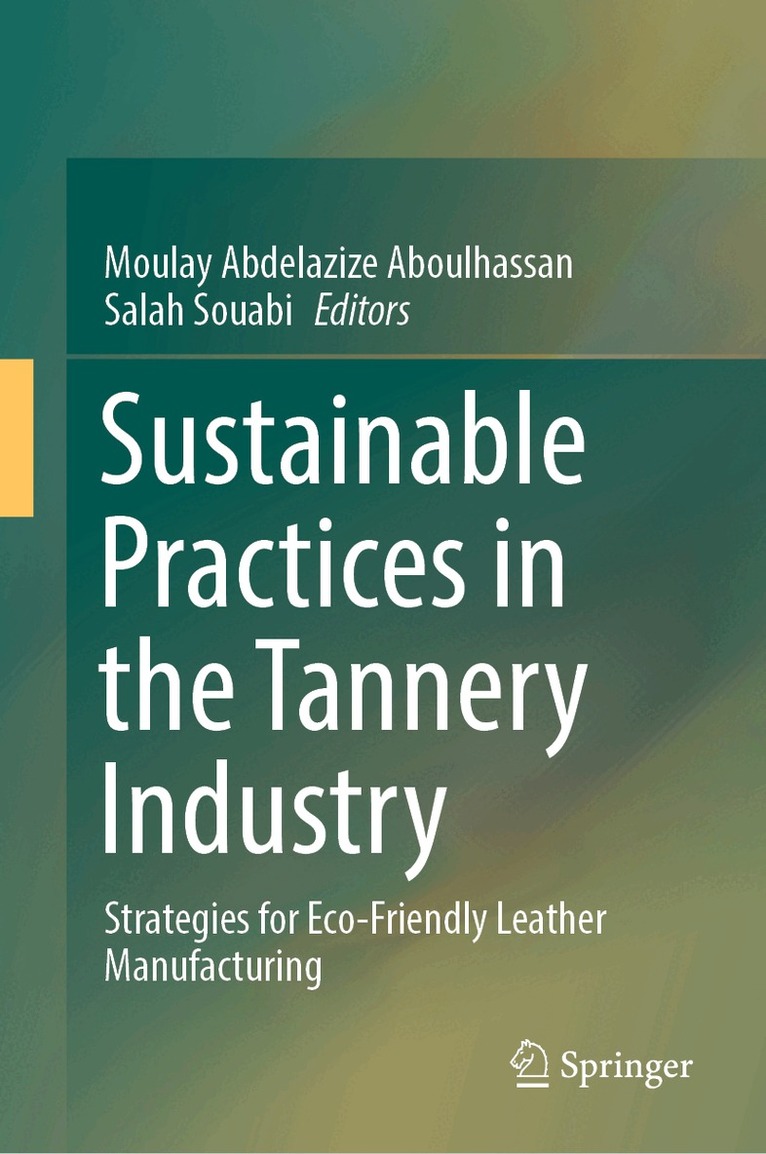
    Sustainable Practices in the Tannery Industry

    Strategies for Eco-Friendly Leather Manufacturing

    AvMoulay Abdelazize Aboulhassan,Salah Souabi

    Inbunden, Engelska, 2025

    1 518 kr

    Beställningsvara. Skickas inom 10-15 vardagar. Fri frakt över 249 kr.

    Beskrivning

    Tannery operations have significant environmental impacts due to liquid, solid, and gaseous waste discharges, along with substantial consumption of resources like raw hides, energy, chemicals, and water. On average, tanneries use 50 m3 of water and 300 kg of chemicals per ton of processed hides, exacerbating global drought challenges. To mitigate these impacts, there's a critical need to rethink water management practices in the industry.This book offers an approach to decouple economic growth from resource overuse, thereby combating climate change. It guides businesses in managing the production process with a focus on recycling water and product components, such as chromium, which is highly toxic. Integrated management methods, including the application of consumption ratios and adherence to standards like ISO management systems, are highlighted.Given the complexity and cost of treatment technologies, prioritizing best practices and preventive measures is essential to reduce liquid and solid waste production. The book also underscores the advantages of clean technologies in curbing water and chemical usage.In summary, this resource empowers tanneries to operate more efficiently and sustainably, fostering responsible economic development.

    Produktinformation

    • Utgivningsdatum:2025-07-29
    • Mått:155 x 235 x 22 mm
    • Vikt:703 g
    • Format:Inbunden
    • Språk:Engelska
    • Antal sidor:303
    • Förlag:Springer International Publishing AG
    • ISBN:9783031920363

    Utforska kategorier

    • Miljövetenskap och miljöpolitik inom Naturvetenskap och teknik
    • Tillverkningsteknik inom Naturvetenskap och teknik
    • Miljöteknik inom Naturvetenskap och teknik

    Mer om författaren

    Professor Abdelazize Aboulhassan holds a PhD in Science and Technology from Hassan II University, Faculty of Science and Technology Mohammedia, with a specialization in water treatment. An accomplished researcher, he has published over 45 peer-reviewed articles in indexed journals. He is currently a professor at the National School of Applied Sciences (ENSA), Ibn Zohr University, Morocco. In addition to his teaching role, Professor Aboulhassan serves as the Director of the Laboratory of Mechanic Process Energy and Environment. His research interests include water and waste treatment, wastewater plant operations, leachate treatment, solid waste valorization, and landfill management. From 2016 to 2021, he led the Process and Environmental Engineering program and currently chairs the Process Engineering Department at ENSA Agadir. Widely recognized as a national expert, Professor Aboulhassan also serves as a reviewer for numerous scientific journals.Dr. Salah Souabi is a Professor at Hassan II University of Casablanca, Morocco, Faculty of Science and Technology Mohammedia, Laboratory of Process and Environmental Engineering. He holds a PhD in water chemistry and microbiology from the University of Poitiers, France, and a PhD in water treatment from Moulay Ismail Maknes University, Morocco. Professor Salah Souabi treats liquid and solid waste in a team. He is an expert in several scientific journals in environmental sciences. Mr. Souabi has participated in several waste management projects and recovery projects. He has adequate experience in water, wastewater, waste management, environmental pollution, and the realization of various R&D projects. Professor Souabi has participated in several industrial projects to manage and recover liquid and solid discharges. He is responsible for the engineering and Mastar Water and Environmental Engineering courses. He is an expert at the level of several international newspapers. Professor Souabi has supervised 28 doctoral students for PhD degrees in water, wastewater treatment, environmental pollution, solid waste management, and wastewater treatment plant operations and sustainability. He has published 165 peer-reviewed articles, 30 book chapters, 11 edited books, and 310 communications.

    Innehållsförteckning

    • Part 1: Tannery Effluents and Environmental Impact.- Health Risk Assessment for Contamination of Water by Chromium near Leather Tanning Facilities.- Unveiling tanning troubles and Mitigating the Ecological Footprint of Leather Production.- Environmental and Marine Ecosystem Impacts of Tannery Effluent: Pollution Load, Variability, and Bioindicator Analysis.- Industrial discharges from tanneries: speciation of heavy metals and reduction of metallic pollution.- Part 2:Advanced Approaches in Tannery Wastewater Treatment.- Treatment of Tannery Wastewater.- Adsorption Strategies for Environmental Remediation: A Case Study of Tanneries in Morocco.- Electrochemical Treatment of Tannery Effluent: A Sustainable Approach.- Part 3:Sustainable Practices and Effluent Management in the Tannery Sector.- Sustainable Treatment of Tannery Effluents: Pollution Reduction and Biodegradability Improvements.- Sustainable salt recovery from the solid residue of tannery common effluent treatment plants.-  Promoting circular economy: implementation principles in the tannery sector.- Part 4:Advancing Circular Economy and Overcoming Challenges in the Tannery Sector.- Strategies for Advancing Circular Economy in the Tannery Sector.- Confronting Challenges in Technological Development within Sustainable Leather Manufacturing: Barriers and Routes.- Utilization of Tannery Solid Wastes for Eco-friendly and Sustainable Leather Industry.- Fostering circular economy principles in tannery sector: accomplishment strategies.