• Fri frakt över 249 kr
  • •
  • Snabba leveranser
  • •
  • Billiga böcker
Kundservice

Du är på sajten för privatpersoner.

Företag, bibliotek eller offentlig verksamhet?

Du handlar på classic.bokus.com, där alla dina funktioner finns intakta.
Till classic.bokus.com
Bokus logotyp. Gå till startsidan.
  • Erbjudanden
  • Nyheter
  • Student
  • Topplistor
  • Barn & ungdom
  • Bokus Play
  • E-böcker
  • Pocketböcker
  • Spel & pussel

10% rabatt på allt med kod: NYSTART10 →

Sidfot

Mina sidor

    Hjälp

    • Kundservice
    • Vanliga frågor och svar
    • Frakt och leverans
    • Retur vid ångerrätt
    • Reklamera vara
    • Betalning
    • Köpvillkor
    • Allmänna villkor
    • Information om webbplatsens tillgänglighet

    Om Bokus

    • Om oss
    • Pressrum
    • För studenter
    • För företag
    • För bibliotek och offentlig verksamhet
    • För leverantörer
    • Hållbarhet

    Populärt

    • Aktuella erbjudanden
    • Presentkort
    • Studentlitteratur
    • Nya böcker
    • Topplistor
    • Signerade böcker
    • Engelska böcker

    Inspiration

    • Boktips
    • BookTok
    • Populära bokserier
    • Barnbokskaraktärer
    • Populära författare
    Logotyp för Bokus
    Följ oss på Facebook (extern länk)Följ oss på Instagram (extern länk)Följ oss på YouTube (extern länk)Följ oss på TikTok (extern länk)
    bokus @ CookiesAnpassa cookiesIntegritetspolicyKöpvillkor
    Till Citymail hemsida (extern länk)Till Budbee hemsida (extern länk)Till Postnord hemsida (extern länk)Till Schenker hemsida (extern länk)Till Early Bird hemsida (extern länk)Till Walleys hemsida (extern länk)
    1. Naturvetenskap och teknik
    2. Matematik och naturvetenskap
    3. Matematik
    4. Tillämpad matematik

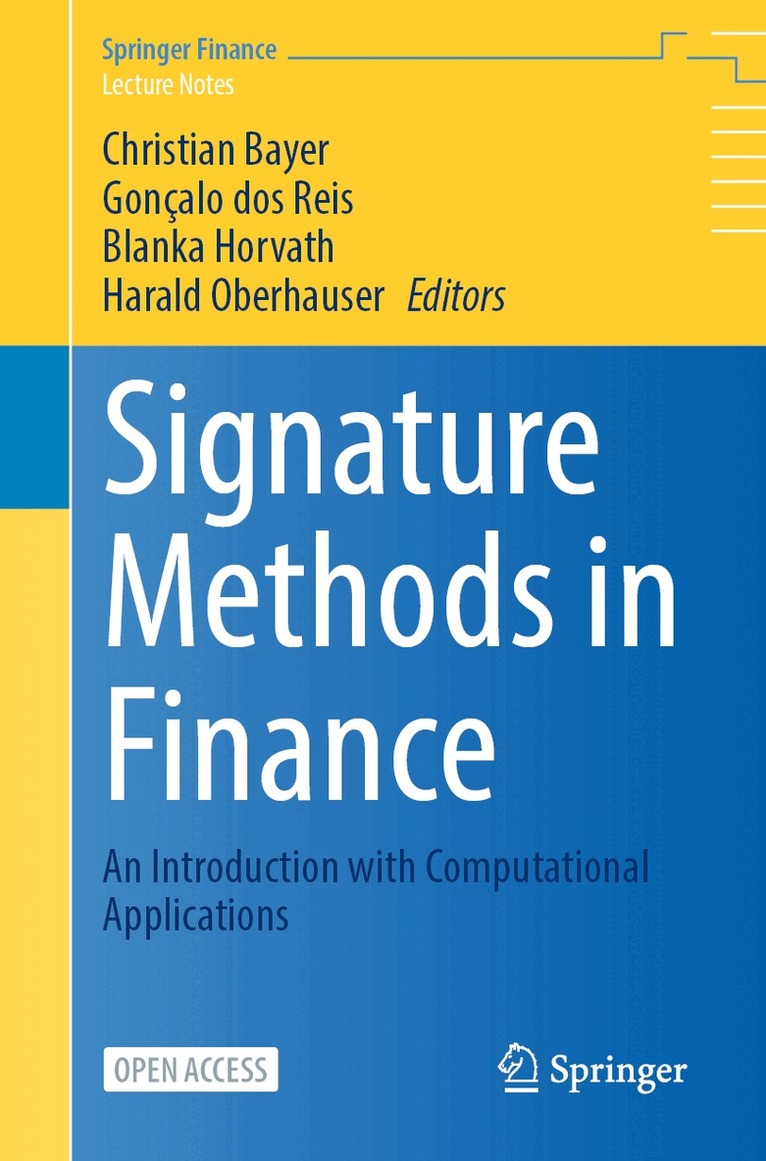
    Signature Methods in Finance

    An Introduction with Computational Applications

    AvGoncalo Dos Reis,Christian Bayer

    Häftad, Engelska, 2025

    Del i serien Springer Finance

    438 kr

    Beställningsvara. Skickas inom 5-8 vardagar. Fri frakt över 249 kr.

    Beskrivning

    This Open Access volume offers an accessible entry point into the fast-growing field of signature methods in finance. It is written for early-career researchers and quantitatively minded practitioners—quant analysts and applied researchers—seeking a clear, practical introduction. It highlights recent developments and includes coding examples to help readers apply signature methods in practice.The advantages of modeling financial markets from a path-wise perspective, rather than as a traditional series of returns, are increasingly gaining recognition. Signature methods provide a parsimonious description of paths of stochastic processes and, through the signature kernel, open a rich and compelling framework at the interface between machine learning and mathematical finance.“I have been extraordinarily fortunate to work alongside brilliant collaborators throughout this journey, and this book beautifully reflects the richness of that shared contribution—for which I am deeply grateful.”—Prof Terry Lyons, University of Oxford, Imperial College, and PI of DataSig“This fascinating collection, dedicated to Terry Lyons, offers invaluable insights into signature methods and their many uses.” Jim Gatheral, Presidential Professor, Baruch College, Quant of the Year 2021"A timely and important contribution to the fast-growing field of signature methods, showcasing the theory and applications of these powerful ideas.” — Prof Ben Hambly, University of Oxford“An impressive book on signatures with articles by the most distinguished researchers in the field. A reference from day one." – Dr Hans Buehler, co-CEO XTX Markets, Quant of the Year 2022"This book provides a masterful exposition and development of signature methods in finance. It is concise, precise, and actionable. It will be an excellent source for anyone interested in modern financial engineering techniques." – Prof Alexander Lipton, Global Head of R&D, ADIA, and Founding Member ADIA Lab, Quant of the Year 2000 and Buy-side Quant of the Year 2021.

    Produktinformation

    • Utgivningsdatum:2025-11-09
    • Mått:155 x 235 x 24 mm
    • Vikt:663 g
    • Format:Häftad
    • Språk:Engelska
    • Serie:Springer Finance
    • Antal sidor:424
    • Förlag:Springer International Publishing AG
    • ISBN:9783031972386

    Utforska kategorier

    • Tillämpad matematik inom Naturvetenskap och teknik
    • Finansiering inom Ekonomi och Ledarskap

    Mer om författaren

    Christian Bayer is PI of the focus platform Quantitative analysis of stochastic and rough systems within the Weierstrass Institute (in Berlin). His main research interests are financial mathematics and stochastic numerics. One of his major research projects focuses on modelling stock indices like the S&P 500 index (SPX) consistently with respect to the implied volatility surface, and the volatility index (VIX). A specific issue is the behaviour of the implied volatility of options for very short maturities, which is largely believed to exhibit explosion in the form of a power law as maturity goes to zero. And these lead to rough volatility models. The theory of rough paths has many applications in machine learning. He is, in particular, interested in its applications to stochastic optimal control. He uses the path signature to derive efficient numerical approximation methods for stochastic optimal control problems, when the state process is not a Markov process. Gonçalo dos Reis is an Associate Professor at the University of Edinburgh’s School of Mathematics. He received his PhD in Mathematics from the Humboldt University of Berlin and works at the intersection of stochastic analysis, applied probability, and machine learning. His research combines theoretical developments with practical mathematics for industrial applications in finance, engineering, and energy systems. He serves on the editorial boards of several journals, including Energy and AI, and is regularly involved in the curation and dissemination of interdisciplinary research. In 2022, he received the University-wide Best PhD Supervisor of the Year prize in recognition of his mentorship and academic work. His research reflects a sustained engagement with interdisciplinary projects that address both academic and real-world challenges.Blanka Horvath is an associate professor in mathematical and computational finance at the University of Oxford, an associate member of the Oxford-Man Institute and the 2024-25 Emmy Noether Fellow of the LMS. Her research is at the intersection of stochastic analysis and mathematical finance that includes option pricing, forecasting and simulation, with the use of asymptotic, - and numerical methods as well as machine learning techniques. In recent years, Blanka's research focus has been on rough path theory and signature methods, rough volatility models, and generative models. She is convinced of the value of an active dialogue between the financial sector's industry quants and academics. She has multiple ongoing research collaborations with industry partners on cutting-edge technological developments and regular engagements at industry conferences.  Blanka is also the inaugural recipient of the Quant Rising Star Award 2020, and a member of the Rising Star Selection Panel ever since. Harald Oberhauser is a Professor in the Mathematical Institute at the University of Oxford, a Tutorial Fellow at St. Hugh's College, and an associate member of the Oxford-Man Institute. He obtained his PhD from the Statslab in the Department of Pure Mathematics and Mathematical Statistics at the University of Cambridge. He held postdoctoral positions in Berlin and Oxford. Harald works on mathematics that allows to better understand, model and make inference about systems that evolve under the influence of randomness. He is especially interested in topics that connect recent progress in theoretical mathematics with real world applications.

    Innehållsförteckning

    • - Part I: Introduction to Signatures in Machine Learning.- A Primer on the Signature Method in Machine Learning.- An Introduction to Tensors for Path Signatures.- The Signature Kernel.- Part II: Applications of Signatures.- Market Generators: A Paradigm Shift in Financial Modeling.- Signature Maximum Mean Discrepancy Two-Sample Statistical Tests.- Signature and the Functional Taylor Expansion.- Signature-Based Models in Finance.- Signature Trading Strategies.- Optimal Stopping for Non-Markovian Asset Price Processes.- Adapted Topologies and Higher-Rank Signatures.- On Expected Signatures and Signature Cumulants in Semimartingale Models.