• Fri frakt över 249 kr
  • •
  • Snabba leveranser
  • •
  • Billiga böcker
Kundservice

Du är på sajten för privatpersoner.

Företag, bibliotek eller offentlig verksamhet?

Du handlar på classic.bokus.com, där alla dina funktioner finns intakta.
Till classic.bokus.com
Bokus logotyp. Gå till startsidan.
  • Erbjudanden
  • Nyheter
  • Student
  • Topplistor
  • Barn & ungdom
  • Bokus Play
  • E-böcker
  • Pocketböcker
  • Spel & pussel

10% studentrabatt med kod TERM26

Sidfot

Mina sidor

    Hjälp

    • Kundservice
    • Vanliga frågor och svar
    • Frakt och leverans
    • Retur vid ångerrätt
    • Reklamera vara
    • Betalning
    • Köpvillkor
    • Allmänna villkor
    • Information om webbplatsens tillgänglighet

    Om Bokus

    • Om oss
    • Pressrum
    • För studenter
    • För företag
    • För bibliotek och offentlig verksamhet
    • För leverantörer
    • Hållbarhet

    Populärt

    • Aktuella erbjudanden
    • Presentkort
    • Studentlitteratur
    • Nya böcker
    • Topplistor
    • Signerade böcker
    • Engelska böcker

    Inspiration

    • Boktips
    • BookTok
    • Populära bokserier
    • Barnbokskaraktärer
    • Populära författare
    Logotyp för Bokus
    Följ oss på Facebook (extern länk)Följ oss på Instagram (extern länk)Följ oss på YouTube (extern länk)Följ oss på TikTok (extern länk)
    bokus @ CookiesAnpassa cookiesIntegritetspolicyKöpvillkor
    Till Citymail hemsida (extern länk)Till Budbee hemsida (extern länk)Till Postnord hemsida (extern länk)Till Schenker hemsida (extern länk)Till Early Bird hemsida (extern länk)Till Walleys hemsida (extern länk)
    1. Naturvetenskap och teknik
    2. Matematik och naturvetenskap
    3. Fysik
    4. Materietillstånd

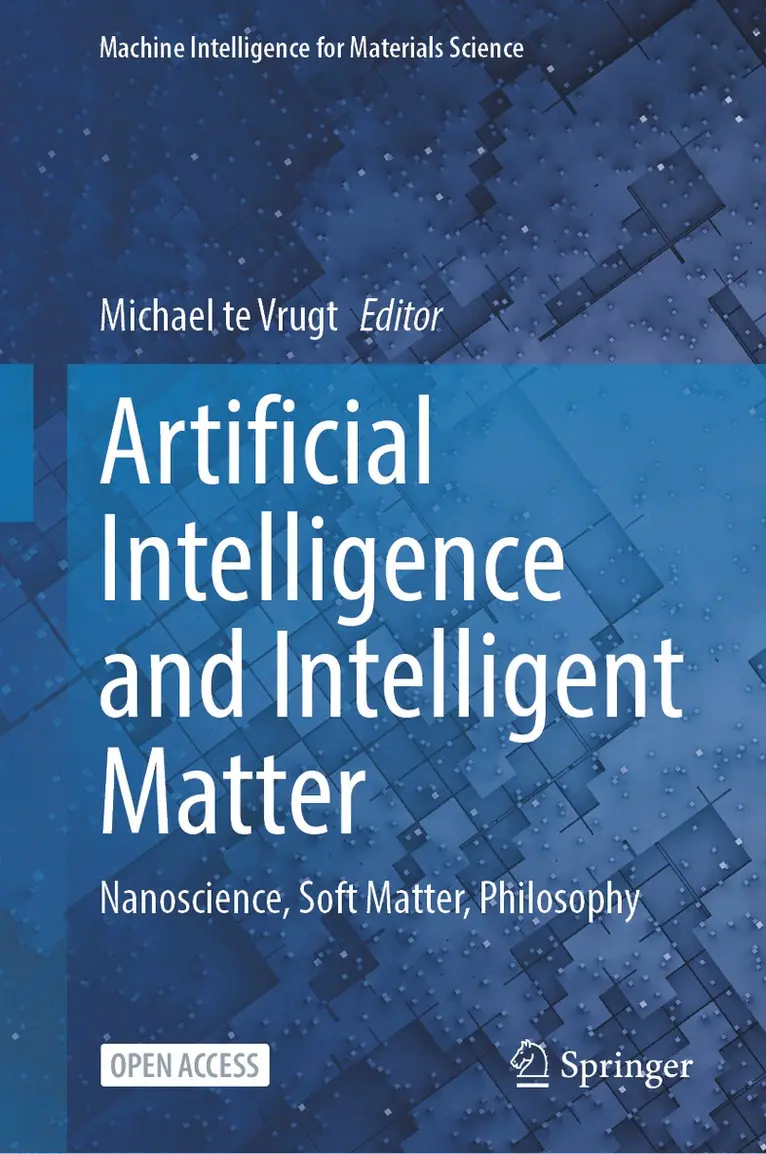
    Artificial Intelligence and Intelligent Matter

    Nanoscience, Soft Matter, Philosophy

    AvMichael te Vrugt

    Inbunden, Engelska, 2026

    Del i serien Machine Intelligence for Materials Science

    547 kr

    Beställningsvara. Skickas inom 10-15 vardagar. Fri frakt över 249 kr.

    Beskrivning

    This open access book provides an introduction to the role that Artificial Intelligence (AI) plays in the study of nanosystems—ranging from soft and active materials to optics and quantum condensed matter. This role is twofold: On the one hand, Artificial Intelligence finds many applications in this field and enables researchers to solve problems that were not (easily) solvable before. Very notable examples are the use of machine learning to obtain energy functionals in density functional theory or the design of novel materials. On the other hand, researchers nowadays try to make the nanosystems themselves intelligent. This idea, sometimes referred to as “intelligent matter,” can be realized in a plethora of ways including intelligent microswimmers, optical neuromorphic computing, and machine learning using quantum systems.The book consists of four parts. The first one provides a brief introduction to AI, while the second and third ones introduce applications of AI to nanosystems and implementations of AI in nanosystems, respectively. Here, a broad spectrum of physical systems is covered, ranging from quantum, magnetic, and optical systems to soft and active matter. Finally, the fourth part provides some philosophical perspectives.

    Produktinformation

    • Utgivningsdatum:2026-01-14
    • Mått:155 x 235 x 34 mm
    • Vikt:937 g
    • Format:Inbunden
    • Språk:Engelska
    • Serie:Machine Intelligence for Materials Science
    • Antal sidor:509
    • Förlag:Springer Nature Switzerland AG
    • ISBN:9783032041289

    Utforska kategorier

    • Materietillstånd inom Naturvetenskap och teknik
    • Teknik: allmänt inom Naturvetenskap och teknik
    • Maskinteknik och material inom Naturvetenskap och teknik

    Mer om författaren

    Michael te Vrugt is assistant professor of physics at the Johannes Gutenberg University Mainz in Germany. Previously, he completed PhDs in theoretical physics and philosophy of science, both at the University of Münster in Germany, and worked as a postdoctoral researcher at the University of Cambridge in UK. His main fields of research are nonequilibrium statistical mechanics, theory of soft condensed matter, and philosophy of physics. He is the author of more than 35 scientific articles and has received several awards for his work, including the Infineon PhD Award and the CRC 1459’s Young Researcher Award for Intelligent Matter.

    Innehållsförteckning

    • Preface.- 1. Introduction: Artificial Intelligence and Intelligent Matter.- Part I: Introduction to Artificial Intelligence.- 2. Introduction to Artificial Intelligence.- 3. An Introduction to Reinforcement Learning – In Artificial and Biological Control Systems.- 4. An Introduction to Reservoir Computing.- Part II: Applications of Artificial Intelligence to Nanosystems. 5. Learning Dynamical Systems from Data.- 6. Machine Learning Approaches to Classical Density Functional Theory.- 7. Machine Learning in Quantum Density Functional Theory.- 8. Generative Deep learning for the Inverse Design of Materials.- 9. Machine Learning for Identifying Dynamical Phases Intopologicallasers.- 10. Artificial Intelligence Reshaping the Semiconductor Metrology.- 11. Machine Learning for Active Matter.- Part III: Implementations of Artificial Intelligence in Nanosystems.- 12. A Primer on Neuromorphic Hardware: Underlying Principles and Approaches – From Sensors to Processors.- 13. Towards Intelligent Active Particles.- 14. Intelligent Matter Consisting of Active Particles.- 15. Neural Networks Consisting of DNA.- 16. Intelligence Without a Brain – Perspectives from the Aneural Slime Mold as a Computing Model for Artificial Intelligence.- 17. Integrated Photonics for Neuromorphic Computing.- 18. Time-multiplexed Reservoir Computing with Semiconductor Laser Systems.- 19. Neuromorphic Spintronics.- 20. Machine Learning with Quantum Computers.- Part IV: Philosophical Aspects.- 21. Normativity and the Intelligent Matter Framework.- 22. What Is It Like To Be a Nail? – The Intentions of Matter.- 23. Rethinking Computational Implementation Through Symphoria.- 24. Ethical Aspects of Artificial Intelligence in Nanoscience.