• Fri frakt över 249 kr
  • •
  • Snabba leveranser
  • •
  • Billiga böcker
Kundservice

Du är på sajten för privatpersoner.

Företag, bibliotek eller offentlig verksamhet?

Du handlar på classic.bokus.com, där alla dina funktioner finns intakta.
Till classic.bokus.com
Bokus logotyp. Gå till startsidan.
  • Erbjudanden
  • Nyheter
  • Student
  • Topplistor
  • Barn & ungdom
  • Bokus Play
  • E-böcker
  • Pocketböcker
  • Spel & pussel

10% rabatt på allt med kod: NYSTART10 →

Sidfot

Mina sidor

    Hjälp

    • Kundservice
    • Vanliga frågor och svar
    • Frakt och leverans
    • Retur vid ångerrätt
    • Reklamera vara
    • Betalning
    • Köpvillkor
    • Allmänna villkor
    • Information om webbplatsens tillgänglighet

    Om Bokus

    • Om oss
    • Pressrum
    • För studenter
    • För företag
    • För bibliotek och offentlig verksamhet
    • För leverantörer
    • Hållbarhet

    Populärt

    • Aktuella erbjudanden
    • Presentkort
    • Studentlitteratur
    • Nya böcker
    • Topplistor
    • Signerade böcker
    • Engelska böcker

    Inspiration

    • Boktips
    • BookTok
    • Populära bokserier
    • Barnbokskaraktärer
    • Populära författare
    Logotyp för Bokus
    Följ oss på Facebook (extern länk)Följ oss på Instagram (extern länk)Följ oss på YouTube (extern länk)Följ oss på TikTok (extern länk)
    bokus @ CookiesAnpassa cookiesIntegritetspolicyKöpvillkor
    Till Citymail hemsida (extern länk)Till Budbee hemsida (extern länk)Till Postnord hemsida (extern länk)Till Schenker hemsida (extern länk)Till Early Bird hemsida (extern länk)Till Walleys hemsida (extern länk)
    1. Naturvetenskap och teknik
    2. Geovetenskap
    3. Miljövetenskap och miljöpolitik
    • Nyhet

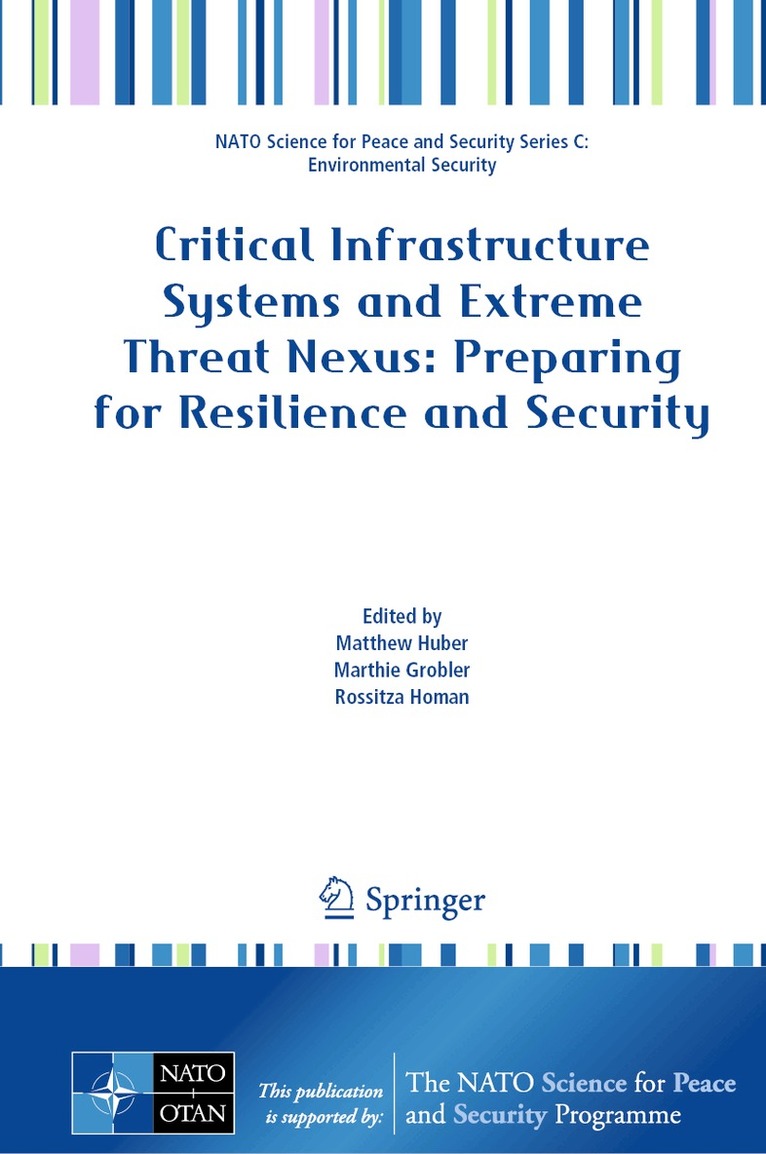
    Critical Infrastructure Systems and Extreme Threat Nexus: Preparing for Resilience and Security

    AvMatthew Huber,Marthie Grobler

    Inbunden, Engelska, 2026

    Del i serien NATO Science for Peace and Security Series C: Environmental Security

    2 165 kr

    Beställningsvara. Skickas inom 10-15 vardagar. Fri frakt över 249 kr.

    Beskrivning

    This book synthesizes the findings from a collaborative workshop featuring leading experts from academia, government, and industry, aimed at addressing the intricate interdependencies between climate change, cybersecurity, and critical infrastructure resilience.Delve into key themes such as the vulnerabilities of our energy sector against emerging hazards, the role of autonomous uncrewed systems in maintaining undersea infrastructure, and the metrics necessary for a climate-adapted cyber-physical grid. With chapters like Mapping Critical Infrastructure Interdependencies and Beyond the Trend: Climate Variability as a Threat Multiplier, this book provides a nuanced understanding of how climate change exacerbates risks and challenges across various sectors.The workshop's dynamic format, including keynote presentations, tabletop exercises, and scenario mapping, has informed the development of actionable strategies for enhancing resilience. Readers will gain insights into diversified reservoir management for water security, the implications of quantum technology on cybersecurity, and the need for a robust response to climate variability.This book is essential for policymakers, researchers, and practitioners seeking to navigate the complexities of climate adaptation and risk management. Join us in exploring innovative pathways to secure our infrastructure and ensure a sustainable future in the face of unprecedented challenges.

    Produktinformation

    • Utgivningsdatum:2026-08-03
    • Mått:155 x 235 x 28 mm
    • Vikt:774 g
    • Format:Inbunden
    • Språk:Engelska
    • Serie:NATO Science for Peace and Security Series C: Environmental Security
    • Antal sidor:371
    • Förlag:Springer Nature Switzerland AG
    • ISBN:9783032131690

    Utforska kategorier

    • Miljövetenskap och miljöpolitik inom Naturvetenskap och teknik

    Mer om författaren

    Matthew HuberDavid E. Ross Professor in the Earth, Atmospheric, and Planetary Sciences Department at Purdue UniversityMatthew Huber is a professor in the Earth, Atmospheric, and Planetary Sciences Department at Purdue University and the inaugural David E. Ross Director of the Institute for a Sustainable Future, Purdue’s transdisciplinary institute working on both fundamental and applied research in areas aligned with the United Nations Sustainable Development Goals. Huber’s scholarship has been internationally recognized for its far-reaching global conclusions on Earth’s habitability, resilience, and sustainability on long time horizons. His research areas include the physical processes generating tropical “thermostats,” the polar amplification of warming, and the environmental, economic, ecological and evolutionary implications of these processes. Over the past decade, Huber’ has shifted focus to emphasize more applied and solutions-oriented research to help society build a better future. Planning for future needs requires seeing energy, environment, economics, climate, health, politics and society as linked systems and considering risk, resiliency, and security in all of these areas concurrently.Marthie GroblerPrincipal Research Scientist, CSIRODr Marthie Grobler is a Principal Research Scientist in human-centred cybersecurity at CSIRO’s Data61 and is the Mission Lead of the Critical Infrastructure Protection and Resilience Mission. Grobler's research focus is on enhancing the usability of security solutions by considering human factors, with a strong interest in executive education, cybersecurity governance and critical infrastructure resilience and protection. Grobler spearheaded the establishment of the original human-centric security research team in CSIRO, which focuses on addressing the alignment and integration of human factors in the cyber domain to enhance security adoption and efficiency. Her research, management, and consulting experience span multiple continents, national and state government departments, and a variety of domains linked with the digital domain.Rossitza HomanManager, Resilience and Regulatory Effects Department, Sandia National LaboratoriesDr. Rossitza Homan is a distinguished leader at Sandia National Laboratories, where she oversees research, capability development, and the deployment of critical solutions for national security missions. As the head of the Risk and Resilience of Complex Systems department, Dr. Homan is dedicated to creating innovative, scientifically sound solutions that provide decision-makers across the national security enterprise with valuable insights, thereby enhancing the resilience of critical infrastructures in the physical, cyber, and information domains. Dr. Homan drives strategic initiatives, fosters partnerships, and manages large, multidisciplinary projects that support national security, global security, integrated deterrence, and complex systems resilience. She leads teams working with both U.S. government and non-government agencies, focusing on areas such as multi-modal intelligence, cyber-physical resilience, and artificial intelligence. Her collaborative efforts extend to U.S. Federally Funded R&D Centers, academia, and various domestic and international stakeholders.

    Innehållsförteckning

    • 1. The cascading impact of cyber on climate.- 2. Vulnerable Links: Human and Social Risks within CPSICC Nexus.- 3. Unraveling The Cyber-Physical-Social Infrastructure Climate Change.- 4. Beyond the Trend: Climate Variability as a Threat Multiplier for Climate Change Impacts on Global Cyber-Physical-Social Systems.- 5. Mapping critical infrastructure interdependencies for building resilience to climate and other risks.