• Fri frakt över 249 kr
  • •
  • Snabba leveranser
  • •
  • Billiga böcker
Kundservice

Du är på sajten för privatpersoner.

Företag, bibliotek eller offentlig verksamhet?

Du handlar på classic.bokus.com, där alla dina funktioner finns intakta.
Till classic.bokus.com
Bokus logotyp. Gå till startsidan.
  • Erbjudanden
  • Nyheter
  • Student
  • Topplistor
  • Barn & ungdom
  • Bokus Play
  • E-böcker
  • Pocketböcker
  • Spel & pussel

10% rabatt på allt med kod NYSTART10 →

Sidfot

Mina sidor

    Hjälp

    • Kundservice
    • Vanliga frågor och svar
    • Frakt och leverans
    • Retur vid ångerrätt
    • Reklamera vara
    • Betalning
    • Köpvillkor
    • Allmänna villkor
    • Information om webbplatsens tillgänglighet

    Om Bokus

    • Om oss
    • Pressrum
    • För studenter
    • För företag
    • För bibliotek och offentlig verksamhet
    • För leverantörer
    • Hållbarhet

    Populärt

    • Aktuella erbjudanden
    • Presentkort
    • Studentlitteratur
    • Nya böcker
    • Topplistor
    • Signerade böcker
    • Engelska böcker

    Inspiration

    • Boktips
    • BookTok
    • Populära bokserier
    • Barnbokskaraktärer
    • Populära författare
    Logotyp för Bokus
    Följ oss på Facebook (extern länk)Följ oss på Instagram (extern länk)Följ oss på YouTube (extern länk)Följ oss på TikTok (extern länk)
    bokus @ CookiesAnpassa cookiesIntegritetspolicyKöpvillkor
    Till Citymail hemsida (extern länk)Till Budbee hemsida (extern länk)Till Postnord hemsida (extern länk)Till Schenker hemsida (extern länk)Till Early Bird hemsida (extern länk)Till Walleys hemsida (extern länk)
    1. Språk och ordböcker
    2. Språkvetenskap och lingvistik
    • Nyhet

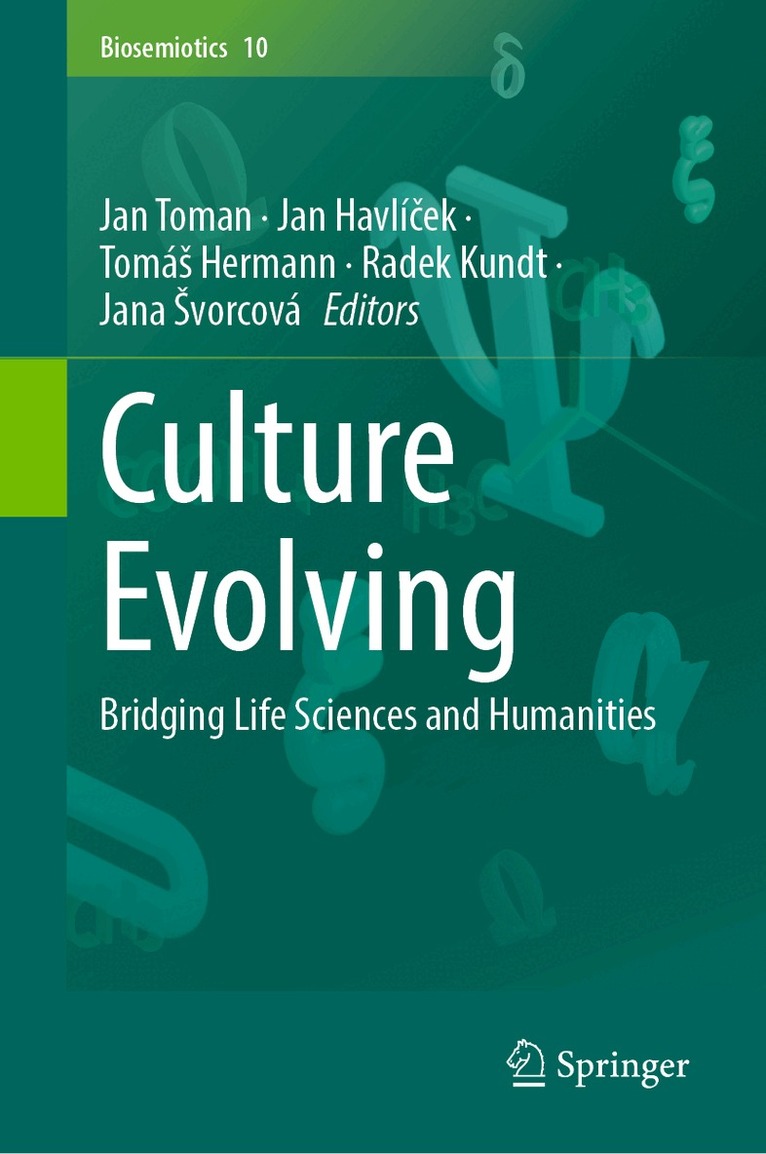
    Culture Evolving

    Bridging Life Sciences and Humanities

    AvJan Toman,Jan Havlíček

    Inbunden, Engelska, 2026

    Del 10 i serien Biosemiotics

    1 516 kr

    Beställningsvara. Skickas inom 10-15 vardagar. Fri frakt över 249 kr.

    Beskrivning

    This volume examines how evolutionary principles can help us understand the dynamics of culture while acknowledging the risks of their uncritical application. Drawing on perspectives from the philosophy and history of science, anthropology, archaeology, behavioural science, and evolutionary biology, it explores how ideas about evolution have shaped – and at times distorted – our understanding of human nature and cultural change. The book also shows how biosemiotics provides a promising framework for bridging biological and cultural perspectives.The volume is organised into four parts. The first discusses the historical roots of evolutionary thinking and the conceptual assumptions that made it possible, as well as the dangers of ideological misuse of analogies between cultural and biological evolution. The second part examines how evolutionary ideas have influenced anthropology and archaeology, while the third addresses key theoretical perspectives to the study of cultural transmission and change, including the cognitive mechanisms involved. The final part focuses on biosemiotics and explores how meaning-making processes connect biological and cultural evolution.The volume does not propose a single unified theory, instead the contributors engage in a dialogue across disciplinary boundaries, showing how the humanities and life sciences can mutually inform each other through shared attention to evolutionary and semiotic processes. The book combines theoretical reflection with a balanced presentation of key ideas, aiming to make complex ideas accessible to readers from a range of disciplines interested in cultural evolution, biosemiotics, and the interplay between biology and culture.

    Produktinformation

    • Utgivningsdatum:2026-08-05
    • Mått:155 x 235 x 34 mm
    • Vikt:937 g
    • Format:Inbunden
    • Språk:Engelska
    • Serie:Biosemiotics
    • Antal sidor:501
    • Förlag:Springer Nature Switzerland AG
    • ISBN:9783032161239

    Utforska kategorier

    • Språkvetenskap och lingvistik inom Språk och ordböcker
    • Naturvetenskapens filosofi inom Naturvetenskap och teknik
    • Biovetenskap inom Naturvetenskap och teknik

    Mer om författaren

    Jan Toman is a postdoctoral researcher at the Department of Philosophy and History of Sciences, Faculty of Science, Charles University. His research focuses on macroevolutionary and theoretical biological topics, encompassing the evolution of evolvability, stability-based sorting and its role in evolving systems, as well as cultural evolution and biosemiotics. He is also interested in the history of biological concepts and science outreach.Jan Havlíček is a Full Professor at the Department of Zoology, Faculty of Science, Charles University. His main research interests concern the evolutionary aspects of human social perception, particularly within the theoretical frameworks of signalling theory, sexual selection, and dual inheritance theory. He has published over 170 papers and co-edited a textbook on animal behaviour.Tomáš Hermann is a researcher at the Department of Philosophy and History of Sciences, Faculty of Science, Charles University. His research focuses on intellectual history and the history of sciences in the 19th and 20th centuries in the Czech and Central European context, with particular emphasis on the life sciences, philosophy, and historiography. He is a long-standing member of the Society for the History of Sciences and Technology of the Czech Republic and serves as Editor-in-Chief of its scientific journal Dějiny věd a techniky – History of Sciences and Technology.Radek Kundt is a researcher at LEVYNA – Laboratory for the Experimental Research of Religion, Department for the Study of Religions, Masaryk University. Interested in the origins of ritual, he argues that collective ritual evolved as a complex signalling system facilitating mutualistic cooperation. Combining methods from experimental anthropology and experimental psychology, he researched the effects of religious priming on prosocial and moral behaviour, drawing on several years of laboratory and field experience in the Czech Republic and Mauritius.Jana Švorcová is an Assistant Professor at the Department of Philosophy and History of Sciences, Faculty of Science, Charles University. She teaches theoretical and evolutionary biology, and her research focuses on non-mechanistic approaches to living systems within biophilosophy. Her interests also include non-genetic evolutionary variation and inheritance, organismal agency, and various levels of memory in living systems.

    Innehållsförteckning

    • Introduction (Jan Havlíček & Jan Toman).- Part 1:The Human Condition and Evolutionary Thought in the History of Ideas (Tomáš Hermann).- .1. Progress or Decline? The Evolution of Culture According to Some Ancient Thinkers (Vojtěch Hladký & Eliška Fulínová).- 2: Breaking Through the Boundaries of Time: Changing Modern Notions About the Age of Nature and Culture (Tomáš Hermann, Vojtěch Hladký & Lucie Strnadová).- 3: The Evolutionary Utopia and a Confusion of Discourses: Projecting Eugenic Para-Religious Visions onto Human Future (Tomáš Hermann, Michal V. Šimůnek & Jan Musil).- 4: On the Monistic and Dualistic Origins and the Development of Nature and Culture: Haeckel and Ehrenfels (Lenka Ovčáčková).- Part 2:Cultural Evolution and the Human Sciences: Archaeological and Anthropological Perspectives (Radek Kundt).- 5: Genes, Identity, and Material Culture: In Search of a Unifying Theory (Petr Květina & Václav Hrnčíř).- 6: Shifting Perceptions of the Greek Bronze Age: From Simple Valuative Judgements Like ‘Civilised’ or ‘Barbaric’ to a Comprehensive Implementation of the Archaeological Science (Tomáš Alušík).- 7: The Evolutionary and Cognitive Perspectives in Research of Cultural and Social Phenomena (Danijela Jerotijević & Radek Kundt).- 8: Appreciating Culture in Human Mating and Parenting Research: The Reproductive Functions of Religious Systems (Terezie Dvořáčková, Eva Kundtová Klocová & Radek Kundt).- Part 3: Culture from the Perspective of Evolutionary Behavioural Science (Jan Havlíček).- 9: Culture: Uniquely Human? (Jitka Lindová).- 10: Memetics: Rise, Fall, and Reconsideration (Jaroslav Flegr & Jan Toman).- 11: Cultural Attraction as One of the Pillars of Cultural Evolution (Pavlína Hillerová & Petr Tureček).- 12: Cultures as Species: Tree Thinking and the Phylogenetic Approach in Linguistics, Archaeology, and Anthropology (Pavel Duda).- 13: Human Cumulative Culture: Bridging Cognition and Population Dynamics (Jan Havlíček).- Part 4: Biosemiotic Reflections upon the Relationships Between Nature and Culture (Jana Švorcová).- 14: The Role of Sociomorphic Modelling in the Perception of Nature (Petr Hampl: Mirroring Nature).- 15: Stability-Based Sorting in Cultural Evolution: Macroevolutionary Phenomena as a Model for Explaining Cultural Dynamics (Jan Toman).- 16: The Past Lives on With Us: Epigenetics as a Link Between Cultural and Biological Evolution (Jana Švorcová & Karel Kleisner).- 17: Abiosphere and Biosphere: An Individual, a Community, a Culture (Anton Markoš).- 18: Reflections on Analogies Between Cultural and Biological Evolution: Contribution to the Discussion from the Perspective of Historical Sciences (Jan Horský).