• Fri frakt över 249 kr
  • •
  • Snabba leveranser
  • •
  • Billiga böcker
Kundservice

Du är på sajten för privatpersoner.

Företag, bibliotek eller offentlig verksamhet?

Du handlar på classic.bokus.com, där alla dina funktioner finns intakta.
Till classic.bokus.com
Bokus logotyp. Gå till startsidan.
  • Erbjudanden
  • Nyheter
  • Student
  • Topplistor
  • Barn & ungdom
  • Bokus Play
  • E-böcker
  • Pocketböcker
  • Spel & pussel

10% rabatt på allt med kod: NYSTART10 →

Sidfot

Mina sidor

    Hjälp

    • Kundservice
    • Vanliga frågor och svar
    • Frakt och leverans
    • Retur vid ångerrätt
    • Reklamera vara
    • Betalning
    • Köpvillkor
    • Allmänna villkor
    • Information om webbplatsens tillgänglighet

    Om Bokus

    • Om oss
    • Pressrum
    • För studenter
    • För företag
    • För bibliotek och offentlig verksamhet
    • För leverantörer
    • Hållbarhet

    Populärt

    • Aktuella erbjudanden
    • Presentkort
    • Studentlitteratur
    • Nya böcker
    • Topplistor
    • Signerade böcker
    • Engelska böcker

    Inspiration

    • Boktips
    • BookTok
    • Populära bokserier
    • Barnbokskaraktärer
    • Populära författare
    Logotyp för Bokus
    Följ oss på Facebook (extern länk)Följ oss på Instagram (extern länk)Följ oss på YouTube (extern länk)Följ oss på TikTok (extern länk)
    bokus @ CookiesAnpassa cookiesIntegritetspolicyKöpvillkor
    Till Citymail hemsida (extern länk)Till Budbee hemsida (extern länk)Till Postnord hemsida (extern länk)Till Schenker hemsida (extern länk)Till Early Bird hemsida (extern länk)Till Walleys hemsida (extern länk)
    1. Naturvetenskap och teknik
    2. Geovetenskap
    3. Miljövetenskap och miljöpolitik

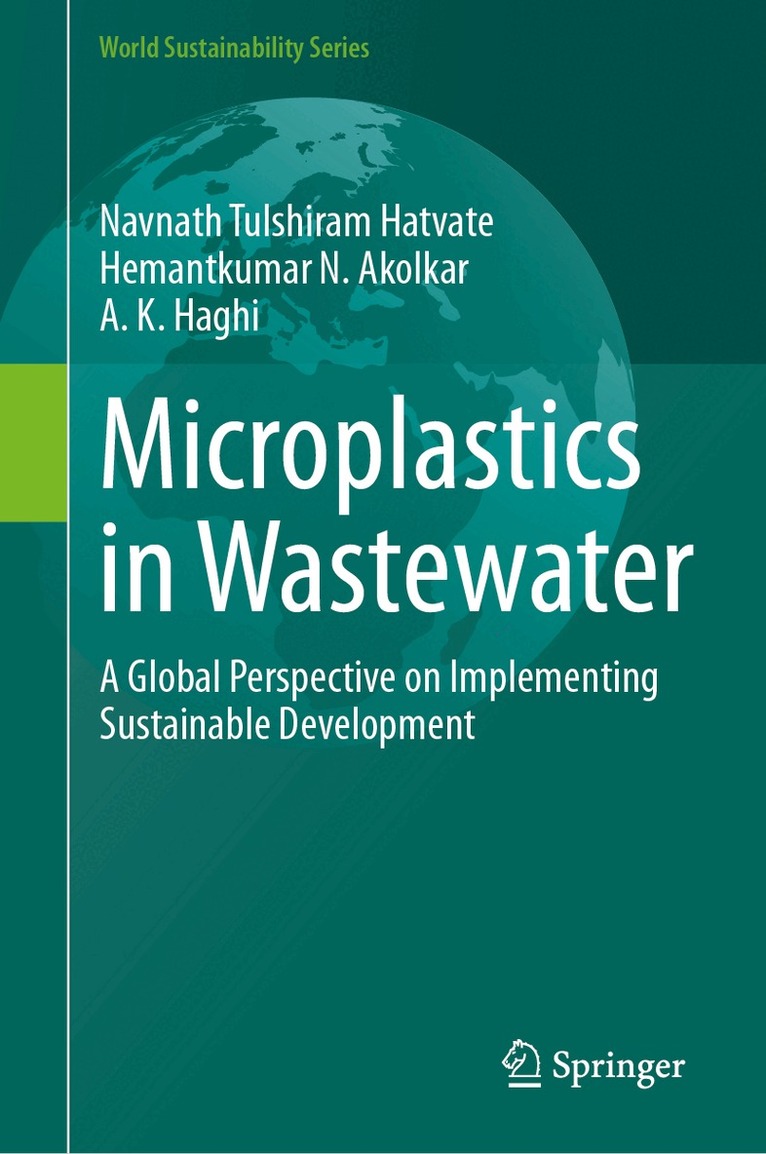
    Microplastics in Wastewater

    A Global Perspective on Implementing Sustainable Development

    AvNavnath Tulshiram Hatvate,Hemantkumar N. Akolkar

    Inbunden, Engelska, 2026

    Del i serien World Sustainability Series

    1 734 kr

    Beställningsvara. Skickas inom 10-15 vardagar. Fri frakt över 249 kr.

    Beskrivning

    Plastics widespread use and ease of disposal after a single use mean they accumulate rapidly in landfills and the environment, often ending up in wastewater systems. Many of these microplastics are durable and take hundreds of years to degrade. This means that the plastic discarded today will remain in the environment, breaking down into microplastics that can be harmful to wildlife and ecosystems. For this reason, wastewater system pollution caused by microplastics is a complex and multidimensional issue. Effectively managing it requires the use of advanced technologies. This book explores key research topics related to microplastics in wastewater, providing practical solutions to mitigate environmental pollution. The book offers a comprehensive approach to discussing the limitations of current wastewater treatment processes for removing microplastics and suggests complementary treatment methods.The discharge of microplastics in water bodies is gaining global attention. It causes severe pollution, harms the aquatic environment, carries various types of contaminants, and indirectly enters the human body through the food chain. Wastewater system pollution and plastic contamination are global concerns that are closely linked to the policy objectives of governments worldwide. It is crucial to analyze the relationship between water system pollution and public health and adopt practical strategies to prevent health hazards. Continued research on this important topic is also necessary. The book contains information on the occurrence of microplastics in wastewater, their source of entry, and detection methods in samples. It also reports microplastic pollution sources that have a remarkable impact on municipal wastewater quality.This book aims to propose treatment methods for analyzing the shapes, sizes, and composition of microplastics found in wastewater systems. The book delves into the most current scientific findings on emerging microplastic pollutants, emphasizing their potentiality and the dangers they bring. It will also present that microplastics can ease toxic contact with aquatic organisms. The book also reviews the most recent applications of artificial intelligence (AI) in wastewater treatment plants, aiming to optimize wastewater treatment processes and enhance water quality monitoring.

    Produktinformation

    • Utgivningsdatum:2026-04-21
    • Mått:155 x 235 x 17 mm
    • Vikt:516 g
    • Format:Inbunden
    • Språk:Engelska
    • Serie:World Sustainability Series
    • Antal sidor:220
    • Förlag:Springer Nature Switzerland AG
    • ISBN:9783032179517

    Utforska kategorier

    • Miljövetenskap och miljöpolitik inom Naturvetenskap och teknik
    • Miljöteknik inom Naturvetenskap och teknik

    Mer om författaren

    Dr. Navnath Hatvate is an assistant professor at the Institute of Chemical Technology, Mumbai, Marathwada Campus, Jalna. He holds a Master of Pharmacy and a PhD in Pharmaceutical Chemistry from the Department of Pharmaceutical Sciences and Technology at the Institute of Chemical Technology, Mumbai. His areas of expertise and research interests include the development of new chemical entities (NCEs) and their analogues, modifications of excipients and their applications in drug delivery, the use of AI and ML in drug discovery and drug delivery, and process chemistry of APIs and intermediates. He is also working on the development of novel adsorbents/catalysts for wastewater treatment. Dr. Hatvate has published over 55 research publications and authored 4 books. Currently, he serves as an editorial board member for Scientific Reports and Discover Pharma Sciences (Nature Publishing). He has also guided 21 master's students for their theses. His work has garnered over 1,000 citations, with an H-index of 18 and an i10-index of 31.Dr. Hemantkumar Akolkar is currently working as an Associate Professor in the Department of Chemistry at Rayat Shikshan Sanstha’s Abasaheb Marathe Arts and New Commerce Science College, Maharashtra, India. He is an acclaimed academician and researcher who has worked for the last 14 years at both undergraduate and postgraduate levels. He has published over 55 research papers in reputable national and international journals and conferences. His areas of interest are heterocyclic chemistry, synthetic organic chemistry, and green chemistry. He is a reviewer for several international chemistry journals of repute.A. K. Haghi is a retired professor and has written, co-written, edited, or co-edited more than 1000 publications, including books, book chapters, and papers in refereed journals with over 4500 citations and H-index of 35, according to the Google Scholar database. Professor Haghi holds a BSc in urban and environmental engineering from the University of North Carolina (USA) and holds two MSc degrees, one in mechanical engineering from North Carolina State University (USA) and another one in applied mechanics, acoustics, and materials from the Université de Technologie de Compiègne (France). He was awarded a PhD in Engineering Sciences from Université de Franche-Comté (France).Professor Haghi's extensive educational background and supervisory roles underscore his expertise and contributions to the field of engineering sciences. He is appointed as Honorary Research Associate (HRA) at the University of Coimbra, Portugal. He is a regular reviewer of leading international journals.

    Innehållsförteckning

    • Chapter 1. Introduction to Microplastics and Their Relevance in Wastewater.- Chapter 2. Sources and Types of MPs in Wastewater Systems.- Chapter 3. Occurrence and Behaviour of Microplastics in Wastewater Treatment Plants (WWTPs).- Chapter 4. Sampling Strategies and Pre-treatment Techniques for Microplastics.- Chapter 5. Analytical Techniques for Microplastic Detection.- Chapter 6. Advances in Microplastic Identification and Quantification.- Chapter 7. Environmental and Ecotoxicological Impacts of Microplastics.- Chapter 8. Human Health Risks and Exposure Pathways of microplastics.- Chapter 9. Smart Solution for Microplastics removal.- Chapter 10. Policy, Standardization, and Future Directions for Microplastics Management.