• Fri frakt över 249 kr
  • •
  • Snabba leveranser
  • •
  • Billiga böcker
Kundservice

Du är på sajten för privatpersoner.

Företag, bibliotek eller offentlig verksamhet?

Du handlar på classic.bokus.com, där alla dina funktioner finns intakta.
Till classic.bokus.com
Bokus logotyp. Gå till startsidan.
  • Erbjudanden
  • Nyheter
  • Student
  • Topplistor
  • Barn & ungdom
  • Bokus Play
  • E-böcker
  • Pocketböcker
  • Spel & pussel

10% rabatt på allt med kod: NYSTART10 →

Sidfot

Mina sidor

    Hjälp

    • Kundservice
    • Vanliga frågor och svar
    • Frakt och leverans
    • Retur vid ångerrätt
    • Reklamera vara
    • Betalning
    • Köpvillkor
    • Allmänna villkor
    • Information om webbplatsens tillgänglighet

    Om Bokus

    • Om oss
    • Pressrum
    • För studenter
    • För företag
    • För bibliotek och offentlig verksamhet
    • För leverantörer
    • Hållbarhet

    Populärt

    • Aktuella erbjudanden
    • Presentkort
    • Studentlitteratur
    • Nya böcker
    • Topplistor
    • Signerade böcker
    • Engelska böcker

    Inspiration

    • Boktips
    • BookTok
    • Populära bokserier
    • Barnbokskaraktärer
    • Populära författare
    Logotyp för Bokus
    Följ oss på Facebook (extern länk)Följ oss på Instagram (extern länk)Följ oss på YouTube (extern länk)Följ oss på TikTok (extern länk)
    bokus @ CookiesAnpassa cookiesIntegritetspolicyKöpvillkor
    Till Citymail hemsida (extern länk)Till Budbee hemsida (extern länk)Till Postnord hemsida (extern länk)Till Schenker hemsida (extern länk)Till Early Bird hemsida (extern länk)Till Walleys hemsida (extern länk)
    1. Psykologi och pedagogik
    2. Pedagogik
    3. Högskola och universitet

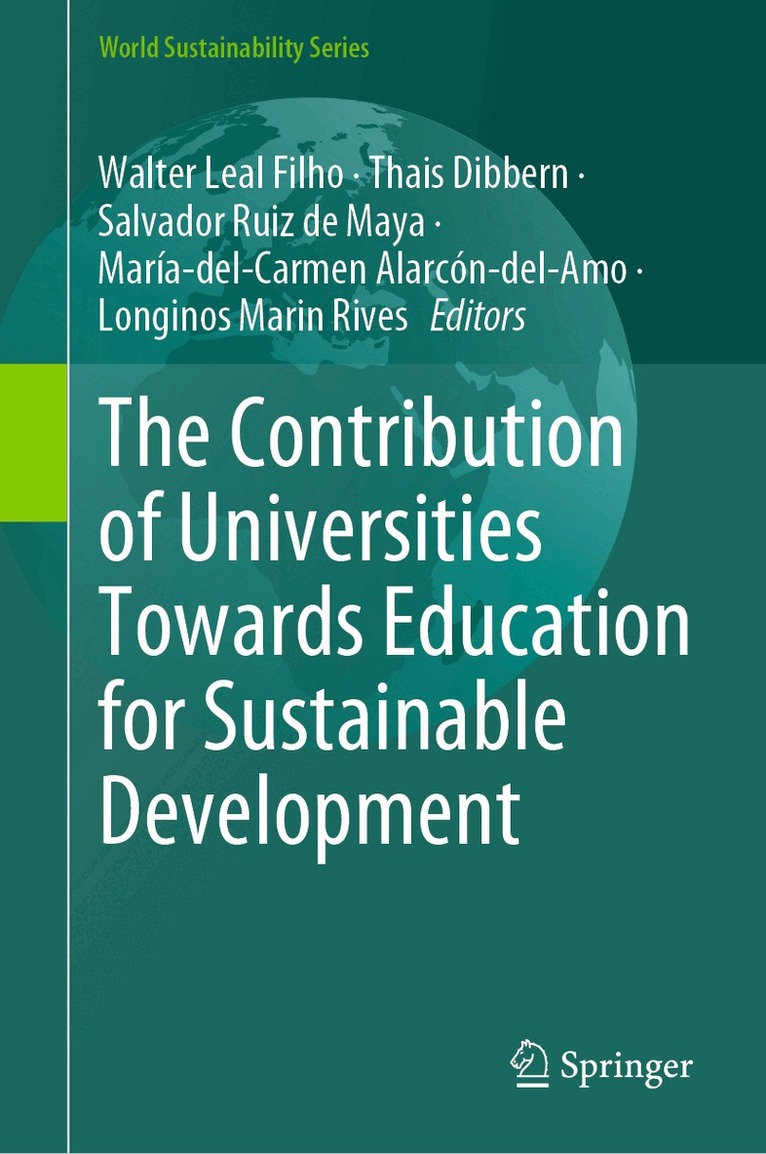
    Contribution of Universities Towards Education for Sustainable Development

    AvWalter Leal Filho,Thais Dibbern

    Inbunden, Engelska, 2024

    Del i serien World Sustainability Series

    1 734 kr

    Beställningsvara. Skickas inom 10-15 vardagar. Fri frakt över 249 kr.

    Beskrivning

    The book gathers inputs from universities and research organizations working on matters related to sustainable development in a variety of contexts. It also provides a platform for the dissemination of information on the latest initiatives, paving the way for technology transfer and networking. Furthermore, the book intends to provide a fertile basis upon which universities may cooperate more closely in this key area.Universities, as centers of education, research, and innovation, have a unique position and responsibility in promoting sustainability. They can offer degree programs, courses, and workshops focused on sustainability, environmental studies, and related fields, educating students and the wider community about the principles and challenges of sustainability. Also, universities can conduct cutting-edge research to address sustainability challenges, such as climate change, resource depletion, and biodiversity loss. They can develop innovative technologies and solutions that promote sustainable practices in various sectors, including energy, agriculture, transportation, and urban planning. There is a perceived need to better understand and engage universities further on sustainability initiatives.Against this backdrop and in order to facilitate a broad discussion on the contribution of universities toward sustainability, this book is being produced.Last but not least, a further aim of the book is to present methodological approaches and experiences deriving from case studies and projects, which aim to show how sustainability may be incorporated as part of university programs.

    Produktinformation

    • Utgivningsdatum:2024-04-02
    • Mått:156 x 234 x 33 mm
    • Vikt:1 017 g
    • Format:Inbunden
    • Språk:Engelska
    • Serie:World Sustainability Series
    • Antal sidor:593
    • Upplaga:2024
    • Förlag:Springer International Publishing AG
    • ISBN:9783031498527

    Utforska kategorier

    • Högskola och universitet inom Psykologi och pedagogik
    • Miljövetenskap och miljöpolitik inom Naturvetenskap och teknik

    Innehållsförteckning

    • ​Chapter 1. Are the UN SDGs being implemented in geography courses at Spanish universities? (Carlos Martínez-Hernández).- Chapter 2. Contributing to food security and sovereignty: Promoting sustainable production, using as an example the standardization of the conditions of a low energy consumption process for the dehydration of strawberry flakes in México (Abraham Juárez Ma. del Rosario).- Chapter 3. Towards Sustainable Mining Operations: Optimizing Thermal and Environmental Conditions for Underground Workers Using CFD Analysis (Juan Carlos Baltazar Vera).- Chapter 4. Education for sustainable development in Higher education institutions (Gemma Tejedor).- Chapter 5. Fieldwork Resource Pack as a tool in the teaching of Chemistry and Education for Sustainability in Secondary Schools (Nadine Sciortino).- Chapter 6. Sustainability in Higher Education Institutions and the Brazilian Environmental Agenda in Public Administration (Laís Viera Trevisan).- Chapter 7. A Guide on Environmental Education: Current Pedagogical Problems and Recommendations for its Implementation in the University English Classroom (Estefanía Sánchez Auñón).- Chapter 8. The integration of ESD in geography syllabi at higher education level in Malta (Rebecca Cassar and Mark Mifsud).- Chapter 9. Ecological Design as Framework of the Sustainable Systems (MS3) Curriculum: A Historical Review of Achievements, Challenges and Community Outreach in Architecture for Sustainability (Bruno Borsari).- Chapter 10. Environmental sustainability in traditional university libraries: contributions from bim/bes integration to the thermal performance and books conservation (Carolina Vaz).- Chapter 11. Implementing sustainability programs in universities – An overview of evolution and challenges from a global and Brazilian perspective (Gustavo José Rodrigues Lopes).- Chapter 12. Energy Consumption Evaluation for an Experimental Supermarket Located ona University Campus (Thiago Toledo Viana Rodrigues).- Chapter 13. Mapping the environmental quality of university campus areas for the needs of blue-green infrastructure planning (Jan Kopp, Jiří Preis).- Chapter 14. The Effect of Architectural Parameters on the Risk of Infection by Airborne Diseases in Classrooms (Pedro Carmo e Souza).- Chapter 15. Implementation of a transversal and multidisciplinary sustainability project for the development of student’s final projects at the Engineering School of Bilbao, UPV/EHU (Spain) (Esther Acha)