• Fri frakt över 249 kr
  • •
  • Snabba leveranser
  • •
  • Billiga böcker
Kundservice

Du är på sajten för privatpersoner.

Företag, bibliotek eller offentlig verksamhet?

Du handlar på classic.bokus.com, där alla dina funktioner finns intakta.
Till classic.bokus.com
Bokus logotyp. Gå till startsidan.
  • Erbjudanden
  • Nyheter
  • Student
  • Topplistor
  • Barn & ungdom
  • Bokus Play
  • E-böcker
  • Pocketböcker
  • Spel & pussel

10% rabatt på allt med kod NYSTART10 →

Sidfot

Mina sidor

    Hjälp

    • Kundservice
    • Vanliga frågor och svar
    • Frakt och leverans
    • Retur vid ångerrätt
    • Reklamera vara
    • Betalning
    • Köpvillkor
    • Allmänna villkor
    • Information om webbplatsens tillgänglighet

    Om Bokus

    • Om oss
    • Pressrum
    • För studenter
    • För företag
    • För bibliotek och offentlig verksamhet
    • För leverantörer
    • Hållbarhet

    Populärt

    • Aktuella erbjudanden
    • Presentkort
    • Studentlitteratur
    • Nya böcker
    • Topplistor
    • Signerade böcker
    • Engelska böcker

    Inspiration

    • Boktips
    • BookTok
    • Populära bokserier
    • Barnbokskaraktärer
    • Populära författare
    Logotyp för Bokus
    Följ oss på Facebook (extern länk)Följ oss på Instagram (extern länk)Följ oss på YouTube (extern länk)Följ oss på TikTok (extern länk)
    bokus @ CookiesAnpassa cookiesIntegritetspolicyKöpvillkor
    Till Citymail hemsida (extern länk)Till Budbee hemsida (extern länk)Till Postnord hemsida (extern länk)Till Schenker hemsida (extern länk)Till Early Bird hemsida (extern länk)Till Walleys hemsida (extern länk)
    1. Samhälle och politik
    2. Samhälle och kultur
    3. Sociala grupper och identitet
    • Nyhet

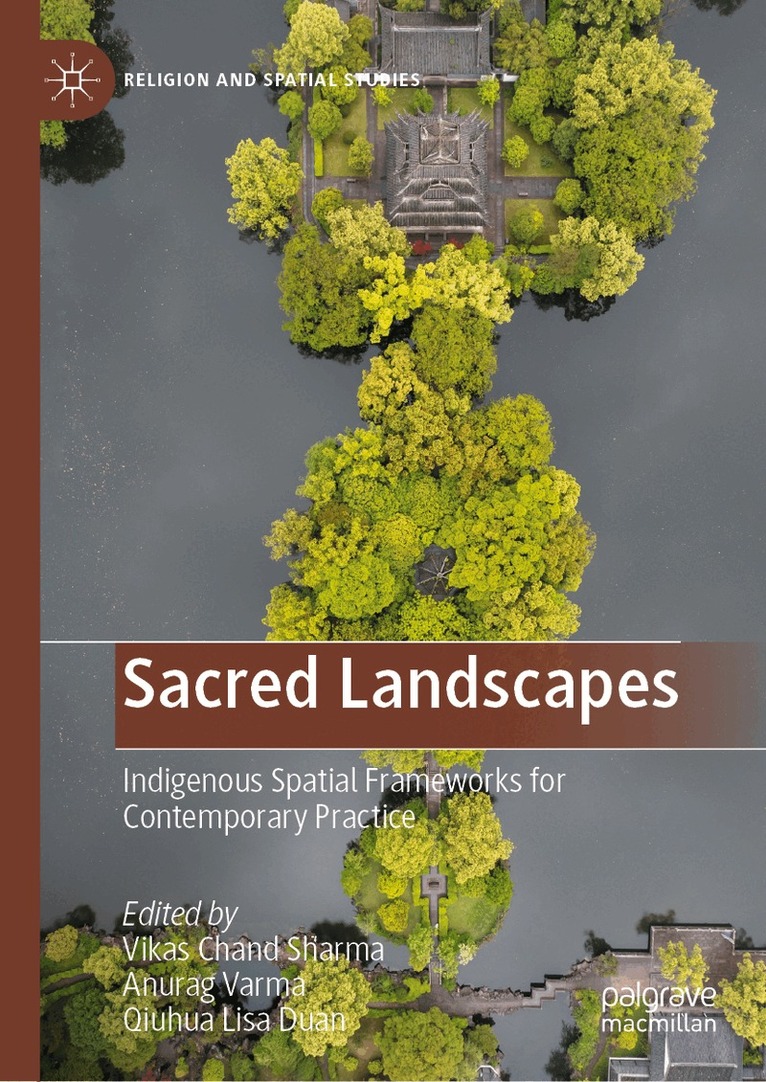
    Sacred Landscapes

    Indigenous Spatial Frameworks for Contemporary Practice

    AvVikas Chand Sharma,Anurag Varma

    Inbunden, Engelska, 2026

    Del i serien Religion and Spatial Studies

    1 839 kr

    Beställningsvara. Skickas inom 10-15 vardagar. Fri frakt över 249 kr.

    Beskrivning

    Positioned at the intersection of indigenous knowledge systems and spatial practice, this volume explores how ritualised, place-based epistemologies can reframe design and planning responses to global ecological crises. Departing from reductive Cartesian abstractions, it interrogates the systemic erasure of sacred space and advances a generative turn toward relational ontologies and decolonial spatial imaginaries. Landscapes are approached not as static heritage artefacts, but as living, agentive systems that co-produce meaning, identity, and ethical responsibility. Drawing on global case studies and innovative methodological approaches, including VOICE, Spiritual Tectonics, and Afro-Cosmological Design, the contributions explore the temporal thickening of sacred sites, where ancestral continuities intersect with emergent technologies. By integrating traditional ecological knowledge with contemporary metrics of resilience and sustainability, the book outlines actionable pathways for spatial practitioners. It speaks to researchers and professionals across architecture, urban planning, religious studies, cultural geography, and the environmental humanities.

    Produktinformation

    • Utgivningsdatum:2026-08-04
    • Mått:148 x 210 x 22 mm
    • Vikt:511 g
    • Format:Inbunden
    • Språk:Engelska
    • Serie:Religion and Spatial Studies
    • Antal sidor:283
    • Förlag:Springer Nature Switzerland AG
    • ISBN:9783032181275

    Utforska kategorier

    • Sociala grupper och identitet inom Samhälle och politik
    • Andra religioner och trosföreställningar inom Filosofi och religion

    Mer om författaren

    Vikas Chand Sharma is an Associate Professor at Chandigarh University and a researcher at Guru Nanak Dev University, India, with 13 years of experience in architecture and urban planning. He specializes in sustainable urban design for historic cities, developing resilient frameworks through phenomenological inquiry and digital mapping. His research appears in the International Journal of Construction Education and Research, Landscape Research, and Journal of Architecture & Urbanism. He serves on the Scientific Committees for Contesti. Città, Territori, Progetti (University of Florence, Italy) and Anales de Investigación en Arquitectura (Universidad ORT Uruguay) and is an Editorial Board Member for several journals, including Artificial Intelligence for Sustainable Cities (WSSET, UK).Dr. Anurag Varma, an academician, architect, and consultant, brings over 25 years of diverse professional experience. Currently, as the Executive Director of the Liberal Arts and Humanities cluster at Chandigarh University, he concurrently leads his self-owned design and planning consulting firm. His expertise spans spatial planning, urbanism, heritage conservation, and architectural design, showcased in leadership roles at a top-100 ENR rated International Design Firm and a leading workshare firm. His academic journey includes Doctoral research from TERI School of Advanced Studies, focusing on sacred cultural heritage and its intersection with urban planning in pilgrimage towns, alongside interests in sustainable built environments, architecture pedagogy, and advancements in education.Dr. Qiuhua (Lisa) Duan is an Assistant Professor specializing in sustainable built environments, building performance, and advanced materials. Her research develops innovative solutions for energy efficiency and occupant well-being within resilient communities. Dr. Duan holds dual PhDs in Architectural Engineering (Pennsylvania State University, USA) and Disaster Prevention and Reduction Engineering (Tongji University, China). She has led some research projects funded by NOAA, the DOE and participated in US National Science Foundation initiatives. With over 50 peer-reviewed publications, her work focuses on energy-efficient building envelopes and indoor environmental quality, offering high-performance technical frameworks for contemporary spatial practice.

    Innehållsförteckning

    • Part I: Experiential Frameworks.- Chapter 1. Afrocosmology and Sacred Design: Towards a Decolonial Spatial Imagination (Johannes Bhanye).- Chapter 2. The field and the knower: understanding sacred landscapes through the Bhagavad Gītā (Umberto Baresi).- Chapter 3. Reconciling Geometries and Geographies of the Self (Karim W. F. Youssef).- Chapter 4. The 'Relational Turn' in Sacred Space: A Phenomenological Mapping Framework (Vikas Chand Sharma, and Sandeep Dua).- Chapter 5. Spiritual Tectonics: Integrating Yogic Principles and Sacred Architecture for Meditative Stillness (Ines Consuela Essen).- Chapter 6. Samādhis as Cultural Landscapes: Remembering Saints in Contemporary Bhakti (Leena Taneja).- Part II: Indigenous Frameworks.- Chapter 7. Deriving the Indigenous Proportioning System of Ek-Ratna Temples of Bishnupur (Peu Banerjee).- Chapter 8. Recursive sacred space and multiple emotional resonance: development model of Thai Chinese temples based on symbolic representation (Huiying Wang and Warunee Wang).- Chapter 9. Reimagining Traditional Water Systems in Sacred Landscapes: A Planning Framework for Govardhan, India (Aman Sharma, Anurag Varma, and Shiva Ji).- Chapter 10. Reviving the Sacred Through Self-Rule: Gandhi’s Gram Swaraj and Festival Space Planning (Nimai Sarkar).- Chapter 11. Rethinking Conservation Frameworks of Living Religious Heritage Sites (Samidha Pusalkar).- Chapter 12. Village Voice: Reimagining Development through Sacred Ecologies in Goa (Ginella George and George Jerry Jacob).- Chapter 13. Tir Aikym: Creating an environmental stewardship framework for a living eco-spiritual centre (Anoup Kerrai, Girija Shettar, Hiral Patel, and Mohan Siyani).