• Fri frakt över 249 kr
  • •
  • Snabba leveranser
  • •
  • Billiga böcker
Kundservice

Du är på sajten för privatpersoner.

Företag, bibliotek eller offentlig verksamhet?

Du handlar på classic.bokus.com, där alla dina funktioner finns intakta.
Till classic.bokus.com
Bokus logotyp. Gå till startsidan.
  • Erbjudanden
  • Nyheter
  • Student
  • Topplistor
  • Barn & ungdom
  • Bokus Play
  • E-böcker
  • Pocketböcker
  • Spel & pussel

10% rabatt på allt med kod NYSTART10 →

Sidfot

Mina sidor

    Hjälp

    • Kundservice
    • Vanliga frågor och svar
    • Frakt och leverans
    • Retur vid ångerrätt
    • Reklamera vara
    • Betalning
    • Köpvillkor
    • Allmänna villkor
    • Information om webbplatsens tillgänglighet

    Om Bokus

    • Om oss
    • Pressrum
    • För studenter
    • För företag
    • För bibliotek och offentlig verksamhet
    • För leverantörer
    • Hållbarhet

    Populärt

    • Aktuella erbjudanden
    • Presentkort
    • Studentlitteratur
    • Nya böcker
    • Topplistor
    • Signerade böcker
    • Engelska böcker

    Inspiration

    • Boktips
    • BookTok
    • Populära bokserier
    • Barnbokskaraktärer
    • Populära författare
    Logotyp för Bokus
    Följ oss på Facebook (extern länk)Följ oss på Instagram (extern länk)Följ oss på YouTube (extern länk)Följ oss på TikTok (extern länk)
    bokus @ CookiesAnpassa cookiesIntegritetspolicyKöpvillkor
    Till Citymail hemsida (extern länk)Till Budbee hemsida (extern länk)Till Postnord hemsida (extern länk)Till Schenker hemsida (extern länk)Till Early Bird hemsida (extern länk)Till Walleys hemsida (extern länk)
    1. Samhälle och politik
    2. Samhälle och kultur
    3. Sociala och etiska frågor

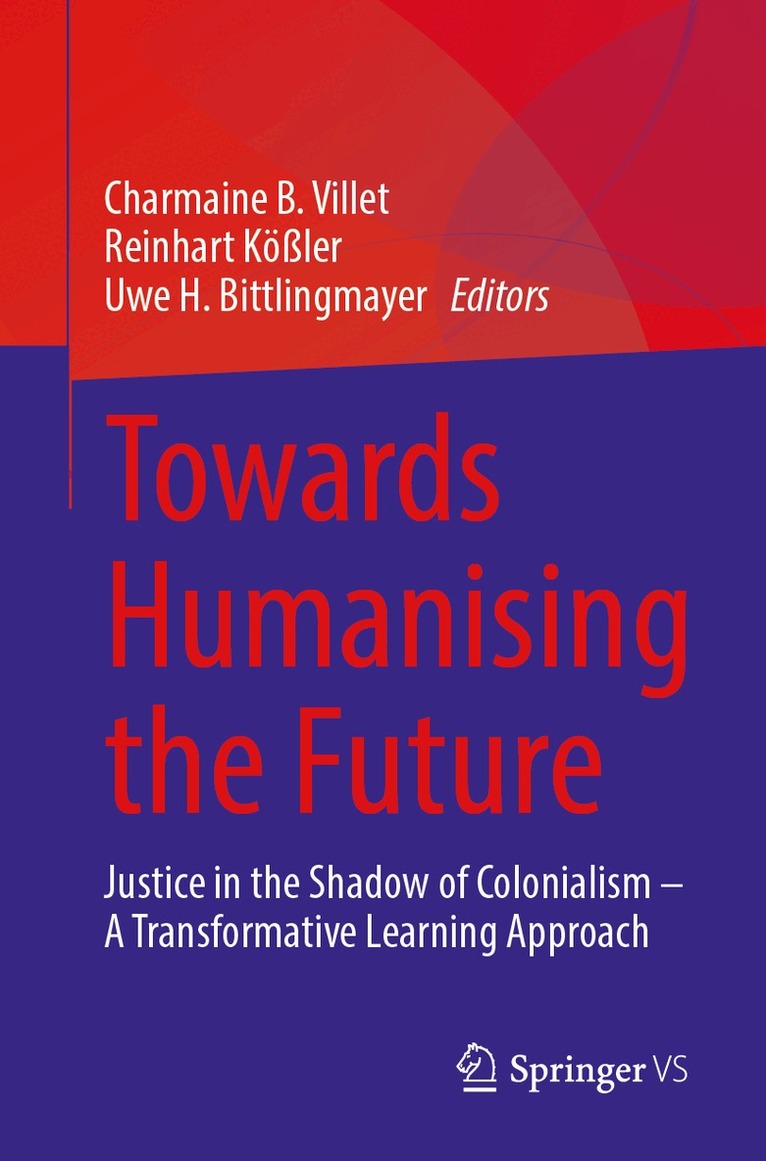
    Towards Humanising the Future

    Justice in the Shadow of Colonialism – A Transformative Learning Approach

    AvCharmaine B. Villet,Reinhart Kößler

    Häftad, Engelska, 2026

    1 301 kr

    Beställningsvara. Skickas inom 5-8 vardagar. Fri frakt över 249 kr.

    Beskrivning

    Education is intertwined with social justice in multivarious ways, and it takes place in historically defined contexts. The proposed collective volume brings together a range of perspectives from an interdisciplinary array of social sciences with a clear focus on education. The authors include academics and some activists from Namibia and Germany. The contributions are centred on current issues and challenges, but in particular on account of the binational composition of the authors, the historical context of German colonial rule and the 1903-1908 genocide also form a focus of attention. However, the contributions do not rehearse history only or exclusively. Authors address an array of current issues, ranging from social justice to the issues of recognition, apology, and reparation connected with the genocide. The latter issue is connected in many ways with the questions of justice and equity as well as with the persistent high social inequality that besets Namibia. It affects the psycho-social well-being of learners and their family relations, but relates also to class room practice and the syllabus. One main concern here, motivated especially by educational considerations, is transgenerational trauma in the wake of the genocide. As has been shown in other, more intensely researched cases, most notably the Holocaust, trauma sustained from experiences of large-scale violence including mass killings, genocide or concentration camps may be transmitted to survivors’ posterity through several generations. In Namibia, various discourses among victim communities speak to this circumstance. The proposed volume addresses these issues from the various perspectives of educational science, history, philosophy, sociology, and public health. It addresses communal memory practices, which keep oral traditions alive. It also looks at curricular issues and various aspects of teaching practice, in particular approaches centred on social change.

    Produktinformation

    • Utgivningsdatum:2026-05-29
    • Mått:155 x 235 x 13 mm
    • Vikt:347 g
    • Format:Häftad
    • Språk:Engelska
    • Antal sidor:207
    • Förlag:Springer Nature Switzerland AG
    • ISBN:9783032182562

    Utforska kategorier

    • Sociala och etiska frågor inom Samhälle och politik
    • Antropologi inom Samhälle och politik
    • Sociala grupper och identitet inom Samhälle och politik

    Mer om författaren

    Uwe H. Bittlingmayer studied Sociology, Philosophy and Political Science at the Institute of Sociology, Muenster University. He made his PhD at the same institute with a critical study about the knowledge society. Later on he worked in several third-funded projects at Bielefeld University at the Faculty of Public Health. Finally, he became full professor for general sociology at the Institute of Sociology at the University of Education Freiburg. Reinhart Kößler studied sociology, history, in particular Eastern European history and ethnology at the University of Heidelberg and Chinese Studies at the University of Leeds. He took his doctorate in sociology 1978 at the University of Münster and his senior doctorate (Habilitation) in 1987 also at Münster. He pursues a long-time interest in southern Africa, for many years with a focus on Namibia, combining scholarly and activist pursuits. After retiring as Director of the Arnold-Bergstraesser-Institut Freiburg in 2015, he remains an associate there as well as at the Department of Anthropology at the University of the Free State, South Africa. Charmaine Villet completed her Ph.D. studies in Curriculum and Instructional Leadership at Ohio University in the USA. She teaches in the Department of Applied Educational Sciences in the School of Education at the University of Namibia. Charmaine participated and led prominent studies on educational reform and transformation with the World Bank, UNESCO, the EU, the AU and in Namibia and the SADC region. She served as the co-chair of the International Taskforce on Teachers for Education 2030/UNESCO from 2016 – 2018 and heads the sub-cluster on Curriculum, Teaching and Learning in Higher Education under the African Union’s Continental Education Strategy for Africa/ CESA 2016-25 as articulated in the African Union’s vision of Agenda 2063: The Africa We Want.

    Innehållsförteckning

    • Chapter 1. Introduction.- Part I: Burdens of History.- Chapter 2. Addressing the Intergenerational Trauma of the People of Namibia through Transformative Higher Education.- Chapter 3. Generational Trauma: The Impact of Genocide on Gender Relations in Namibia.- Chapter 4. German Postcolonial Entanglements – Namibia and Beyond.- Part II: Social Justice.- Chapter 5. Social Justice in Postcolonial Namibia: Whose Justice? What Justice? Which Rationality?.- Chapter 6. Justice. On the Importance to Recognize Dignity and Social Equity as Two Sides of the Same Coin.- Chapter 7. Justice and Fairness in Negotiations: On Genocide and Reparations.- Chapter 8. Bringing Justice to the Dead. The Open and Seemingly Desolated Old Location Cemetery in Kramersdorf, Swakopmund.-  Part III: Challenges of Teaching.- Chapter 9. Facing History, Teaching for change and social action.- Chapter 10. The Curriculum Coverage of Genocide Studies in Namibian Schools and Pedagogical Issues.- Chapter 11. A Comparative Analysis of Life Skills Education in Namibia and Germany – and what we can learn from each other and for the future.- Chapter 12. Life Skills in Home Economics.- Part IV: Venues of Remembrance.- Chapter 13. Learning to See History whilst Listening. Acoustic Echoes of German Colonialism in Namibia – Memory Cultures in Museums and Exhibitions.- Chapter 14. Germany and Namibia: Laying Bare Layers of Memory to Dismantle the Past for the Future. Chapter 15. freiburg-postkolonial.de: local practice.- Chapter 16. The Way Forward. Final remarks.