• Fri frakt över 249 kr
  • •
  • Snabba leveranser
  • •
  • Billiga böcker
Kundservice

Du är på sajten för privatpersoner.

Företag, bibliotek eller offentlig verksamhet?

Du handlar på classic.bokus.com, där alla dina funktioner finns intakta.
Till classic.bokus.com
Bokus logotyp. Gå till startsidan.
  • Erbjudanden
  • Nyheter
  • Student
  • Topplistor
  • Barn & ungdom
  • Bokus Play
  • E-böcker
  • Pocketböcker
  • Spel & pussel

10% rabatt på allt med kod: NYSTART10 →

Sidfot

Mina sidor

    Hjälp

    • Kundservice
    • Vanliga frågor och svar
    • Frakt och leverans
    • Retur vid ångerrätt
    • Reklamera vara
    • Betalning
    • Köpvillkor
    • Allmänna villkor
    • Information om webbplatsens tillgänglighet

    Om Bokus

    • Om oss
    • Pressrum
    • För studenter
    • För företag
    • För bibliotek och offentlig verksamhet
    • För leverantörer
    • Hållbarhet

    Populärt

    • Aktuella erbjudanden
    • Presentkort
    • Studentlitteratur
    • Nya böcker
    • Topplistor
    • Signerade böcker
    • Engelska böcker

    Inspiration

    • Boktips
    • BookTok
    • Populära bokserier
    • Barnbokskaraktärer
    • Populära författare
    Logotyp för Bokus
    Följ oss på Facebook (extern länk)Följ oss på Instagram (extern länk)Följ oss på YouTube (extern länk)Följ oss på TikTok (extern länk)
    bokus @ CookiesAnpassa cookiesIntegritetspolicyKöpvillkor
    Till Citymail hemsida (extern länk)Till Budbee hemsida (extern länk)Till Postnord hemsida (extern länk)Till Schenker hemsida (extern länk)Till Early Bird hemsida (extern länk)Till Walleys hemsida (extern länk)
    1. Samhälle och politik
    2. Sociologi och antropologi
    3. Sociologi
    • Nyhet

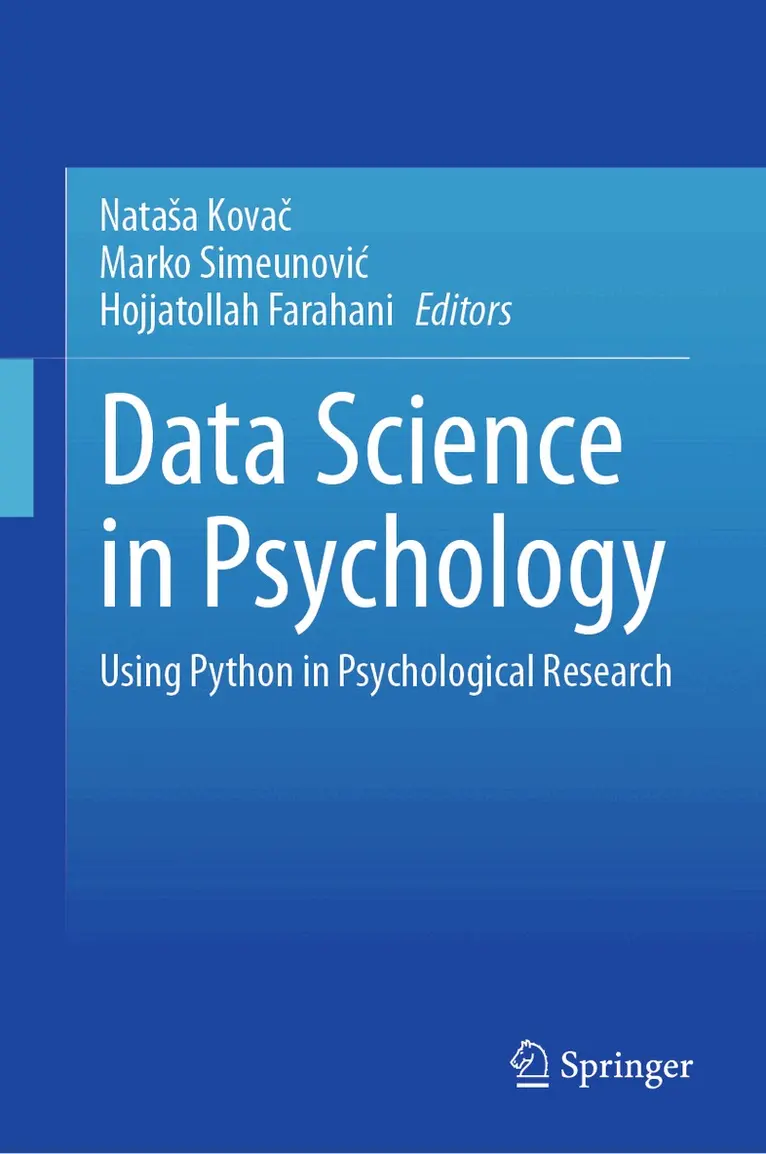
    Data Science in Psychology

    Using Python in Psychological Research

    AvNataša Kovač,Marko Simeunović

    Inbunden, Engelska, 2026

    1 685 kr

    Beställningsvara. Skickas inom 10-15 vardagar. Fri frakt över 249 kr.

    Beskrivning

    This book is an innovative resource designed to bridge the gap between traditional psychological research methods and contemporary data science techniques. This book provides a comprehensive introduction to using Python for analyzing psychological data, enabling researchers, educators, and students to harness the analytical power of data science within their work. The volume is structured into four parts, encompassing programming skills, data preparation, advanced data processing, and the interpretation of results, each reinforced with practical examples and case studies.The content starts with the basics of Python programming, tailored specifically for psychological research applications. It then progresses to the sophisticated analysis of psychological data using statistical models, machine learning, and artificial intelligence, with a strong focus on Python's capabilities in these areas. This includes detailed discussions on Confirmatory Factor Analysis, machine learning algorithms like SVMs, and innovative techniques such as metaheuristics and simulations.This book is particularly timely as psychological research becomes increasingly data-driven, necessitating a deeper understanding of complex datasets and the development of more sophisticated analytical tools. "Data Science in Psychology" addresses this need by providing not only the technical skills required but also a deep understanding of how these techniques can be applied specifically to psychological research. The primary audience, including psychology researchers, academics, and advanced students, will find this book invaluable for integrating data science into their daily toolkit, thus leveling up their research capabilities and broadening their methodological approaches in an era where interdisciplinary skills are an added value.

    Produktinformation

    • Utgivningsdatum:2026-08-03
    • Mått:155 x 235 x 39 mm
    • Vikt:1 078 g
    • Format:Inbunden
    • Språk:Engelska
    • Antal sidor:601
    • Förlag:Springer Nature Switzerland AG
    • ISBN:9783032183118

    Utforska kategorier

    • Sociologi inom Samhälle och politik
    • Psykologisk metod inom Psykologi och pedagogik
    • Databaser inom Data och IT

    Mer om författaren

    Nataša Kovač (https://orcid.org/0000-0002-6671-2938) is an assistant professor at the Faculty of Applied Sciences, University of Donja Gorica. She defended her PhD thesis entitled "Metaheuristic approach to solving a class of optimization problems in transport" at the Faculty of Mathematics, University of Belgrade, and at the same time acquired the title of Doctor of Mathematics. She was employed at the Faculty of Technical Sciences in Novi Sad and the Faculty of Maritime Studies in Kotor as an assistant. She worked as a lecturer at the Mediterranean University in Podgorica, and she also taught as a professor at the Gymnasium in Kotor. She is currently employed at the Faculty of Applied Sciences in Podgorica where she teaches Euclidean and analytical geometry, stochastic processes and probability and mathematical statistics. Her research interests are statistical analysis, metaheuristics, optimization, algorithm development, and applied mathematics in engineering sciences. She has specializations in data science and was awarded the following certifications: Certified Data Collection and Processing with Python (University of Michigan), Statistics with Python specialization (University of Michigan), Introduction to Data Science specialization (IBM), Applied Data Science specialization (IBM), and IBM Data Science specialization (IBM). She has published more than 80 scientific papers and has been involved in more than 10 international projects. She is one of the founders of the SME "MoDrone" supported by the Montenegrin government, which is dedicated to the development and promotion of innovative solutions. She is a full member of the Scientific Research Honor Society Sigma Xi.Marko Simeunović received the B.Sc., M.Sc., and Ph.D. degrees in electrical engineering from the Faculty of Electrical Engineering of the University of Montenegro, in 2008, 2009 and 2013 respectively. From 2008 to 2016 he was with the University of Montenegro covering positions of teaching/research assistant and was an ICT fellow specializing in e-service engineering. In 2016 he was also involved in the first Center of Excellence in Montenegro. He joined the University of Donja Gorica in 2016 where he is currently holding the position of associate professor. From 2020 to 2022 he was with the Department of Town Planning, Engineering Networks and Systems of the Institute of Architecture and Construction, South Ural State University, Chelyabinsk, Russia where he was associate professor. His courses are related to electrical engineering, programming, artificial intelligence, information systems and digital signal and image processing. He published more than 60 papers in international scientific journals and conferences and participated in several FP7, H2020, bilateral and national research projects. He was a leader of two innovative projects funded by the Ministry of Science of Montenegro. Marko Simeunović is a reviewer with most of the world’s leading journals on signal processing. In 2013, Dr Simeunović was honoured by the Montenegrin Academy of Sciences and Arts for his outstanding scientific achievements. His research interests include time-frequency signal analysis, robust estimation, parametric and nonparametric estimation, statistical and array signal processing, genetic algorithm applications, radar signal processing and wireless sensor networks. More information can be found at http://markosimeunovic.optimussoft.me/.Hojjatollah Farahani is an Assistant Professor at the Tarbiat Modares University (TMU), Iran. He received his Ph.D. from Isfahan University in 2009, and he was a postdoctoral researcher in Fuzzy inference at Victoria University in Australia (2014-2015), where he started working on Fuzzy Cognitive Maps (FCMs) under the supervision of Professor Yuan Miao. He is the author or co-author of more than 200 research papers and a reviewer in numerous scientific journals. He has supervised and advised many theses and dissertations in psychological sciences. His research interests and directions include psychometrics, advanced behavioral statistics, fuzzy psychology, artificial intelligence, and machine learning algorithms in psychology. His recent book entitled “An Introduction to Artificial Psychology: Application Fuzzy Set Theory and Deep Machine Learning in Psychological Research using R” was published by Springer in 2023.

    Innehållsförteckning

    • Part I. Python and Psychological Sciences Background.- Chapter 1. Introduction to Python programming.- Chapter 2. Introduction to Psychological Sciences.- Chapter 3. Datasets for Psychological Sciences.- Part II. Data preparation.- Chapter 4. Collecting the data in psychological sciences.- Chapter 5. Datasets preparation.- Chapter 6. Data pre-processing.- Part III. Data processing.- Chapter 7. The difference between data science, statistics, machine learning and artificial intelligence.- Chapter 8. Data modelling.- Chapter 9. Confirmatory Factor Analysis.- Chapter 10. Graded item response theory: developing and validating a psychological scale.- Chapter 11. Bootstrap Exploratory Graph Analysis.- Chapter 12. Clustering methods.- Chapter 13. Latent Class Analysis and Latent Profile Analysis.- Chapter 14. Time-dependent Modelling in Psychological Data.- Chapter 15. Shrinkage Regression: Ridge Regression, LASSO, Elastic Net Regression.- Chapter 16. Bayesian Data Analysis.- Chapter 17. Support Vector Machine Algorithm.- Chapter 18. Classification in Psychological Research.- Chapter 19. Natural Language Processing and Psychological Sciences.- Chapter 20. Metaheuristics in Psychological Data Analysis.- Chapter 21. Simulations in Psychological Research.- Part IV. Interpretation of results.- Chapter 22. Interpreting Statistical Results.- Chapter 23. Advanced Data Interpretation Strategies.- Chapter 24. Reporting and Discussing Findings.