• Fri frakt över 249 kr
  • •
  • Snabba leveranser
  • •
  • Billiga böcker
Kundservice

Du är på sajten för privatpersoner.

Företag, bibliotek eller offentlig verksamhet?

Du handlar på classic.bokus.com, där alla dina funktioner finns intakta.
Till classic.bokus.com
Bokus logotyp. Gå till startsidan.
  • Erbjudanden
  • Nyheter
  • Student
  • Topplistor
  • Barn & ungdom
  • Bokus Play
  • E-böcker
  • Pocketböcker
  • Spel & pussel

10% rabatt på allt med kod: NYSTART10 →

Sidfot

Mina sidor

    Hjälp

    • Kundservice
    • Vanliga frågor och svar
    • Frakt och leverans
    • Retur vid ångerrätt
    • Reklamera vara
    • Betalning
    • Köpvillkor
    • Allmänna villkor
    • Information om webbplatsens tillgänglighet

    Om Bokus

    • Om oss
    • Pressrum
    • För studenter
    • För företag
    • För bibliotek och offentlig verksamhet
    • För leverantörer
    • Hållbarhet

    Populärt

    • Aktuella erbjudanden
    • Presentkort
    • Studentlitteratur
    • Nya böcker
    • Topplistor
    • Signerade böcker
    • Engelska böcker

    Inspiration

    • Boktips
    • BookTok
    • Populära bokserier
    • Barnbokskaraktärer
    • Populära författare
    Logotyp för Bokus
    Följ oss på Facebook (extern länk)Följ oss på Instagram (extern länk)Följ oss på YouTube (extern länk)Följ oss på TikTok (extern länk)
    bokus @ CookiesAnpassa cookiesIntegritetspolicyKöpvillkor
    Till Citymail hemsida (extern länk)Till Budbee hemsida (extern länk)Till Postnord hemsida (extern länk)Till Schenker hemsida (extern länk)Till Early Bird hemsida (extern länk)Till Walleys hemsida (extern länk)
    1. Ekonomi och Ledarskap
    2. Företagsekonomi
    3. Affärsutveckling

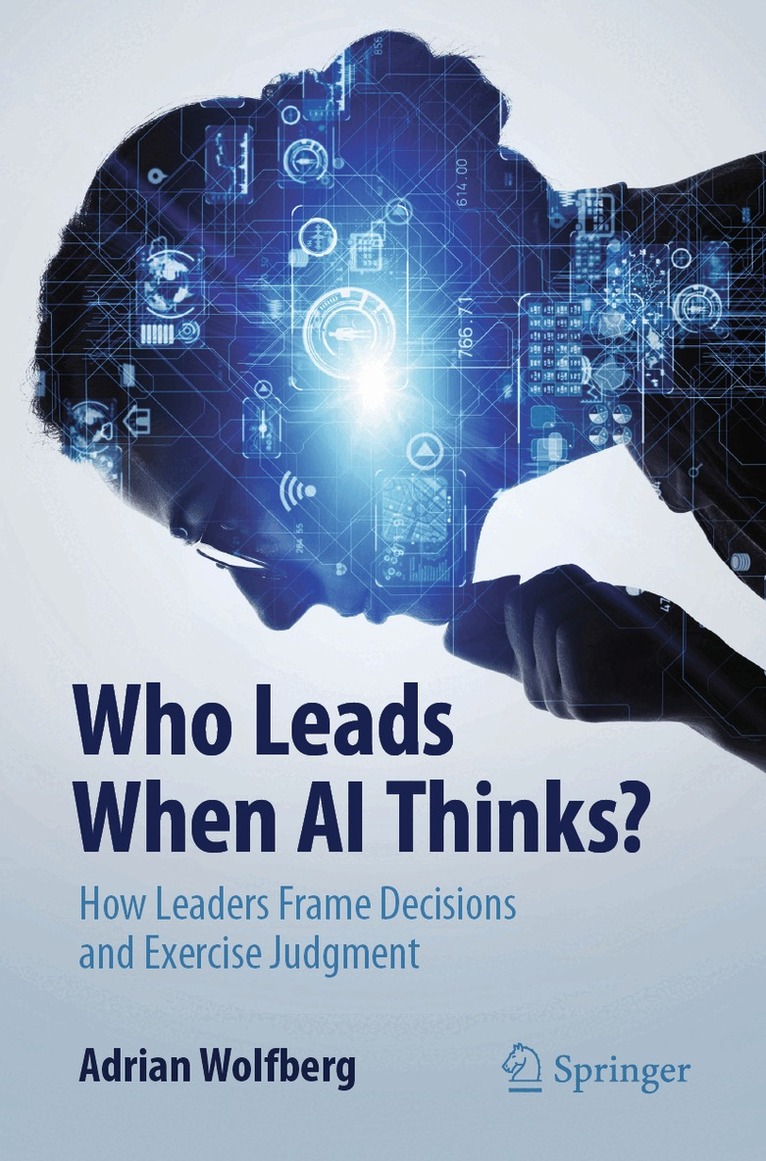
    Who Leads When AI Thinks?

    How Leaders Frame Decisions and Exercise Judgment

    AvAdrian Wolfberg

    Häftad, Engelska, 2026

    292 kr

    Beställningsvara. Skickas inom 10-15 vardagar. Fri frakt över 249 kr.

    Fler format och utgåvor

    E-bok

    407 kr

    Beskrivning

    As Artificial Intelligence (AI) becomes increasingly embedded into the fabric of everyday individual, organizational, and societal life, the issue is not whether leaders should make a binary choice of whether to use it or not, or figuring out what policy to guide its use. The issue we face is the proper alignment between AI and human engagement. This alignment depends on the nature of the problem to be solved. Problems range from simple to complex and evolve over time so there are distinct phases of problems with different problem-solving needs. As problems become more complex, human critical and creative thinking dominate, and when they are simpler, AI dominates. Regardless of the technological advances in artificial intelligence over the next years and decades, there will always be a need for human involvement when faced with complex and human-based problems. This book provides leaders with the knowledge to assign the most effective resource alignment between the level of AI and human engagement to ensure successful outcomes.

    Produktinformation

    • Utgivningsdatum:2026-05-19
    • Mått:155 x 235 x 18 mm
    • Vikt:499 g
    • Format:Häftad
    • Språk:Engelska
    • Antal sidor:301
    • Förlag:Springer Nature Switzerland AG
    • ISBN:9783032197160

    Utforska kategorier

    • Affärsutveckling inom Ekonomi och Ledarskap
    • Artificiell intelligens inom Data och IT
    • Ledarskap och motivation inom Ekonomi och Ledarskap

    Mer om författaren

    Adrian Wolfberg is the founder of Organizational Insight Consulting LLC and an adjunct professor at Case Western Reserve University’s Weatherhead School of Management. He has four decades of combined experience as a naval officer, intelligence officer, change agent, boundary spanner, scholarly researcher, and educator. As a naval officer, he was trained as an airborne electronic intelligence officer collecting and analyzing electromagnetic signals from weapon-associated radars on adversary ground-, sea-, and air-based systems. He flew intelligence gathering missions from aircraft carrier-based reconnaissance aircraft and, then, assigned as an Indications & Warning officer assigned to the Joint Staff Intelligence Directorate. He was employed by Defense Intelligence Agency (DIA) as a civilian intelligence analyst where he was a counterdrug analyst. While at DIA, he created and led an internal organizational consulting capability called the DIA Knowledge Lab. Its purpose was to help intelligence officers in the organization—regardless of seniority or formal position—learn how to help themselves in order to solve or make progress solving intractable problems. While assigned to DIA, he graduated from the National War College, spent four years supporting the Office of National Drug Control Policy, four years teaching at the United States Army War College, and two years conducting research at the National Intelligence University. He earned a Ph.D. in organizational science from Case Western Reserve University. Adrian’s scholarly research has focused on psychological, organizational, and technological (including machine intelligence) factors that affect the intelligence analyst’s ability to create and communicate knowledge, and how decision-making consumers of intelligence receive and absorb knowledge. His experiences as an intelligence analyst, leading the DIA Knowledge Lab, and his scholarly research have addressed the challenges of confronting and navigating different knowledge boundaries.

    Innehållsförteckning

    • Chapter 1: The Leader’s Dilemma.- Chapter 2: Who Leads in the Human-AI Dance: Decision Strategy.- Chaper 3: How Does the Dance Flow: Operational Dynamics.- Chapter 4: How to Adapt the Dance: The Reframing Cycle.- Chapter 5: Hybrid Problems: Framing the Challenge.- Chapter 6: Problem Decomposition: Tools for Reframing.- Chapter 7: Problem Characterization and Modes of Thought.- Chapter 8: Learning: Building Adaptive Capacity.- Chapter 9: Cognition: Sharpening Mental Lenses.- Chapter 10: Knowledge Bridging: Connecting Across Boundaries.- Chapter 11: The Leader’s Design.