• Fri frakt över 249 kr
  • •
  • Snabba leveranser
  • •
  • Billiga böcker
Kundservice

Du är på sajten för privatpersoner.

Företag, bibliotek eller offentlig verksamhet?

Du handlar på classic.bokus.com, där alla dina funktioner finns intakta.
Till classic.bokus.com
Bokus logotyp. Gå till startsidan.
  • Erbjudanden
  • Nyheter
  • Student
  • Topplistor
  • Barn & ungdom
  • Bokus Play
  • E-böcker
  • Pocketböcker
  • Spel & pussel

10% rabatt på allt med kod: NYSTART10 →

Sidfot

Mina sidor

    Hjälp

    • Kundservice
    • Vanliga frågor och svar
    • Frakt och leverans
    • Retur vid ångerrätt
    • Reklamera vara
    • Betalning
    • Köpvillkor
    • Allmänna villkor
    • Information om webbplatsens tillgänglighet

    Om Bokus

    • Om oss
    • Pressrum
    • För studenter
    • För företag
    • För bibliotek och offentlig verksamhet
    • För leverantörer
    • Hållbarhet

    Populärt

    • Aktuella erbjudanden
    • Presentkort
    • Studentlitteratur
    • Nya böcker
    • Topplistor
    • Signerade böcker
    • Engelska böcker

    Inspiration

    • Boktips
    • BookTok
    • Populära bokserier
    • Barnbokskaraktärer
    • Populära författare
    Logotyp för Bokus
    Följ oss på Facebook (extern länk)Följ oss på Instagram (extern länk)Följ oss på YouTube (extern länk)Följ oss på TikTok (extern länk)
    bokus @ CookiesAnpassa cookiesIntegritetspolicyKöpvillkor
    Till Citymail hemsida (extern länk)Till Budbee hemsida (extern länk)Till Postnord hemsida (extern länk)Till Schenker hemsida (extern länk)Till Early Bird hemsida (extern länk)Till Walleys hemsida (extern länk)
    1. Kultur
    2. Arkitektur
    • Nyhet

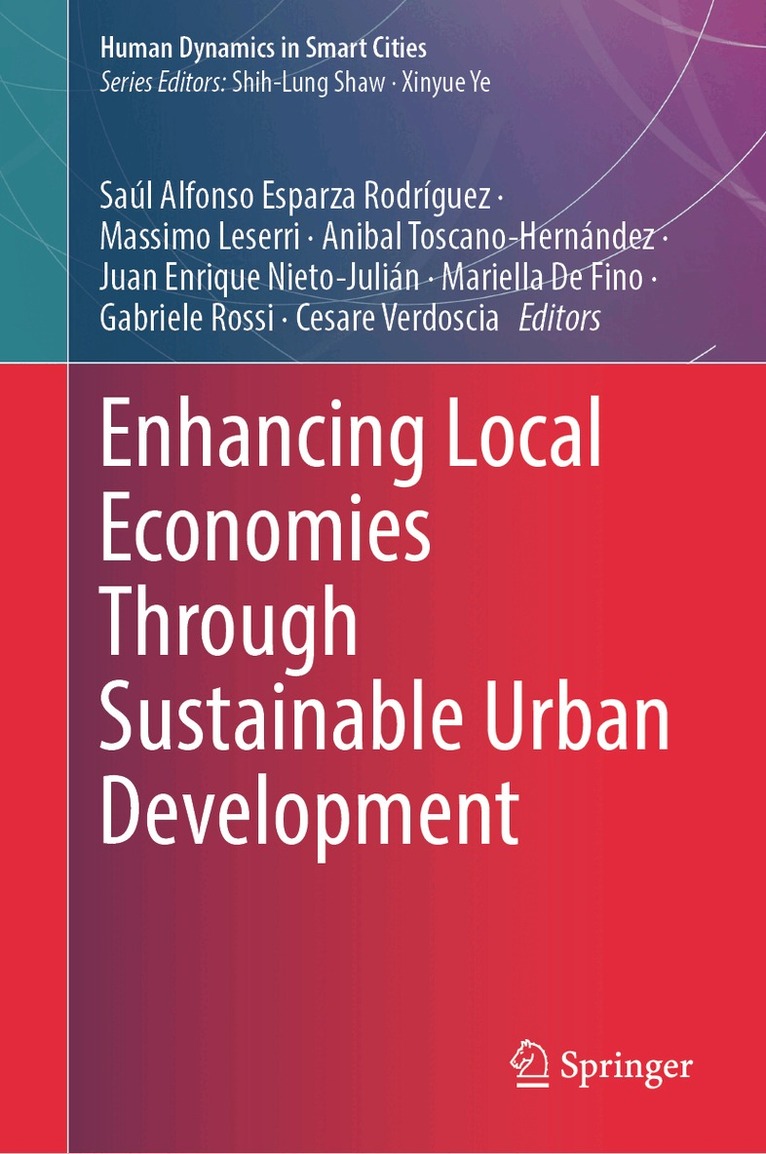
    Enhancing Local Economies Through Sustainable Urban Development

    AvSaúl Alfonso Esparza Rodríguez,Massimo Leserri

    Inbunden, Engelska, 2026

    Del i serien Human Dynamics in Smart Cities

    1 776 kr

    Beställningsvara. Skickas inom 11-20 vardagar. Fri frakt över 249 kr.

    Beskrivning

    This book explores how sustainable urban development can drive global progress toward Sustainable Development Goal (SDG) 11 by enhancing cities and communities. Through an integrative focus on public spaces, sustainable transportation, urban resilience, and cultural heritage, it presents actionable strategies and case studies from diverse global regions that address inclusivity, safety, and accessibility in urban environments.This work examines how visual and sensory documentation of public spaces can improve perception, accessibility, and safety, by presenting insights on AI technologies and 3D simulations, it reveals how sensory design and mental mapping help create environments that feel more welcoming and secure, thereby fostering broader social engagement and utilization of these spaces, emphasizing the role of sustainable transportation and inclusive urban planning in supporting local economies and promoting tourism. Furthermore, the book delves into the critical relationship between urban resilience and the preservation of cultural and natural heritage, underscoring that resilient cities are better able to maintain and protect their historical assets, revealing strategies for safeguarding these treasures, offering examples from Europe, Latin America, and North Asia.Through scenario analysis and urban risk management, it provides a roadmap for integrating urban resilience with cultural heritage conservation, ensuring these sites remain intact for future generations while boosting their appeal as tourist destinations. Green and public spaces are highlighted as pivotal components for sustainable tourism and social development, with a focus on creating “smart” cities that integrate green spaces designed to promote social interaction and enhance public health.The book examines how urban spaces can be optimized to foster social cohesion, improve public well-being, and support economic growth. By discussing roles of stakeholders in advancing sustainable tourism creating urban environments that are not only visually appealing but also functionally inclusive and beneficial for communities, it concludes by exploring integrative approaches and future pathways for sustainable urban development, offering recommendations for policymakers, urban planners, and scholars.

    Produktinformation

    • Utgivningsdatum:2026-08-09
    • Mått:155 x 235 x undefined mm
    • Format:Inbunden
    • Språk:Engelska
    • Serie:Human Dynamics in Smart Cities
    • Antal sidor:360
    • Förlag:Springer Nature Switzerland AG
    • ISBN:9783032229694

    Utforska kategorier

    • Arkitektur inom Kultur
    • Geografi inom Naturvetenskap och teknik
    • Miljövetenskap och miljöpolitik inom Naturvetenskap och teknik

    Mer om författaren

    Dr. Saúl Alfonso Esparza Rodríguez is an outstanding academic and professional in the field of Management and Competitiveness, member of the National System of Researchers (SNII) of Mexico. He is currently a researcher professor in the Anahuac School of Business, Universidad Anahuac Queretaro, contributing his broad international experience to the academic development of the institution; he is also participating in a postdoctoral fellowship at the Faculty of Accounting and Administration of the National Autonomous University of Mexico. His strong academic background is complemented by a distinguished career as an inventor, holding patents registered with the Mexican Institute of Industrial Property (IMPI) and more than 20 copyrights registered with the National Institute of Copyright (INDAUTOR).Massimo Leserri is an architect and Assistant professor, specializing in architectural representation and digital surveying. His scientific activity, deeply rooted in university research, focuses on the application of emerging technologies for the preservation and enhancement of historical heritage. He currently operates within the DICATECh Department at the Polytechnic University of Bari, where he coordinates cutting-edge studies aimed at merging technical documentation with cultural storytelling.Dr. Anibal Enrique Toscano-Hernández holds a PhD in Economics and Business from the University of Oviedo (Spain). He is a Professor and Researcher at the Universidad del Sinú (Colombia). With over 15 years of experience in research and strategic consultancy, his work focuses on Applied Economics, Sustainable Marketing, and Regional Development, he is recognized as a Senior Researcher by the Ministry of Science, Technology, and Innovation of Colombia.Juan Enrique Nieto-Julián holds a PhD from the University of Seville. Degree in Architecture, Technical Architecture and Master's Degree in Architecture and Historical Heritage. He develops his scientific work in the lines: Historical Building Information Models - HBIM and Application of new techniques of measurement and non-destructive prospecting in Heritage: Laser Scanning and Photogrammetry. He has been a professor since 1997, attached to the Department of Graphic Expression and Building Engineering.Mariella De Fino holds a PhD in Building Engineering and is currently an Associate Professor in Architectural Engineering at the Polytechnic University of Bari. She is a Visiting Professor at ESITC Caen (France), a founding partner of the university spin-off B.Re.D srl – Building Refurbishment and Diagnostics, and coordinator of the Bachelor’s Degree Program in Building Engineering, she is also the inventor of a national patent for a non-invasive inspection system for concrete structures aimed at determining carbonation.Gabriele Rossi holds a PhD in Surveying and Representation of Architecture and the Environment and is Full Professor of Architectural Drawing at the Polytechnic University of Bari (Italy). He teaches Architectural Surveying at the School of Specialization in Architectural and Landscape Heritage and is co-founder of the university spin-off AESEI – Architectural & Engineering Survey of Environment and Infrastructures srl, and he is author of around 150 scientific publications.Cesare Verdoscia, Architect, Ph.D. in “Documentation, Analysis and Reuse of Cultural Heritage”, at the Interdepartmental Documentation Center for the Study of Urban and Rural Settlements in Puglia of the University of Bari Aldo Moro. Associate Professor of the SSD CEAR-10/A Drawing of the Department of Civil, Environmental, Territorial, Construction and Chemical Engineering - D.I.C.A.T.E.Ch. of the Polytechnic of Bari. Teacher of "Drawing and model of the built environment" for the Degree Course in Building Engineering of the Polytechnic of Bari. Scientific director of the Architectural and Urban Modeling Laboratory (MauLab) of the Polytechnic of Bari.

    Innehållsförteckning

    • Chapter 1. Innovative Approaches for the Virtual Reconstruction of Urban Scenario with 3D Gaussian Splatting.- Chapter 2. NatCity Catalysing Creative Economies via Multispecies Urban Design.- Chapter 3. Analysis of the 'Santuario de Las Lajas' and Its Vulnerabilities in Relation to Sustainable Tourism.- Chapter 4. Sierra Minera in Transition. Case study of the participatory elaboration of the Action Plan of the sustainable development strategy of some municipalities in a situation of demographic challenge.- Chapter 5. Ciudad Universitaria of Bogotá: a heritage campus and its recognition for the recovery of public space.- Chapter 6. Sociodigital strategies addressing 3BL issues between urban, and rural areas in Mexico.- Chapter 7. Digital Twins for sustainable and inclusive tourism planning of natural and cultural routes based on geomatics tools and data.- Chapter 8. A neuronal network analysis of the Mexican National Public Health Sociodigital infrastructure.- Chapter 9. Index for the Evaluation of Climate Change Mitigation in Cities: Application to the Most Populated Provincial Capital Cities in Spain.- Chapter 10. Transformations of the Amphibious Coastline at Spratt Bight Pathway: Public Space, Tourism, and Sustainability in the Island Planning of San Andrés.- Chapter 11. Circular Economy strategies for municipal waste management in Latin America.- Chapter 12. Comparison of smart city models and their application in coastal cities for the creation of a sustainable smart city model using SMARTPLS.- Chapter 13. Firenze 2025: overtourism, public spaces and sustainable transformations.- Chapter 14. Exploring the link between green innovation practices and international tourism: a case from European countries and the environmental human dynamics context.