• Fri frakt över 249 kr
  • •
  • Snabba leveranser
  • •
  • Billiga böcker
Kundservice

Du är på sajten för privatpersoner.

Företag, bibliotek eller offentlig verksamhet?

Du handlar på classic.bokus.com, där alla dina funktioner finns intakta.
Till classic.bokus.com
Bokus logotyp. Gå till startsidan.
  • Erbjudanden
  • Nyheter
  • Student
  • Topplistor
  • Barn & ungdom
  • Bokus Play
  • E-böcker
  • Pocketböcker
  • Spel & pussel

10% rabatt på allt med kod: NYSTART10 →

Sidfot

Mina sidor

    Hjälp

    • Kundservice
    • Vanliga frågor och svar
    • Frakt och leverans
    • Retur vid ångerrätt
    • Reklamera vara
    • Betalning
    • Köpvillkor
    • Allmänna villkor
    • Information om webbplatsens tillgänglighet

    Om Bokus

    • Om oss
    • Pressrum
    • För studenter
    • För företag
    • För bibliotek och offentlig verksamhet
    • För leverantörer
    • Hållbarhet

    Populärt

    • Aktuella erbjudanden
    • Presentkort
    • Studentlitteratur
    • Nya böcker
    • Topplistor
    • Signerade böcker
    • Engelska böcker

    Inspiration

    • Boktips
    • BookTok
    • Populära bokserier
    • Barnbokskaraktärer
    • Populära författare
    Logotyp för Bokus
    Följ oss på Facebook (extern länk)Följ oss på Instagram (extern länk)Följ oss på YouTube (extern länk)Följ oss på TikTok (extern länk)
    bokus @ CookiesAnpassa cookiesIntegritetspolicyKöpvillkor
    Till Citymail hemsida (extern länk)Till Budbee hemsida (extern länk)Till Postnord hemsida (extern länk)Till Schenker hemsida (extern länk)Till Early Bird hemsida (extern länk)Till Walleys hemsida (extern länk)
    1. Naturvetenskap och teknik
    2. Matematik och naturvetenskap
    3. Biologi
    • Nyhet

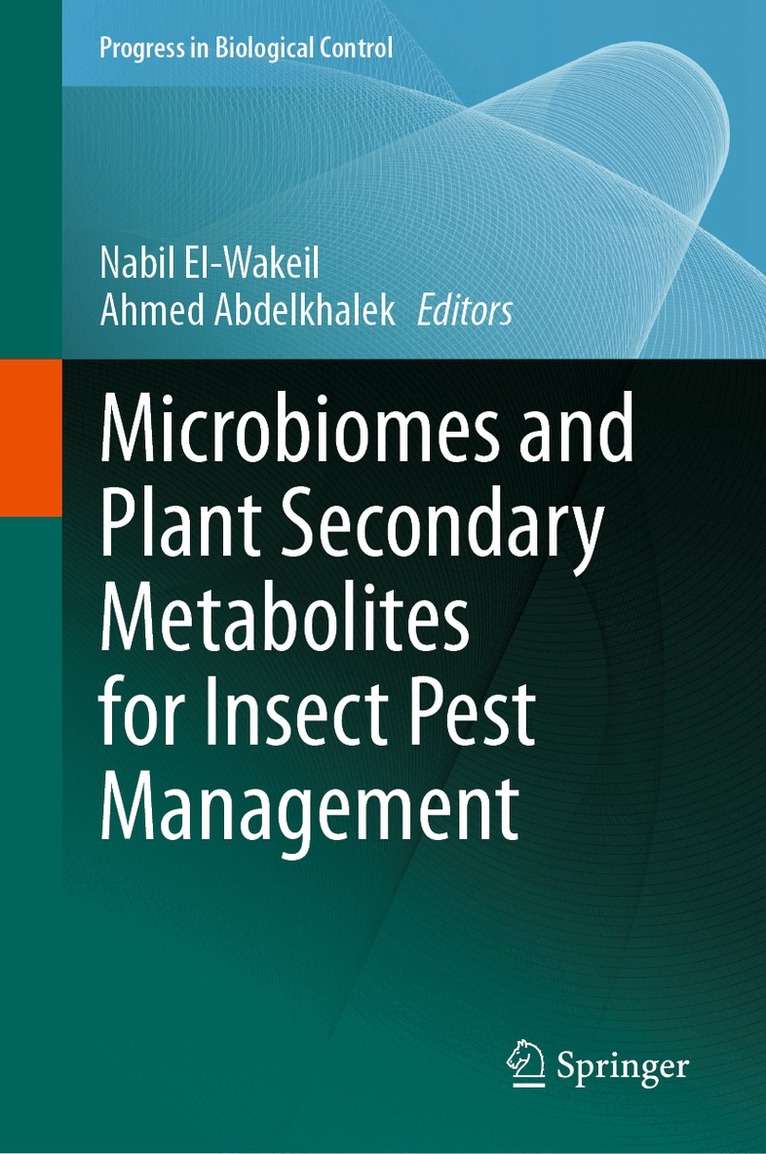
    Microbiomes and Plant Secondary Metabolites for Insect Pest Management

    AvNabil El-Wakeil,Ahmed Abdelkhalek

    Inbunden, Engelska, 2026

    Del 23 i serien Progress in Biological Control

    1 842 kr

    Beställningsvara. Skickas inom 10-15 vardagar. Fri frakt över 249 kr.

    Beskrivning

    This comprehensive volume explores sustainable crop protection through the intricate relationships between plants, their chemistry, and microbial communities. It presents advances in understanding plant defense mechanisms against insect pests, offering a roadmap toward reducing chemical pesticide dependence.The book examines the dual defense systems plants employ against insect pests. It explores how secondary metabolites, including alkaloids, terpenoids, and flavonoids, function as natural deterrents while attracting beneficial organisms like parasitoids and pollinators. It also investigates herbivore-associated bacteria in plant-insect interactions, revealing how host plants shape gut bacterial communities of damaging insects such as aphids, beetles, weevils, and bugs.Unlike conventional texts treating plant chemistry and microbiology separately, this volume integrates both perspectives for a holistic understanding of crop immunity. It bridges fundamental plant science and practical applications, demonstrating how specialized metabolism and phytomicrobiomes work together to create resilient agricultural systems. The focus on symbiotic relationships and their manipulation for pest suppression represents a paradigm shift in sustainable agriculture.Readers will discover how secondary metabolic compounds provide natural protection against serious insect pests and the mechanisms by which plants influence insect gut bacteria. The book presents strategies for enhancing crop resistance through manipulation of plant secondary metabolism, along with practical applications of phytomicrobiomes for improving soil health, plant vigor, and pest suppression. It also addresses the ecological roles of beneficial organisms in creating balanced agricultural ecosystems.This reference serves academics and researchers in entomology, plant science, and agricultural biotechnology seeking cutting-edge knowledge for sustainable pest management. Educators will find it valuable for teaching advanced concepts in plant defense mechanisms, chemical ecology, and integrated pest management at graduate and postgraduate levels. Agricultural practitioners, extension specialists, and policymakers will discover evidence-based approaches to reducing pesticide side effects while maintaining productive farming systems that protect human health, animals, and beneficial insects like bees.

    Produktinformation

    • Utgivningsdatum:2026-07-12
    • Mått:155 x 235 x 35 mm
    • Vikt:984 g
    • Format:Inbunden
    • Språk:Engelska
    • Serie:Progress in Biological Control
    • Antal sidor:532
    • Förlag:Springer Nature Switzerland AG
    • ISBN:9783032243294

    Utforska kategorier

    • Biologi inom Naturvetenskap och teknik
    • Växtböcker inom Djur och Natur
    • Botanik inom Naturvetenskap och teknik

    Mer om författaren

    Prof.Dr. Nabil Elwakeil, he is currently working as Professor of Biological Control of Insects in King Faisal University in Saudi Arabia. He has over 35 years of experience in the field of Entomology and Biological Control. He began his professional career at the National Research Centre in Cairo in 1993. He obtained his Ph.D. in Agricultural Sciences (Biological Control of Insects) from Georg August- Göttingen University in Germany in 2003 and has been working as a Professor of Biological Control of insect pests since June 2013. Dr. Elwakeil has extensive research and academic experience, including work and teaching at significant international universities such as Martin Luther University in Germany and the Texas A&M University - USA. He is currently working as a Professor of Entomology and Biological Control at King Faisal University in the Kingdom of Saudi Arabia. He has participated in international projects in the field of biological control and studying the impact of genetically engineered crops on natural enemies. His distinguished scientific contributions include nearly 60 research papers published in international journals, and he has co-authored 10 books on integrated pest management for strategic crops such as cotton, wheat, corn, grapes, and potatoes.His Most Prominent Areas of Expertise Include:Mass rearing and production of natural enemies (especially the parasitoid Trichogramma).Studying the behavior of insect parasitoids and their interaction with plant hosts.Studying the impact of genetically engineered plants on insects and natural enemies.Using predators (such as lady beetle and aphid lions), parasitoids, and entomopathogenic nematodes in biological control.Studying the effect of plant morphological and chemical characteristics on the behavior of natural enemies.Prof. Dr. Ahmed Abdelkhalek is Professor of Molecular Plant Pathology at the City of Scientific Research and Technological Applications (SRTA-City), Egypt. His research focuses on plant virology, molecular biology, biotechnology, and biological control, particularly plant–microbe interactions and sustainable management of plant pathogens. His work includes antiviral strategies, green nanotechnology, microbial biocontrol, and plant defense mechanisms. He has published more than 100 peer-reviewed papers and has led and contributed to funded projects on antiviral compounds, rhizobial interactions, and eco-friendly biocontrol of plant pathogens. He has held postdoctoral appointments in India, Slovakia, and Poland. In 2020, he received the State Incentive Award in Advanced Technological Sciences (Agricultural Sciences) and was included in Stanford University’s list of the world’s top 2% scientists in 2023, 2024, and 2025.

    Innehållsförteckning

    • Part I Phytomicrobiome and Insect Microbiome for pest's Management.- The Role of Tree-Insect-Microbiome Interactions in Herbivory and Applications in Pest Management.- Tri-trophic Interactions: The Role of the Plant and Insect Microbiome in Shaping Pest-Parasitoid Dynamics.- Use of Plant Beneficial Microbes to Control Bayoud Disease in Date Palms.- Effect of Plant-Microbiome on Plant Physiology to Overcome Climate Changes.- The Interconnected Microbiomes of Plants and Insects: Implications for Yield Quality and Pest Management.- The Plant Microbiome: An Engine for Sustainable Crop Growth and Yield.- Effeteness of Microbiota of Honeybees on Their Activities and Productivity.- Part II Secondary Metabolism of Plants for Managing the Agricultural Pests.- Using Plant Metabolic Products to Develop Relationship among Plants, Insect Pests and their Natural Enemies.- Efficiency of Plant Metabolic Products on Insect Pests and their Parasitoids. Role of Secondary Metabolites in Plant Defense and their effects on Insect Pests and Predatory Arthropods.- Efficiency of Plant Metabolic Products on Insect Pests and the Associated Entomopathogenic Organisms.- Efficacy of Plant Metabolic Products to Suppress the Plant Pathogenic Nematodes.- Efficacy of Plant Metabolic Products to Suppress the Plant Pathogenic Fungi.- Efficacy of Plant Metabolic Products to Suppress Plant Pathogens Organisms.- Efficacy of Plant Metabolic Products to Suppress Plant Pathogens Organisms.- Antifungals Produced by Bacteria and their Role in Biological Control.- Biological Control of Viruses Using Actinomycetes Species.- Effect of Mineral Nutrition and Metabolic Products on Barley Yield Under Drought Conditions.- Part III Conclusions.- Synthesis and Future Directions.