• Fri frakt över 249 kr
  • •
  • Snabba leveranser
  • •
  • Billiga böcker
Kundservice

Du är på sajten för privatpersoner.

Företag, bibliotek eller offentlig verksamhet?

Du handlar på classic.bokus.com, där alla dina funktioner finns intakta.
Till classic.bokus.com
Bokus logotyp. Gå till startsidan.
  • Erbjudanden
  • Nyheter
  • Student
  • Topplistor
  • Barn & ungdom
  • Bokus Play
  • E-böcker
  • Pocketböcker
  • Spel & pussel

10% rabatt på allt med kod: NYSTART10 →

Sidfot

Mina sidor

    Hjälp

    • Kundservice
    • Vanliga frågor och svar
    • Frakt och leverans
    • Retur vid ångerrätt
    • Reklamera vara
    • Betalning
    • Köpvillkor
    • Allmänna villkor
    • Information om webbplatsens tillgänglighet

    Om Bokus

    • Om oss
    • Pressrum
    • För studenter
    • För företag
    • För bibliotek och offentlig verksamhet
    • För leverantörer
    • Hållbarhet

    Populärt

    • Aktuella erbjudanden
    • Presentkort
    • Studentlitteratur
    • Nya böcker
    • Topplistor
    • Signerade böcker
    • Engelska böcker

    Inspiration

    • Boktips
    • BookTok
    • Populära bokserier
    • Barnbokskaraktärer
    • Populära författare
    Logotyp för Bokus
    Följ oss på Facebook (extern länk)Följ oss på Instagram (extern länk)Följ oss på YouTube (extern länk)Följ oss på TikTok (extern länk)
    bokus @ CookiesAnpassa cookiesIntegritetspolicyKöpvillkor
    Till Citymail hemsida (extern länk)Till Budbee hemsida (extern länk)Till Postnord hemsida (extern länk)Till Schenker hemsida (extern länk)Till Early Bird hemsida (extern länk)Till Walleys hemsida (extern länk)
    1. Naturvetenskap och teknik
    2. Matematik och naturvetenskap
    3. Biologi

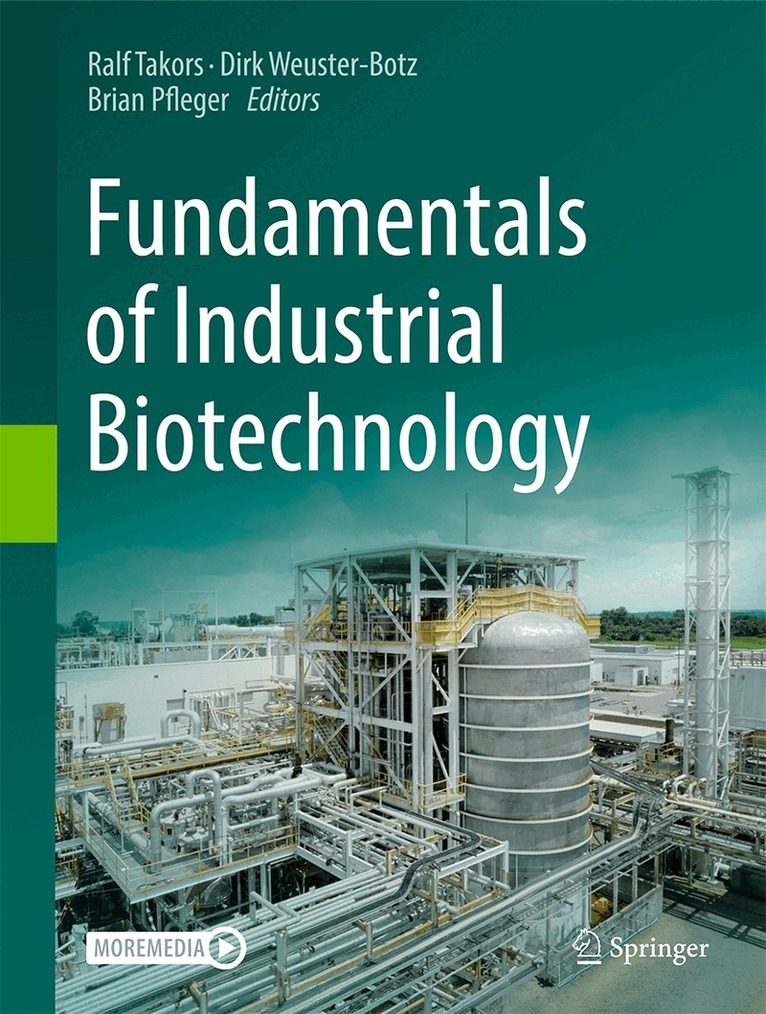
    Fundamentals of Industrial Biotechnology

    AvRalf Takors,Dirk Weuster-Botz

    Inbunden, Engelska, 2026

    2 329 kr

    Kommande

    Beskrivning

    This book aims to teach the fundamentals of industrial biotechnology to everyone, regardless of their perspective, and to highlight the importance of biotechnology throughout human history, where biological processes have been used to solve societal problems. From alcohol fermentation to food preservation to the production of natural medicines, biotechnology has had a staggering impact on society. It offers a comprehensive overview of both molecular sciences and bioprocess engineering to empower a new generation of biotechnologists with the skills needed to translate innovative ideas into industrial practice. The textbook is aimed at bachelor's and master's students in bioprocess engineering, biotechnology, microbiology, etc., as well as postgraduates from other disciplines who are entering the field as professionals. The textbook brings together fundamental knowledge of both biology and bioprocess engineering, providing a set of essential criteria that scientists, engineers and entrepreneurs should consider when planning the development of novel bioprocesses; the last section of the book includes an overview of state-of-the-art solutions to the most common problems in bioprocess development and includes successful examples of current production processes that can serve as motivation for readers to succeed. Importantly, exercises - along with online video material - are also included to test the success of individual learning.

    Produktinformation

    • Utgivningsdatum:2026-10-17
    • Mått:210 x 279 x undefined mm
    • Format:Inbunden
    • Språk:Engelska
    • Antal sidor:550
    • Förlag:Springer Nature Switzerland AG
    • ISBN:9783032256614

    Utforska kategorier

    • Biologi inom Naturvetenskap och teknik
    • Biokemisk teknik inom Naturvetenskap och teknik

    Mer om författaren

    Ralf Takors received his Dr.-Ing. from RWTH Aachen University in 1997 in the field of bioprocess engineering and his venia legendi (habilitation) in 2004 in the field of metabolic engineering, both based on his research work at the Institute of Biotechnology at Forschungszentrum Jülich GmbH. In 2001, he was awarded the Young University Teacher Prize by DECHEMA e.V. He then moved to Evonik Degussa GmbH, where he was responsible for bioprocess development in the Health & Nutrition business unit until mid-2009. Since July 2009, he has headed the Institute for Biochemical Engineering at the University of Stuttgart (www.ibvt.uni-stuttgart.de). He was co-chair of the ‘Bioprocess Engineering’ section of DECHEMA e.V. from 2014 to 2024. Since 2020, he has been an appointed member of the Baden-Württemberg State Bioeconomy Council and the ‘Microbial Biotechnology’ division board of the European Federation of Biotechnology, and since 2021, he is a member of the German Academy of Science and Engineering. Since 2024, he is also an elected member of the German Science Foundation (DFG). At the University of Stuttgart, he also represents the Stuttgart Research Partnership ‘Valorisation of Bioresources, ValBio’. Ralf has (co-) authored more than 170 peer reviewed publications and has filed and received more than 20 patents. Besides, Ralf co-edited multiple textbooks and book chapters.Dirk Weuster-Botz, Chemical Engineer by education, received his Dr.-Ing. from the University of Karlsruhe in 1991 in the field of Biochemical Engineering and his postdoctoral lecture qualification (habilitation) on Environmental and Bioprocess Engineering in 1999 from RWTH Aachen. The research work for both qualifications was conducted at the Institute of Biotechnology, headed by Christian Wandrey, at the Research Center Jülich, interrupted by an industrial research stay at DSM in Geleen (Netherlands). In 2000, he was appointed as a full professor and head of the Chair of Biochemical Engineering (www.epe.ed.tum.de/biovt) at the Technical University of Munich (TUM). 2003 – 2009, he was chair of the Bioprocess Engineering section of GVC VDI (since 2007 co-chair of the joint section of GVC VDI / DECHEMA e.V.). From 2008 to 2011, he served on the review board for Biological Process Engineering at the German Research Foundation (DFG). Since 2011, he has chaired the newly founded inter-facultative Master’s program Industrial Biotechnology at TUM. In 2012, he was elected as a member of the National Academy of Science and Engineering (acatech). Since 2014, he has been the director of the TUM – Pilot for Industrial Biotechnology. Dirk Weuster-Botz served as Editor-in-Chief of the scientific journal ‘Bioprocess and Biosystems Engineering’ (2005 – 2025) and is (co-)author of more than 270 peer-reviewed publications, as well as many patents and book chapters. Since 2025, he has been retired.Brian Pfleger received his bachelor’s degree in Chemical Engineering from Cornell University and earned his PhD in Chemical Engineering from the University of California-Berkeley. Brian was a postdoctoral fellow at the University of Michigan for two years before starting his career at UW-Madison. Brian is currently the Karen and William Monfre Professor of Chemical and Biological Engineering at UW-Madison with an appointment in the Microbiology Doctoral Training Program. Brian’s research group uses systems and synthetic biology approaches to develop biocatalysts for production of small molecules. His group has published over 120 articles, and 10 patents. Brian served on the Board of Directors for the Society of Industrial Microbiology and Biotechnology, the ACS BIOT Division, and the International Metabolic Engineering Society. Brian’s research has been recognized with awards from 3M, the Alexander von Humboldt Foundation (Bessel Research award), NSF (CAREER), DOE (Early Career), the Air Force Office of Scientific Research (AFOSR-YIP), Biotechnology and Bioengineering (Daniel IC Wang Award), the Society of Industrial Microbiology and Biotechnology, the American Chemical Society BIOT Division (2018 YI Award), and Purdue University (Mellichamp lectureship). Brian also received the Benjamin Smith Reynolds teaching award from the UW-Madison College of Engineering for his efforts to introduce undergraduates to biotechnology.

    Innehållsförteckning

    • 1 Biomolecules.- 1.1 The central dogma of biology.- 1.2 Building blocks of cells.- 1.3 Nucleic acids.- 1.4 Proteins .- 1.5 Sugars .- 1.6 Storage Polymers .- 1.7 Biological membranes .- 1.8 Vitamins .- 1.9 The link between biomolecules and metabolism .- 2 Metabolism - Microbial Metabolism.- 2.1 Forms of Energy.- 2.2. Central Metabolic Pathways .- 2.3. Nitrogen, Sulfur, and Phosphorus Assimilation .- 3 Microbial communities.- 3.1 Introduction.- 3.2 Why use microbial communities for biotechnology?.- 3.3 Understanding how microbial communities come together.- 3.4 Engineering the function of microbial communities.- 4 Enzyme Kinetics.- 4.1 Nomenclature and Classification of Enzymes.- 4.2 Reaction Orders.- 4.3 Ligand Binding.- 4.4 Kinetics of Single-Substrate Reactions.- 4.5 Determination of Kinetic Parameters .- 4.6 Modulators of Enzymatic Activity .- 4.7 Enzyme Stability .- 4.8 Empirical, semi-mechanistic and mechanistic models .- 4.9 Regulatory Enzymes .- 4.10. Kinetics of Multi-Substrate Reactions .- 5 Growth Kinetics.- 5.1 Introduction.- 5.2 Growth Models.- 5.3 Growth Curve.- 5.4 Non-structured Growth Models.- 5.5 Growth Kinetics of Filamentous Microorganisms .- 5.6 Further Influencing Factors .- 6 Bioprocess Models.- 6.1 Introduction.- 6.2 Balancing of Homogeneously Mixed Reactors.- 6.3 Special Operating Modes of Homogeneously Mixed Reactors .- 6.4 Oxygen Transfer .- 6.5 Plug Flow Reactor .- 6.6 Bubble Column and Airlift Reactor .- 6.7 Diffusion in Cell and Enzyme Layers .- 6.8 Non-Ideal Bioreactors .- 6.9 Identification of Model Parameters .- 7 Bioreactors.- 7.1 Bioreactors – Tasks and Classification.- 7.2 Stirred Tank Bioreactors - Power Input via Mechanically Moved Installations.- 7.3 Bubble Column Bioreactors - Power Input via Gas Expansion.- 7.4 Bioreactors with Power Input via Circulation with Pumps.- 7.5 Parallel Bioreactors for the Bioprocess Development.- 7.6 Single-Use Bioreactors.- 8 Recommendations for Designing a Biomanufacturing Project.- 8.1 Introduction.- 8.2 The Strategic Alignment.- 8.3 Scheduling the Project .- 8.4 The Economic Perspective .- 9 Protein Engineering.- 9.1 Proteins have engineerable properties with utility in industry and medicine.- 9.2 Engineerable properties on proteins of use for industrial processes.- 9.3 Generating genetically modified proteins and libraries.- 9.4 Directed evolution approaches for engineering proteins.- 9.5 Medium and high-throughput screening and selection platforms.- 9.6 Rational and computational approaches for engineering proteins.- 10 Synthetic Biology.- 10.1 Recombinant DNA technology.- 10.2 Common cloning strategies.- 10.3 Genome integration.- 10.4 DNA synthesis.- 10.5 DNA sequencing.- 10.6 Regulation of genetic elements.- 11 Systems Metabolic Engineering.- 11.1 What is metabolic engineering?.- 11.2 Metabolic Flux.- 11.3 Pathway Thermodynamics.- 11.4 Altering Enzyme Activity.- 11.5 Leveraging Native Metabolism.- 11.6 Environmental Factors Influence Pathway Fluxes.- 11.7 Modeling at the Metabolic Level.- 12 Computational Bioreactor Design.- 12.1 Basics of Mass Transfer.- 12.2 Multi-Phase Flow Models.- 12.3 Implementation by Computational Design Tools.- 12.4 Basics of Heat Transfer.- 13 Sterilization and Sterile Design.- 13.1 Introduction.- 13.2 Sterilization by Inactivation.- 13.3 Sterilization by Removal – Membrane Filtration.- 13.4 Sterile Design Principles.- 14 Bioprocess Analytics and Control.- 14.1 Bioprocess System Theory.-14.2 Sensor Fundamentals.- 14.3 Hardware Sensors.- 14.4 Soft Sensors.- 14.5 Strategies for Bioprocess Control.- 15 Downstream Processing.- 15.1 Introduction.-15.2 Harvest & Capture.- 15.3 Purification & Polishing.- 15.4 Process Development & Processing modes.- 16 Enzymatic Processes.- 16.1 Basic Considerations for Enzymatic Production Processes.- 16.2 Industrial Implementation of Biocatalysis Exemplified by Lipase.- 16.3 Cross-linked Enzyme Aggregates.- 16.4 Carrier-fixed Enzymes.- 16.5 Enzyme Encapsulation.- 16.6 Whole Cells.- 16.7 Multiphase Systems.- 17 Microbial Processes.- 17.1 Hallmarks of Biotechnology and Biochemical Engineering.- 17.2 Biochemical Engineering Today.- 18 Biotechnological Applications of Microbial Communities.- 18.1 Food fermentation.- 18.2 Environmental applications.- 19 Mammalian cell processes.- 19. 1 General introduction to mammalian cells.- 19.2 Different scales and modes of mammalian cell bioprocessing.- 19. 3 Mammalian cell culture media development.- 19. 4 Critical process parameters and critical quality attributes.- 19. 5 Process analytical technology and bioprocessing intensification.- 19. 6 Future perspectives for mammalian cell processes.- 20 Excercises& Solutions.