• Fri frakt över 249 kr
  • •
  • Snabba leveranser
  • •
  • Billiga böcker
Kundservice

Du är på sajten för privatpersoner.

Företag, bibliotek eller offentlig verksamhet?

Du handlar på classic.bokus.com, där alla dina funktioner finns intakta.
Till classic.bokus.com
Bokus logotyp. Gå till startsidan.
  • Erbjudanden
  • Nyheter
  • Student
  • Topplistor
  • Barn & ungdom
  • Bokus Play
  • E-böcker
  • Pocketböcker
  • Spel & pussel

10% studentrabatt med kod TERM26

Sidfot

Mina sidor

    Hjälp

    • Kundservice
    • Vanliga frågor och svar
    • Frakt och leverans
    • Retur vid ångerrätt
    • Reklamera vara
    • Betalning
    • Köpvillkor
    • Allmänna villkor
    • Information om webbplatsens tillgänglighet

    Om Bokus

    • Om oss
    • Pressrum
    • För studenter
    • För företag
    • För bibliotek och offentlig verksamhet
    • För leverantörer
    • Hållbarhet

    Populärt

    • Aktuella erbjudanden
    • Presentkort
    • Studentlitteratur
    • Nya böcker
    • Topplistor
    • Signerade böcker
    • Engelska böcker

    Inspiration

    • Boktips
    • BookTok
    • Populära bokserier
    • Barnbokskaraktärer
    • Populära författare
    Logotyp för Bokus
    Följ oss på Facebook (extern länk)Följ oss på Instagram (extern länk)Följ oss på YouTube (extern länk)Följ oss på TikTok (extern länk)
    bokus @ CookiesAnpassa cookiesIntegritetspolicyKöpvillkor
    Till Citymail hemsida (extern länk)Till Budbee hemsida (extern länk)Till Postnord hemsida (extern länk)Till Schenker hemsida (extern länk)Till Early Bird hemsida (extern länk)Till Walleys hemsida (extern länk)
    1. Samhälle och politik
    2. Samhälle och kultur
    3. Kultur och medier
    4. Referensverk och tvärvetenskap

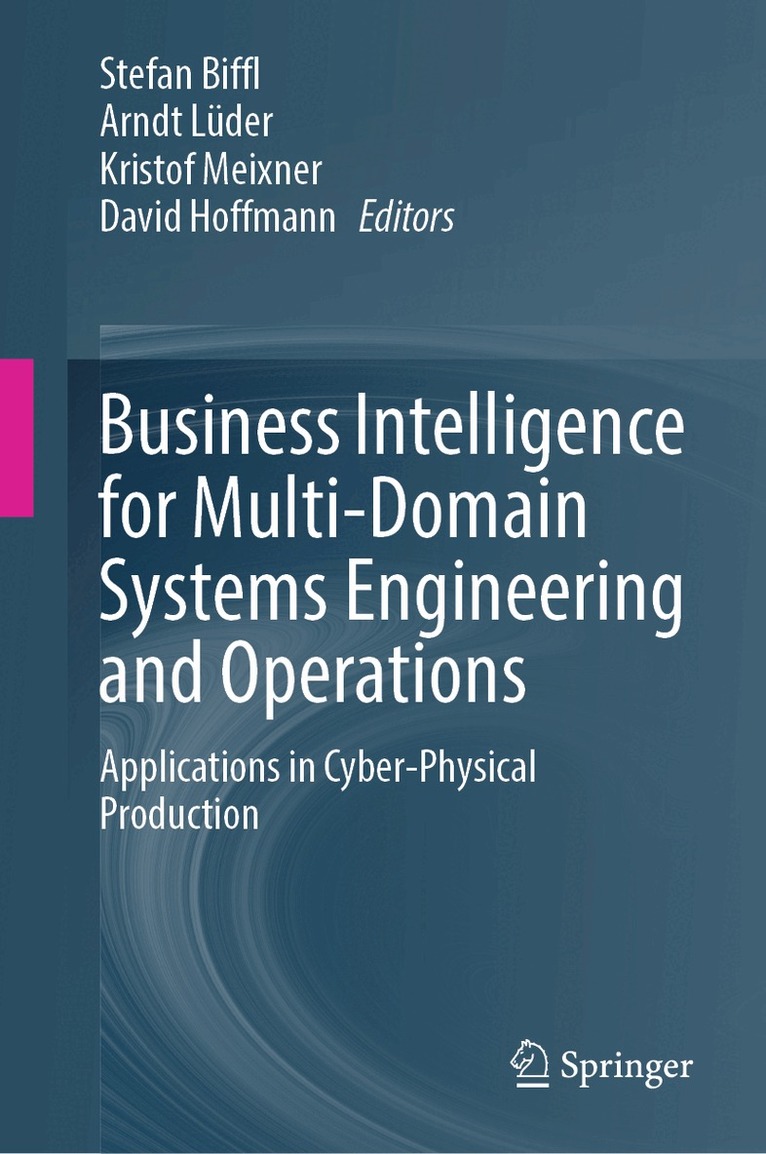
    Business Intelligence for Multi-Domain Systems Engineering and Operations

    Applications in Cyber-Physical Production

    AvStefan Biffl,Arndt Lüder

    Inbunden, Engelska, 2026

    2 121 kr

    Kommande

    Beskrivning

    This book aims at capabilities for knowledge representation, collection, and integration required for business intelligence for multi-domain systems engineering and operation with applications in cyber-physical production. This book builds on established domain standards and guidelines, such as ISO 9000 quality improvement; the widely used cross-industry standard process for data mining (CRISP-DM) open standard process model to inform quality improvement; multi-disciplinary configuration management and reuse guidelines (VDI 3695) to define system configurations and engineering processes; multi-domain production engineering data on (i) products, (ii) production processes, and (iii) resources to conduct and automate production (VDI 3682) to link knowledge on product, processes and resources (PPR); the AutomationML standard (IEC 62714) to represent systems engineering knowledge independent of technologies; IT security improvement guideline (VDI 2182) to link systems engineering and operation to IT security; and failure mode and effects analysis (FMEA) (DIN 60812) to explore root causes of effects in systems engineering and operation.To connect business intelligence for quality improvement with the required multi-domain knowledge and data on systems engineering and operation, this book consists of three main parts (1) Digital transformation based on business intelligence in multi-domain systems engineering and operation; (2) Information systems engineering for business and quality improvement; and (3) Multi-domain data refinery to provide the high-quality data required for business intelligence.

    Produktinformation

    • Utgivningsdatum:2026-08-31
    • Mått:155 x 235 x undefined mm
    • Format:Inbunden
    • Språk:Engelska
    • Antal sidor:583
    • Förlag:Springer Nature Switzerland AG
    • ISBN:9783032257963

    Utforska kategorier

    • Referensverk och tvärvetenskap inom Samhälle och politik
    • Elektronik och kommunikationer inom Naturvetenskap och teknik
    • Programvaruutveckling inom Data och IT

    Mer om författaren

    Stefan Biffl is an Associate Professor for Software Engineering at TU Wien with PhD and MS degrees in computer science from TU Wien and an MS in social and economic sciences from University of Vienna. His research focuses on multi-domain engineering of cyber-physical production systems (Industry 4.0), software and systems engineering, and empirical software engineering. He investigates model-driven methods, software architecture, and value-based software engineering to facilitate consistent engineering processes across domains. He headed the Christian Doppler Laboratory for Software Engineering Integration for Flexible Automation and has co-authored more than 200 publications and multiple books on software engineering topics.Prof. Dr.-Ing. habil. Arndt Lüder studied mathematics and economical mathematics at Otto-von-Guericke University Magdeburg, Germany, and completed his PhD in engineering sciences 2000 at Martin-Luther-University Halle, Germany. He habilitated in 2007. Since 2001 he is working at the Faculty Mechanical Engineering at Otto-von-Guericke University. He is currently acting head of the chair of production systems and automation. His research focus is on application of innovative technologies in areas of factory automation such as Industry 4.0 systems, agents and mechatronic concepts enhancing engineering processes and technologies. He is involved in national and international standardization within GMA, AutomationML, DKE and IEC.David Hoffmann is a researcher in production systems engineering at OvGU Magdeburg with an M.Sc. in Digital Engineering. His work is focused on model-based systems engineering and multidisciplinary production system design. His research investigates the integration of model-driven methods to enable consistent, scalable, and interoperable engineering processes across domains. He explores how digital models can support system understanding, traceability, and decision-making throughout the lifecycle of complex production systems. His research further addresses the alignment of engineering methodologies with emerging digital technologies, e.g., via AutomationML, to improve efficiency, adaptability, and reproducibility in industrial and academic contexts.Kristof Meixner is a Senior Scientist in Software Engineering at TU Wien with a PhD in Computer Science (2024). His research focuses on software product line engineering, variability modeling and management, and process improvement for software-intensive systems. He investigates multi-domain modeling and reusable solution patterns, and how software engineering principles can be combined with AI/ML to enable scalable, reproducible engineering and research processes. Within the dataTUdiscovery project, he contributes to integrating AI/ML into scientific workflows across disciplines.

    Innehållsförteckning

    • 1. Introduction to Business Intelligence for Multi-Domain Systems Engineering and Operation.- Part I: Digital Transformation Based on Business Intelligence in Multi-Domain Systems Engineering and Operation.- 2. Holistic Transformation Strategy towards Digital Engineering Processes.- 3. Digital Transformation for Small and Medium-sized Enterprises.- 4. Lean Engineering in Production Engineering: How to Reduce Data Waste in Multi-domain Production Systems Engineering.- 5. Business Intelligence for Value-based Process and Systems Engineering and Operation with procan.do.-  Part II: Information Systems Engineering for Business and Quality Improvement.- 6. Production Knowledge Graphs as a Semantic Foundation for Contextualized Quality Analytics.- 7. Stakeholder-oriented and Efficient Production Data Acquisition and Analysis.- 8. Product Digital Twin for Electric Vehicle Batteries to Improve Business and Sustainability.- 9. Business Intelligence for Risk Analysis in Engineering and Adapting Cyber-Physical Production Systems.- 10. Structured Field Test Execution for Drone Missions.- 11. Designing Hierarchical Digital Twins for Multi-Domain System Engineering and Business Intelligence.- Part III: Multi-Domain Data Refinery – Applications from Cyber-Physical Production.- 12. Facilitating Continuous Improvement with Product–Process–Resource Modeling.- 13. Common Data Model for Cross-Disciplinary Data Management.- 14. Engineering Data Logistics for Multi-Domain Production Systems: Towards Seamless and Consistent Data Exchange.- 15. A Guideline to Support the Digitization of Production Systems by Selecting the Right Runtime Data.- 16. A System Architecture Modeling Framework Utilizing Model-Based Systems Engineering for Evolving Flexible Production Systems.- 17. Outlook on Business Intelligence for Multi-Domain Systems Engineering and Operation.