• Fri frakt över 249 kr
  • •
  • Snabba leveranser
  • •
  • Billiga böcker
Kundservice

Du är på sajten för privatpersoner.

Företag, bibliotek eller offentlig verksamhet?

Du handlar på classic.bokus.com, där alla dina funktioner finns intakta.
Till classic.bokus.com
Bokus logotyp. Gå till startsidan.
  • Erbjudanden
  • Nyheter
  • Student
  • Topplistor
  • Barn & ungdom
  • Bokus Play
  • E-böcker
  • Pocketböcker
  • Spel & pussel

10% rabatt på allt med kod: NYSTART10 →

Sidfot

Mina sidor

    Hjälp

    • Kundservice
    • Vanliga frågor och svar
    • Frakt och leverans
    • Retur vid ångerrätt
    • Reklamera vara
    • Betalning
    • Köpvillkor
    • Allmänna villkor
    • Information om webbplatsens tillgänglighet

    Om Bokus

    • Om oss
    • Pressrum
    • För studenter
    • För företag
    • För bibliotek och offentlig verksamhet
    • För leverantörer
    • Hållbarhet

    Populärt

    • Aktuella erbjudanden
    • Presentkort
    • Studentlitteratur
    • Nya böcker
    • Topplistor
    • Signerade böcker
    • Engelska böcker

    Inspiration

    • Boktips
    • BookTok
    • Populära bokserier
    • Barnbokskaraktärer
    • Populära författare
    Logotyp för Bokus
    Följ oss på Facebook (extern länk)Följ oss på Instagram (extern länk)Följ oss på YouTube (extern länk)Följ oss på TikTok (extern länk)
    bokus @ CookiesAnpassa cookiesIntegritetspolicyKöpvillkor
    Till Citymail hemsida (extern länk)Till Budbee hemsida (extern länk)Till Postnord hemsida (extern länk)Till Schenker hemsida (extern länk)Till Early Bird hemsida (extern länk)Till Walleys hemsida (extern länk)
    1. Naturvetenskap och teknik
    2. Matematik och naturvetenskap
    3. Biologi
    4. Biokemi

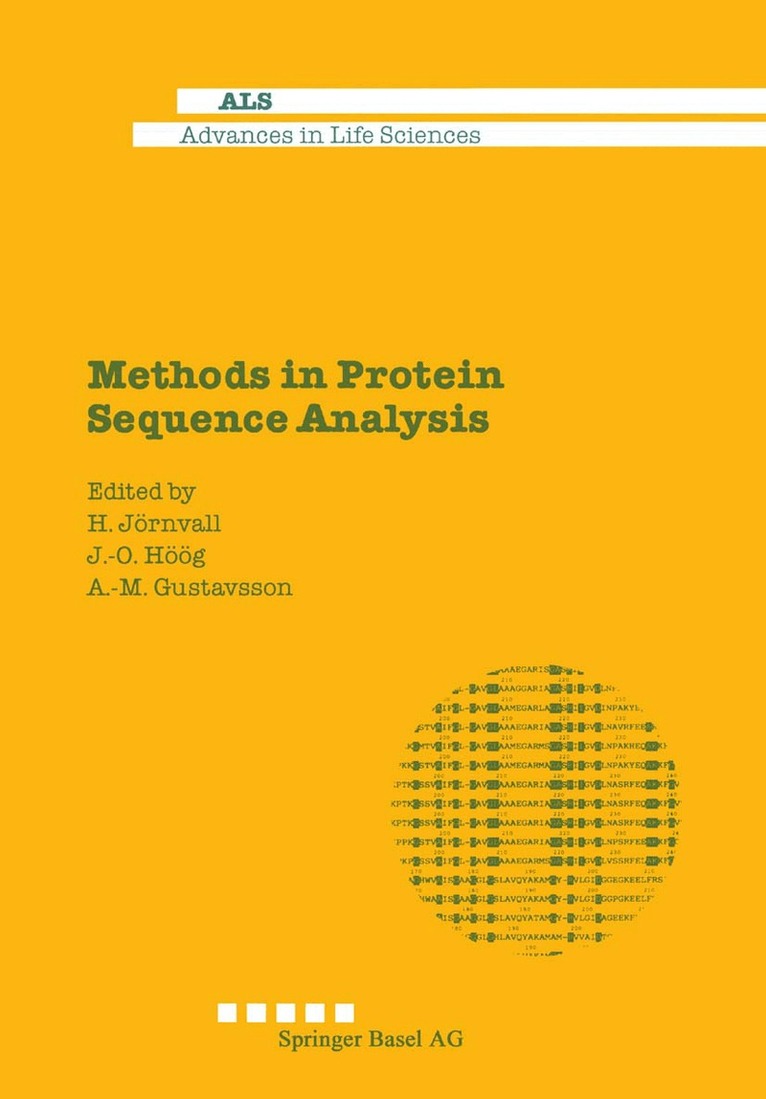
    Methods in Protein Sequence Analysis

    AvJörnvall,Höög

    Häftad, Engelska, 2014

    Del i serien Advances in Life Sciences

    547 kr

    Beställningsvara. Skickas inom 10-15 vardagar. Fri frakt över 249 kr.

    Beskrivning

    Methods in protein sequence analysis constitute important fields in rapid progress. We have experienced a continuous increase in analytical sensitivity coupled with decreases in time necessary for purification and analysis. Several generations of sequencers, liquid/solid/gas-phase, have passed by and returned in other shapes during just over two decades. Similarly, the introduction of HPLC permitted an enormous leap forward in this as in other fields of biochemistry, and we now start to see new major advances in purification/analysis through capillary electrophoresis. Furthermore, progress in the field of mass spectrometry has matched that in chemical analysis and we witness continuous development, now emphasizing ion spray and other mass spectrometric approaches. In short, protein analysis has progressed in line with other developments in modern science and constitutes an indispensable, integral part of present-day molecular biology. Even the available molecular tools, in the form of proteases with different specificities, have increased in number, although we still have far to go to reach an array of "restriction proteases" like the sets of nucleases available to the molecular geneticist. Of course, conferences have been devoted to protein sequence analysis, in particular the MPSA (Methods in Protein Sequence Analysis) series, of which the 8th conference took place in Kiruna, Sweden, July 1-6 1990. Again, we witnessed much progress, saw new instruments, and experienced further interpretational insights into protein mechanisms and functions.

    Produktinformation

    • Utgivningsdatum:2014-08-23
    • Mått:170 x 244 x 23 mm
    • Vikt:708 g
    • Format:Häftad
    • Språk:Engelska
    • Serie:Advances in Life Sciences
    • Antal sidor:398
    • Förlag:Springer Basel
    • ISBN:9783034856805

    Utforska kategorier

    • Biokemi inom Naturvetenskap och teknik

    Innehållsförteckning

    • Sequencer Methodology and Instrumentation.- Modular Berlin Microsequencer for the Sequential Degradation of Proteins and Peptides from the Amino- and Carboxyl-Terminal End.- C-Terminal Sequence Analysis.- Chemical C-Terminal Sequencing.- Extending the Performance of the Solid-Phase Protein Sequencer.- Direct Microsequencing of Blotted and Covalently Attached Proteins in a Cross-Flow Reaction Chamber.- Sample Preparation and Analysis.- Current Strategies for Microscale Purification of Protein and Peptides for Sequence Analysis.- Capillary Electrophoresis: A New Dimension in the Separation Sciences.- Structural Analysis of Membrane Proteins.- Protein-Electroblotting and Microsequencing in Establishing Integrated Human Protein Databases.- Comparison of the Blotting Efficiencies of Various PVDF Membranes.- Sensitive Determination of Amino Acid Derivatives from N-Terminal Sequence Analysis.- Amino Acid Analysis and Sequencing — What is State-of-the-Art?.- Realistic Expectations for Amino Acid Analysis.- Modified Residues, Chemical Problems and Synthetic Peptides.- A Protein Chemistry Approach to the Modelling of Integral Membrane Proteins.- N-Terminal Acetylated Mitochondrial Aldehyde Dehydrogenase is Found in Fresh but not Frozen Liver Tissue.- Elucidating Ligand Binding Sites in Polypeptides by Photoaffinity Labeling with Aryl Azides.- Use of Thiopropyl-Sepharose 6B for Isolation and Structure-Functional Analysis of Thiol Proteins.- Zinc Fingers Involved in MHC Class I Gene Regulation: Use of Synthetic Peptides for Structural Analysis.- Hydrophobic Surfactant Proteins SP-B and SP-C: Special Analytical Problems.- Proteolysis.- The Yeast Prohormone-Processing Kex2 Protease, an Enzyme with Specificity for Paired Basic Residues.- Structures of Three Inhibitor Complexes ofHIV-1 Protease.- Protease Specificity and Protein Sequence Analysis.- Cleavage-Sites in Protein Targeting Signals.- Studies on a Dimeric Aspartic Protease from a Single Domain of Pepsin.- Mass Spectrometry.- LC/MS and LC/MS/MS Screening for the Sites of Post-Translational Modification in Proteins.- Protein and Peptide Sequence Analysis by Tandem Mass Spectrometry in Combination with Either Capillary Electrophoresis or Micro-Capillary HPLC.- Plasma Desorption Mass Spectrometry as a Tool for Characterization of Native and Modified Forms of Recombinant Polypeptides.- Plasma Desorption Mass Spectrometry in Monitoring Peptide Synthesis and Phosphorylation Reactions.- Synergism with DNA Analysis.- Repeating Domains in the Plasma Proteins Participating in Blood Coagulation and Fibrinolysis.- Structural Analysis of the Glucocorticoid Receptor Protein.- C1? Inhibitor: Structure, Genetic Variants and Serpin Homologies.- Genetic Strategies for Protein Purification.- Predictions, Data Banks, Patterns and Tertiary Structures.- The Prediction of the Secondary Structure of Proteins.- A Computer Method of Finding Supersecondary Structures.- Usefulness of the PIR Database for Protein Comparisons.- The Structure and Post-Translational Modification of Lipoyl Domains in 2-Oxo Acid Dehydrogenase Multienzyme Complexes.- Zinc Chemistry in Function and Structure of Zinc Proteins.- Patterns of Sequence Variation in Families of Homologous Proteins.- Protein Folding: Local Structures, Domains and Assemblies.