• Fri frakt över 249 kr
  • •
  • Snabba leveranser
  • •
  • Billiga böcker
Kundservice

Du är på sajten för privatpersoner.

Företag, bibliotek eller offentlig verksamhet?

Du handlar på classic.bokus.com, där alla dina funktioner finns intakta.
Till classic.bokus.com
Bokus logotyp. Gå till startsidan.
  • Erbjudanden
  • Nyheter
  • Student
  • Topplistor
  • Barn & ungdom
  • Bokus Play
  • E-böcker
  • Pocketböcker
  • Spel & pussel

10% rabatt på allt med kod: NYSTART10 →

Sidfot

Mina sidor

    Hjälp

    • Kundservice
    • Vanliga frågor och svar
    • Frakt och leverans
    • Retur vid ångerrätt
    • Reklamera vara
    • Betalning
    • Köpvillkor
    • Allmänna villkor
    • Information om webbplatsens tillgänglighet

    Om Bokus

    • Om oss
    • Pressrum
    • För studenter
    • För företag
    • För bibliotek och offentlig verksamhet
    • För leverantörer
    • Hållbarhet

    Populärt

    • Aktuella erbjudanden
    • Presentkort
    • Studentlitteratur
    • Nya böcker
    • Topplistor
    • Signerade böcker
    • Engelska böcker

    Inspiration

    • Boktips
    • BookTok
    • Populära bokserier
    • Barnbokskaraktärer
    • Populära författare
    Logotyp för Bokus
    Följ oss på Facebook (extern länk)Följ oss på Instagram (extern länk)Följ oss på YouTube (extern länk)Följ oss på TikTok (extern länk)
    bokus @ CookiesAnpassa cookiesIntegritetspolicyKöpvillkor
    Till Citymail hemsida (extern länk)Till Budbee hemsida (extern länk)Till Postnord hemsida (extern länk)Till Schenker hemsida (extern länk)Till Early Bird hemsida (extern länk)Till Walleys hemsida (extern länk)
    1. Samhälle och politik
    2. Samhälle och kultur
    3. Kultur och medier
    4. Referensverk och tvärvetenskap

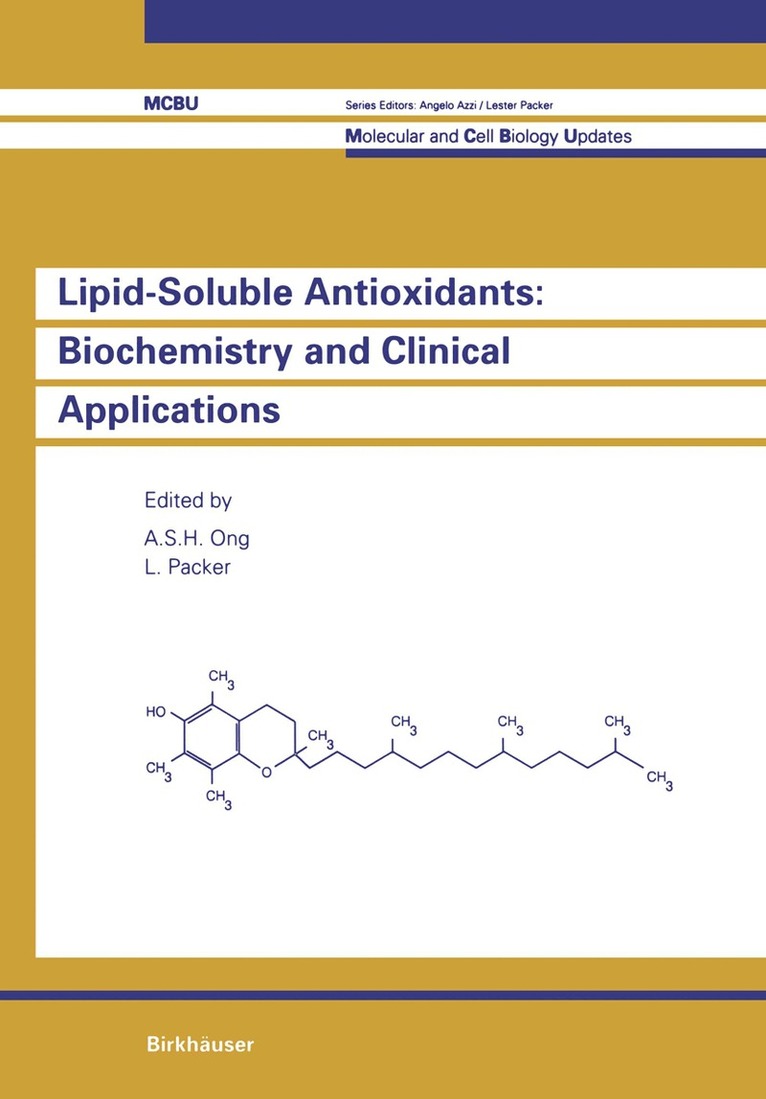
    Lipid-Soluble Antioxidants: Biochemistry and Clinical Applications

    AvONG,PACKER

    Häftad, Engelska, 2012

    Del i serien Molecular and Cell Biology Updates

    539 kr

    Beställningsvara. Skickas inom 10-15 vardagar. Fri frakt över 249 kr.

    Beskrivning

    Antioxidants inhibit the formation and spread of free radicals which can be damaging in biological systems. Free radicals form in biological systems through metabolism, but it is also realized that exogenous environmental sources, such as radiation, food, and drugs, contribute significantly to the generation of free radicals in biological systems. Being reactive species, free radicals are short-lived and do not travel far from cellular targets. Their concentration in biological systems is very low and is difficult to detect directly by electron spin resonance spectroscopy (ESR). Indirect methods of reactions of radicals with specific biomolecules are also sufficiently sensitive to detect quantitatively their presence. Thus the response of antioxidant defenses which react with radical species, can serve as an indirect measure that free radicals have been formed. Redox-based antioxidants change their oxidation state and antioxidants become free radicals themselves. Often, however, the antioxidants give rise to more persistent free radicals, sometimes owing to delocalization of the lone electron around ring structures (in vitamin E, ubiquinones, and certain carotenes). Persistent free radicals react only rarely and the precursors often can be regenerated in biological systems. In recent years, it is becoming clearer from biochemical studies on how the major lipophilic antioxidants work. Particular attention has been given to vitamin E and quinones found in animal and plant membranes and in carotenoids, for the protection of membranes in lipoprotein systems. Flavonoids form another rich and varied source of natural antioxidants.

    Produktinformation

    • Utgivningsdatum:2012-11-26
    • Mått:170 x 244 x 36 mm
    • Vikt:1 114 g
    • Format:Häftad
    • Språk:Engelska
    • Serie:Molecular and Cell Biology Updates
    • Antal sidor:642
    • Förlag:Springer Basel
    • ISBN:9783034874342

    Utforska kategorier

    • Referensverk och tvärvetenskap inom Samhälle och politik

    Innehållsförteckning

    • Vitamin E: Tocopherols and Tocotrienols and Ubiquinones.- New horizons in vitamin E research — The vitamin E cycle, biochemistry, and clinical applications.- The reactivity of tocotrienols and other lipid-soluble antioxidants towards peroxyl radicals.- Physical/chemical studies of vitamin E in membranes.- Synergistic effect of lipid hydroperoxyl radical scavenging and lipid hydroperoxide reduction in the inhibition of lipid peroxidation in biomembranes.- Determination of rate constants for antioxidant activity and use of the crocin assay.- Vitamin E in protection of oxidative impairment in endothelial and platelet functions.- Antioxidant effectiveness of tocopherol isomers.- Effect of vitamin E on metabolism of uremic low density lipoproteins in human monocyte-derived macrophage.- Difference of antioxidative effect between vitamin E and selenium.- Tocopherol and tocotrienol plasma transport and tissue concentrations: Implications for their relative biological functions.- Modulation of cell proliferation by tocopherols and tocotrienols: Role in arteriosclerosis.- Vitamin E and health in the marmoset monkey: A non-human primate model for nutritional research.- Antitumor and antioxidant activity of tocotrienols.- Tocopherols, carotenoids and the glutathione system.- Nutrition of tocotrienols and lipid metabolism.- Carotenoids, Flavonoids and Retinoids.- Carotenoids and vitamin A: An overview.- Metabolism of carotenoids by enzymes of oxygen metabolism.- Role of ?-carotene in disease prevention with special reference to cancer.- Anti-tumor and anti-tumor promoting activity of ?- and ?-carotene.- Production of palm oil carotenoid concentrate and its potential application in nutrition.- Carotenoids, novel polyene polyketones and new capsorubin isomers as efficientquenchers of singlet molecular oxygen.- Modification of alloxan diabetes in rats by vitamin A status.- Flavonoids in foods: Their significance for nutrition and health.- Studies on flavonoids and related compounds as antioxidants in food.- Autocoid-immunopharmacology of flavonoids.- Anticarcinogenicity of flavonoids as studied by inhibition of lipid peroxidation, microsomal degranulation and their interactions with benzo(a)pyrene metabolites.- Role of retinoids in modulating the molecular actions of environmental carcinogens.- Parasitic and Infectious Diseases.- Free radicals and antioxidants in malaria.- Oxygen free radicals in malaria.- The mechanism of antimalarial action of artemisinin (Qinghaosu).- Erythrocytic GSH level and stability in Plasmodium vivax malaria.- Plasma lipid peroxidation in P. falciparum malaria.- Presence, formation and function of ubiquinones Q6 and Q8 in filarial parasites.- Catalase activity in red cell and liver of mice infected with Plasmodium berghei.- Clinical Applications. Antioxidant Therapy.- The hypolipidaemic effect of different diets.- Epidemiological correlations between poor plasma levels of essential antioxidants and the risk of coronary heart disease and cancer.- Effect of different antioxidants in experimental myocardial infarction.- Lipid-soluble plant phenols as antioxidants and anti-mutagens.- Anti-cancer effects of cis-unsaturated fatty acids both in vitro and in vivo.- Clinical studies on polyunsaturated fatty acids and antioxidants in African children.- Dihydrolipoic acid is protective against reperfusion injury.- Effect of japanese herbal medicine, Sho-saiko-to-go-keishi-kashakuyaku-to (TJ-960) on aging.- Lipoprotein oxidation.- Hepatic lipid peroxidation in ethanol potentiated aflatoxin B1 hepatotoxicity.- Palm oil vitamin E effects in hypercholesterolemia.- Fat soluble antioxidant vitamins in cancer patients.- Butylated hydroxytoluene toxicity.- Effects of tocotrienols-rich vitamin E on patients with peripheral vascular disease.- Protection from air pollution injury by dietary vitamin E.