ONG - Böcker
Visar alla böcker från författaren ONG. Handla med fri frakt och snabb leverans.
5 produkter
5 produkter
1 420 kr
Skickas inom 5-8 vardagar
In the short time since the publication of the Handbook of Positive Psychology, research results on the psychology of human strengths have proliferated. However, no major volume has documented the methods and theory used to achieve these results. Oxford Handbook of Methods in Positive Psychology fills this need, providing a broad overview of diverse contemporary methods in positive psychology.With contributions from both leading scholars and promising young investigators, the handbook serves to illuminate and, at times, challenge traditional approaches. Incorporating multiple levels of analysis, from biology to culture, the contributors present state-of-the-art techniques, including those for estimating variability and change at the level of the individual, identifying reliability of measurements within and across individuals, and separating individual differences in growth from aspects of phenomena that exhibit shorter-term variability over time. The volume covers such topics as wisdom, health, hope, resilience, religion, relationships, emotions, well-being, character strengths, and laughter. It enhances our understanding of the balance between human deficits and strengths and demonstrated their connections to other problems.Oxford Handbook of Methods in Positive Psychology will be the essential reference for methods in positive psychology.
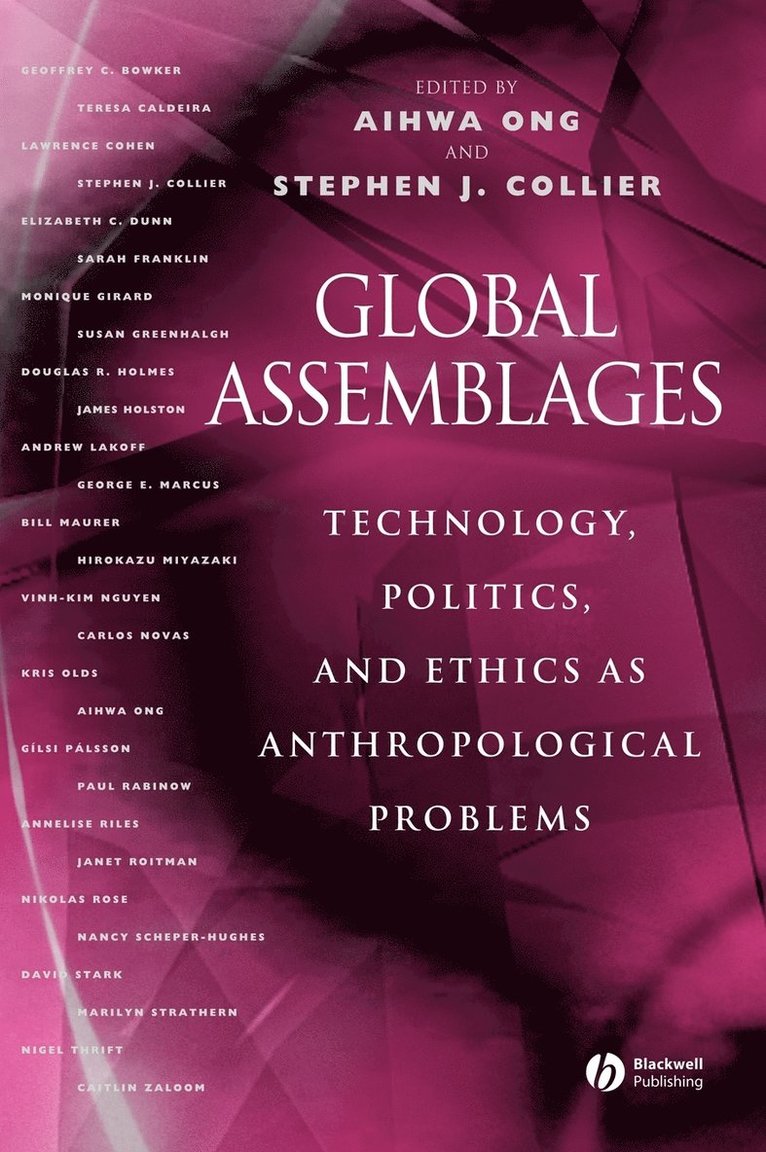
Global Assemblages
Technology, Politics, and Ethics as Anthropological Problems
Inbunden, Engelska, 2004
1 489 kr
Skickas inom 7-10 vardagar
Provides an exciting approach to some of the most contentious issues in discussions around globalization—bioscientific research, neoliberalism, governance—from the perspective of the "anthropological" problems they pose; in other words, in terms of their implications for how individual and collective life is subject to technological, political, and ethical reflection and intervention. Offers a ground-breaking approach to central debates about globalization with chapters written by leading scholars from across the social sciences. Examines a range of phenomena that articulate broad structural transformations: technoscience, circuits of exchange, systems of governance, and regimes of ethics or values. Investigates these phenomena from the perspective of the “anthropological” problems they pose. Covers a broad range of geographical areas: Africa, the Middle East, East and South Asia, North America, South America, and Europe. Grapples with a number of empirical problems of popular and academic interest — from the organ trade, to accountancy, to pharmaceutical research, to neoliberal reform.
Global Assemblages
Technology, Politics, and Ethics as Anthropological Problems
Häftad, Engelska, 2004
467 kr
Skickas inom 7-10 vardagar
Provides an exciting approach to some of the most contentious issues in discussions around globalization—bioscientific research, neoliberalism, governance—from the perspective of the "anthropological" problems they pose; in other words, in terms of their implications for how individual and collective life is subject to technological, political, and ethical reflection and intervention. Offers a ground-breaking approach to central debates about globalization with chapters written by leading scholars from across the social sciences. Examines a range of phenomena that articulate broad structural transformations: technoscience, circuits of exchange, systems of governance, and regimes of ethics or values. Investigates these phenomena from the perspective of the “anthropological” problems they pose. Covers a broad range of geographical areas: Africa, the Middle East, East and South Asia, North America, South America, and Europe. Grapples with a number of empirical problems of popular and academic interest — from the organ trade, to accountancy, to pharmaceutical research, to neoliberal reform.
Del 30 - IJURR Studies in Urban and Social Change Book Series
Worlding Cities
Asian Experiments and the Art of Being Global
Häftad, Engelska, 2011
270 kr
Skickas inom 7-10 vardagar
Worlding Cities is the first serious examination of Asian urbanism to highlight the connections between different Asian models and practices of urbanization. It includes important contributions from a respected group of scholars across a range of generations, disciplines, and sites of study. Describes the new theoretical framework of ‘worlding’Substantially expands and updates the themes of capital and cultureIncludes a unique collection of authors across generations, disciplines, and sites of studyDemonstrates how references to Asian power, success, and hegemony make possible urban development and limit urban politics
528 kr
Skickas inom 10-15 vardagar
Antioxidants inhibit the formation and spread of free radicals which can be damaging in biological systems. Free radicals form in biological systems through metabolism, but it is also realized that exogenous environmental sources, such as radiation, food, and drugs, contribute significantly to the generation of free radicals in biological systems. Being reactive species, free radicals are short-lived and do not travel far from cellular targets. Their concentration in biological systems is very low and is difficult to detect directly by electron spin resonance spectroscopy (ESR). Indirect methods of reactions of radicals with specific biomolecules are also sufficiently sensitive to detect quantitatively their presence. Thus the response of antioxidant defenses which react with radical species, can serve as an indirect measure that free radicals have been formed. Redox-based antioxidants change their oxidation state and antioxidants become free radicals themselves. Often, however, the antioxidants give rise to more persistent free radicals, sometimes owing to delocalization of the lone electron around ring structures (in vitamin E, ubiquinones, and certain carotenes). Persistent free radicals react only rarely and the precursors often can be regenerated in biological systems. In recent years, it is becoming clearer from biochemical studies on how the major lipophilic antioxidants work. Particular attention has been given to vitamin E and quinones found in animal and plant membranes and in carotenoids, for the protection of membranes in lipoprotein systems. Flavonoids form another rich and varied source of natural antioxidants.