• Fri frakt över 249 kr
  • •
  • Snabba leveranser
  • •
  • Billiga böcker
Kundservice

Du är på sajten för privatpersoner.

Företag, bibliotek eller offentlig verksamhet?

Du handlar på classic.bokus.com, där alla dina funktioner finns intakta.
Till classic.bokus.com
Bokus logotyp. Gå till startsidan.
  • Erbjudanden
  • Nyheter
  • Student
  • Topplistor
  • Barn & ungdom
  • Bokus Play
  • E-böcker
  • Pocketböcker
  • Spel & pussel

10% rabatt på allt med kod: NYSTART10 →

Sidfot

Mina sidor

    Hjälp

    • Kundservice
    • Vanliga frågor och svar
    • Frakt och leverans
    • Retur vid ångerrätt
    • Reklamera vara
    • Betalning
    • Köpvillkor
    • Allmänna villkor
    • Information om webbplatsens tillgänglighet

    Om Bokus

    • Om oss
    • Pressrum
    • För studenter
    • För företag
    • För bibliotek och offentlig verksamhet
    • För leverantörer
    • Hållbarhet

    Populärt

    • Aktuella erbjudanden
    • Presentkort
    • Studentlitteratur
    • Nya böcker
    • Topplistor
    • Signerade böcker
    • Engelska böcker

    Inspiration

    • Boktips
    • BookTok
    • Populära bokserier
    • Barnbokskaraktärer
    • Populära författare
    Logotyp för Bokus
    Följ oss på Facebook (extern länk)Följ oss på Instagram (extern länk)Följ oss på YouTube (extern länk)Följ oss på TikTok (extern länk)
    bokus @ CookiesAnpassa cookiesIntegritetspolicyKöpvillkor
    Till Citymail hemsida (extern länk)Till Budbee hemsida (extern länk)Till Postnord hemsida (extern länk)Till Schenker hemsida (extern länk)Till Early Bird hemsida (extern länk)Till Walleys hemsida (extern länk)
    1. Naturvetenskap och teknik
    2. Matematik och naturvetenskap
    3. Astronomi

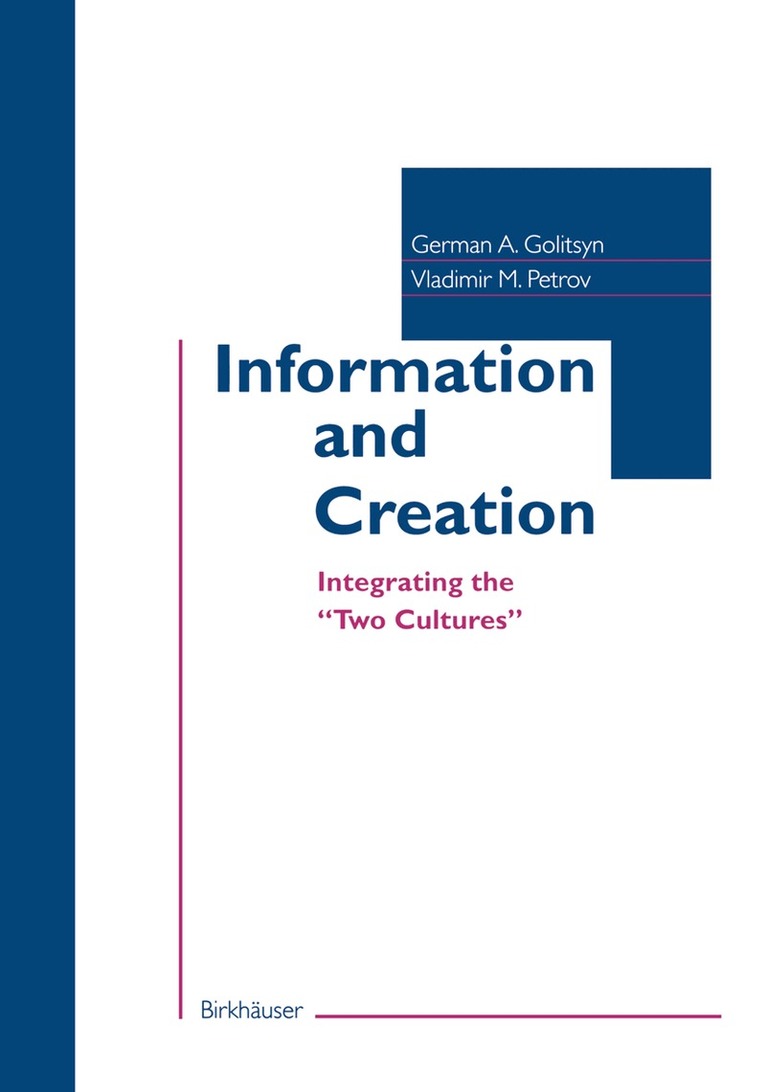
    Information and Creation

    Integrating the “Two Cultures”

    AvGerman Golitsyn,Vladimir Petrov

    Häftad, Engelska, 2012

    547 kr

    Beställningsvara. Skickas inom 10-15 vardagar. Fri frakt över 249 kr.

    Beskrivning

    This book is devoted to one of the central problems of contemporary thinking, for which c.P. Snow in 1959 coined the phrase of the «Two Cultures». In this concept, human endeavour is directed on one side to the (forward-looking) sci­ ences (mathematics, physics, chemistry, biology, etc.) and on the other side to the (backward-looking) humanities (including psychology, linguistics, sociology, etc.). In this dichotomy Snow saw no possibility of unification. On the other hand the urge towards self-consistency and harmony in the mental and spiritual lives of both man and society as a whole is clearly one of the major forces of creativity, both scientific and artistic. This force aims at the unification of the «Two Cultures» in order to build an integrated self-consistent system for our intellectual life. Some attempts in this direction have been made before, and will be described in this book. It is our aim to contribute to the achievement of an integrated mental life on the basis of information theory. In order to construct our model, we examine the laws of information theory, leading us to the deduction of the main laws inherent in both «cultures». Thus, we consider the evolution of both non-living and living matter, human behaviour, the phenomenon of language, the sphere of aesthetics, etc. We hope that our work will be useful both for researchers (who are trying to derive different integral theories) and for various other «consumers» of scientific knowledge (meaning broad circles of intellectuals).

    Produktinformation

    • Utgivningsdatum:2012-04-26
    • Mått:170 x 244 x 12 mm
    • Vikt:355 g
    • Format:Häftad
    • Språk:Engelska
    • Antal sidor:188
    • Förlag:Springer Basel
    • ISBN:9783034874748

    Utforska kategorier

    • Astronomi inom Naturvetenskap och teknik
    • Psykologi inom Psykologi och pedagogik
    • Zoologi inom Naturvetenskap och teknik

    Innehållsförteckning

    • 1: Information and adaptation.- 1.1 Mutual information.- 1.2 Valuable information.- 1.3 Principle of the information maximum.- 1.4 Expansion: Principle of the entropy maximum.- 1.5 Adaptation as organization.- 2: Evolution and creation.- 2.1 Life.- 2.2 Reflexion as a factor of evolution.- 2.3 Memory.- 2.4 Response of the system to a new stimulus.- 2.5 Conditions of the informational interaction. Threshold.- 2.6 Emotions.- 2.7 Perception and pattern recognition.- 2.8 Consciousness.- 2.9 Thinking.- 2.10 Creation.- 2.11 Intuition and logic.- 3: Mechanisms of language.- 3.1 Language: How many mechanisms are involved?.- 3.2 From pre-linguistic mechanisms — to language.- 3.3 On language as one of the roots of literature.- 3.4 The sound structure of language: Choice of the information channel.- 3.5 Phonetic structures: Possible ideal types.- 3.6 Possible evolution of sound structures.- 3.7 At the final step of evolution.- 3.8 Physical realization of speech communication.- 4: Construction of the aesthetic sphere.- 4.1 Natural objects: Absolute and conventional criteria.- 4.2 Artificial objects: By-product and special perfecting impacts.- 4.3 Concrete images and art.- 4.4 Objects’ features, signs, and art.- 4.5 Emotional impact of art: Social aspect.- 4.6 The «Hamburg score» of art.- 5: Devices of art.- 5.1 How to attract attention?.- 5.2 How to keep attention? Nuance.- 5.3 How to switch attention? Contrast.- 5.4 Laws of harmony: Golden section.- 5.5 Temporal structures in poetical works: Theoretical considerations.- 5.6 Temporal structures: Experimental results.- Towards a human integral culture (concluding remarks).