• Fri frakt över 249 kr
  • •
  • Snabba leveranser
  • •
  • Billiga böcker
Kundservice

Du är på sajten för privatpersoner.

Företag, bibliotek eller offentlig verksamhet?

Du handlar på classic.bokus.com, där alla dina funktioner finns intakta.
Till classic.bokus.com
Bokus logotyp. Gå till startsidan.
  • Erbjudanden
  • Nyheter
  • Student
  • Topplistor
  • Barn & ungdom
  • Bokus Play
  • E-böcker
  • Pocketböcker
  • Spel & pussel

10% rabatt på allt med kod: NYSTART10 →

Sidfot

Mina sidor

    Hjälp

    • Kundservice
    • Vanliga frågor och svar
    • Frakt och leverans
    • Retur vid ångerrätt
    • Reklamera vara
    • Betalning
    • Köpvillkor
    • Allmänna villkor
    • Information om webbplatsens tillgänglighet

    Om Bokus

    • Om oss
    • Pressrum
    • För studenter
    • För företag
    • För bibliotek och offentlig verksamhet
    • För leverantörer
    • Hållbarhet

    Populärt

    • Aktuella erbjudanden
    • Presentkort
    • Studentlitteratur
    • Nya böcker
    • Topplistor
    • Signerade böcker
    • Engelska böcker

    Inspiration

    • Boktips
    • BookTok
    • Populära bokserier
    • Barnbokskaraktärer
    • Populära författare
    Logotyp för Bokus
    Följ oss på Facebook (extern länk)Följ oss på Instagram (extern länk)Följ oss på YouTube (extern länk)Följ oss på TikTok (extern länk)
    bokus @ CookiesAnpassa cookiesIntegritetspolicyKöpvillkor
    Till Citymail hemsida (extern länk)Till Budbee hemsida (extern länk)Till Postnord hemsida (extern länk)Till Schenker hemsida (extern länk)Till Early Bird hemsida (extern länk)Till Walleys hemsida (extern länk)
    1. Naturvetenskap och teknik
    2. Teknik och industri
    3. Teknik: allmänt

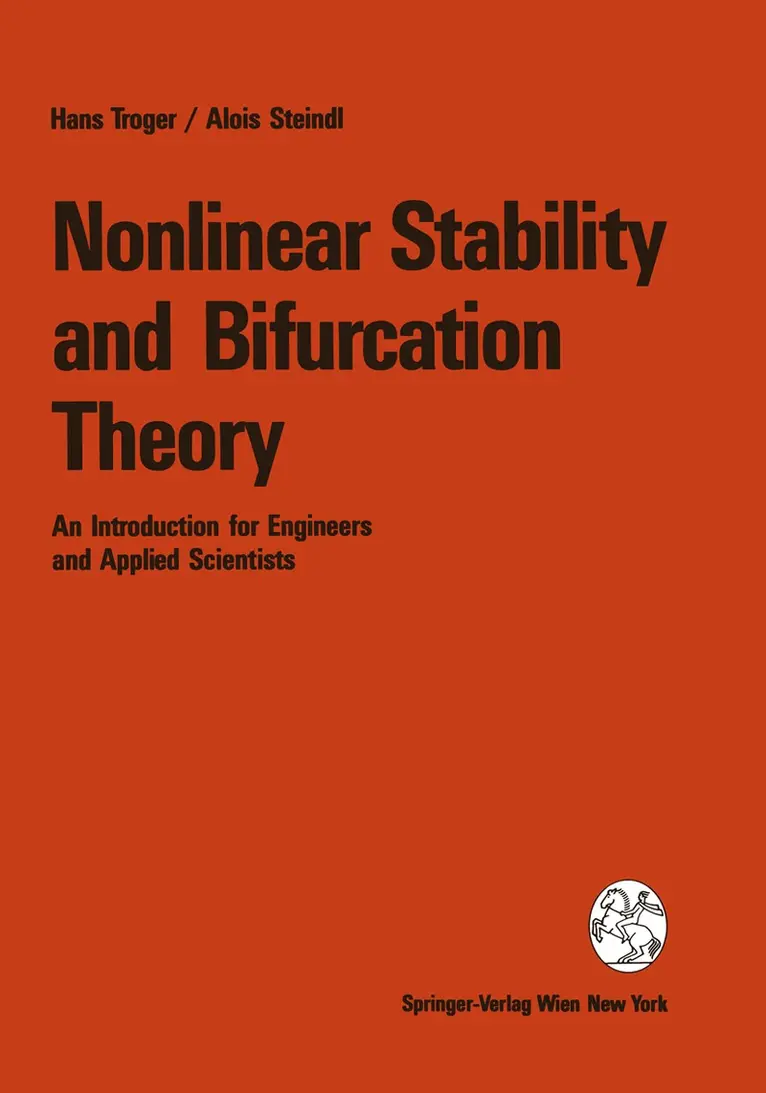
    Nonlinear Stability and Bifurcation Theory

    An Introduction for Engineers and Applied Scientists

    AvHans Troger,Alois Steindl

    Häftad, Engelska, 1991

    547 kr

    Beställningsvara. Skickas inom 10-15 vardagar. Fri frakt över 249 kr.

    Beskrivning

    Every student in engineering or in other fields of the applied sciences who has passed through his curriculum knows that the treatment of nonlin­ ear problems has been either avoided completely or is confined to special courses where a great number of different ad-hoc methods are presented. The wide-spread believe that no straightforward solution procedures for nonlinear problems are available prevails even today in engineering cir­ cles. Though in some courses it is indicated that in principle nonlinear problems are solveable by numerical methods the treatment of nonlinear problems, more or less, is considered to be an art or an intellectual game. A good example for this statement was the search for Ljapunov functions for nonlinear stability problems in the seventies. However things have changed. At the beginning of the seventies, start­ ing with the work of V.1. Arnold, R. Thom and many others, new ideas which, however, have their origin in the work of H. Poincare and A. A. Andronov, in the treatment of nonlinear problems appeared. These ideas gave birth to the term Bifurcation Theory. Bifurcation theory allows to solve a great class of nonlinear problems under variation of parameters in a straightforward manner.

    Produktinformation

    • Utgivningsdatum:1991-10-15
    • Mått:170 x 244 x 23 mm
    • Vikt:728 g
    • Format:Häftad
    • Språk:Engelska
    • Antal sidor:407
    • Förlag:Springer Verlag GmbH
    • ISBN:9783211822920

    Utforska kategorier

    • Teknik: allmänt inom Naturvetenskap och teknik
    • Naturvetenskap:allmänt inom Naturvetenskap och teknik

    Innehållsförteckning

    • 1 Introduction.- 2 Representation of systems.- 2.1 Dynamical systems.- 2.2 Statical systems.- 2.3 Definitions of stability.- 3 Reduction process, bifurcation equations.- 3.1 Finite-dimensional dynamical systems.- 3.2 Infinite-dimensional statical and dynamical systems..- 4 Application of the reduction process.- 4.1 Equilibria of finite-dimensional systems.- 4.2 Periodic solutions of finite-dimensional systems.- 4.3 Finite- and infinite-dimensional statical systems.- 5 Bifurcations under symmetries.- 5.1 Introduction.- 5.2 Finite dimensional dynamical systems.- 5.3 Infinite dimensional statical systems.- 5.4 Infinite dimensional dynamical systems.- 6 Discussion of the bifurcation equations.- 6.1 Transformation to normal form.- 6.2 Codimension.- 6.3 Determinacy.- 6.4 Unfolding.- 6.5 Classification.- 6.6 Bifurcation diagrams.- A Linear spaces and linear operators.- A.1 Linear spaces.- A.2 Linear operators.- B Transformation of matrices to Jordan form.- C Adjoint and self-adjoint linear differential operators.- C.1 Calculation of the adjoint operator.- C.2 Self-adjoint differential operators.- D Projection operators.- D.1 General considerations.- D.2 Projection for non-self-adjoint operators.- D.3 Application to the Galerkin reduction.- E Spectral decomposition.- E.1 Derivation of an inversion formula.- E.2 Three examples.- F Shell equations on the complete sphere.- F.1 Tensor notations in curvilinear coordinates.- F.2 Spherical harmonics.- G Some properties of groups.- G.1 Naive definition of a group.- G.2 Symmetry groups.- G.3 Representation of groups by matrices.- G.4 Transformation of functions and operators.- G.5 Examples of invariant functions and operators.- G.6 Abstract definition of a group.- H Stability boundaries in parameter space.- I Differential equation of anelastic ring.- I.1 Equilibrium equations and bending.- I.2 Ring equations.- J Shallow shell and plate equations.- J.1 Deformation of the shell.- J.2 Constitutive law.- J.3 Equations of equilibrium.- J.4 Special cases.- J.4.1 Plate.- J.4.2 Sphere.- J.4.3 Cylinder.- K Shell equations for axisymmetric deformations.- K.1 Geometrical relations.- K.2 Stress resultants, couples and equilibrium equations.- K.3 Stress strain relations.- K.4 Spherical shell.- L Equations of motion of a fluid conveying tube.- L.1 Geometry of tube deformation.- L.2 Stress-strain relationship.- L.3 Linear and angular momentum.- L.4 Tube equations and boundary conditions.- M Various concepts of equivalences.- M.1 Right-equivalence.- M.2 Contact equivalence.- M.3 Vector field equivalence.- M.4 Bifurcation equivalence.- M.5 Recognition problem.- N Slowly varying parameter.- O Transformation of dynamical systems into standard form.- O.1 Power series expansion.- O.2 Recursive calculation.