Hans Troger – författare
Visar alla böcker från författaren Hans Troger. Handla med fri frakt och snabb leverans.
3 produkter
3 produkter
1 107 kr
Skickas inom 10-15 vardagar
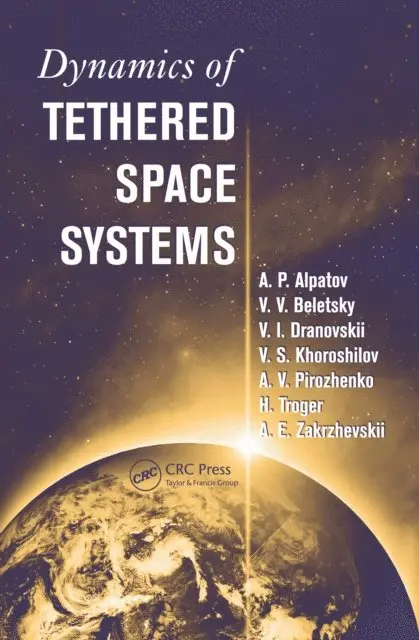
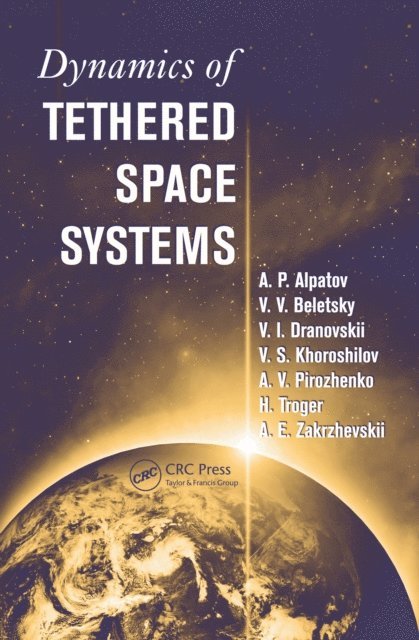
During many of the earliest American and Russian space missions, experiments were performed using cables to connect people and objects to spacecraft in orbit. These attempts generated considerable information about the formation of tethered systems and basic problems with tether orientation and gravity-gradient stabilization. During the 1970s, interest in tethered space systems (TSS) came to the forefront with an international project that involved the hanging of a probe from a low-orbit satellite to collect data on the Earth and its atmosphere. Since that time, TSS has grown to become its own area of research.Dynamics of Tethered Space Systems brings together the work of seven leading researchers working at the forefront of TSS. Together, they provide a brief yet thorough introduction to TSS. Then, combining theory with experimental approaches important to industry, they cover the dynamics of the mechanical, physical, and mathematical modeling approaches involved in tethered satellite deployment. They present several models from the literature, focusing on the simplest but most important system: two satellites in orbit around the Earth. Discussion then expands to cover more complex examples. Along the way, the authors consider a number of important topics, such as energy production resulting from interaction between the system and Earth’s magnetic field and momentum transfer in relation to satellites, microgravity laboratories, and futuristic applications such as the space elevator. They also look at a number of challenges, including those with deployment and energy dissipation.Providing approaches to theoretical models and experimental methods, the text includes a wealth of essential equations and detailed analyses of forces acting on tethered objects in motion. It provides both a starting point for further research and the tools needed to apply that research to the applications of tomorrow.
2 185 kr
Tillfälligt slut
During many of the earliest American and Russian space missions, experiments were performed using cables to connect people and objects to spacecraft in orbit. These attempts generated considerable information about the formation of tethered systems and basic problems with tether orientation and gravity-gradient stabilization. During the 1970s, interest in tethered space systems (TSS) came to the forefront with an international project that involved the hanging of a probe from a low-orbit satellite to collect data on the Earth and its atmosphere. Since that time, TSS has grown to become its own area of research.Dynamics of Tethered Space Systems brings together the work of seven leading researchers working at the forefront of TSS. Together, they provide a brief yet thorough introduction to TSS. Then, combining theory with experimental approaches important to industry, they cover the dynamics of the mechanical, physical, and mathematical modeling approaches involved in tethered satellite deployment. They present several models from the literature, focusing on the simplest but most important system: two satellites in orbit around the Earth. Discussion then expands to cover more complex examples. Along the way, the authors consider a number of important topics, such as energy production resulting from interaction between the system and Earth’s magnetic field and momentum transfer in relation to satellites, microgravity laboratories, and futuristic applications such as the space elevator. They also look at a number of challenges, including those with deployment and energy dissipation.Providing approaches to theoretical models and experimental methods, the text includes a wealth of essential equations and detailed analyses of forces acting on tethered objects in motion. It provides both a starting point for further research and the tools needed to apply that research to the applications of tomorrow.
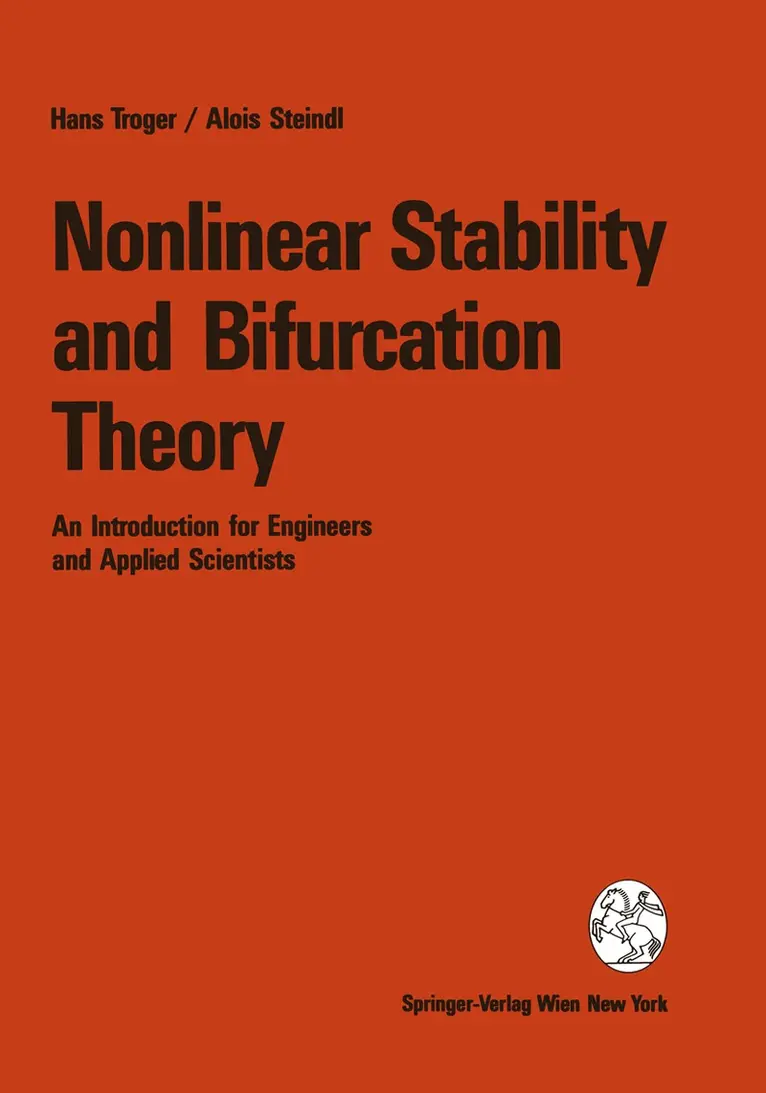
Nonlinear Stability and Bifurcation Theory
An Introduction for Engineers and Applied Scientists
Häftad, Engelska, 1991
534 kr
Skickas inom 10-15 vardagar
This study aims to make progress in the field of stability theory available to scientists and engineers. A treatment of the different types of loss of stability of equilibrium positions of static and dynamic systems and of periodic solutions of dynamic systems is given by means of the methods of bifurcation and singuality theory. The reader needs only a background in mathematics. Among others, concepts such as centre manifold theory, the method of Ljapunov-Schmidt, normal form theory, unfolding theory, bifurcation diagrams, classifications and bifurcations in symmetric systems are discussed, as far as they are relevant in applications. Most important for the whole representation is a set of examples taken from mechanics and engineering showing the usefulness of the above mentioned concepts. These examples include buckling problems of rods, plates and shells, the loss of stability of the motion of road and rail vehicles, of a simple robot, and of fluid conveying elastic tubes. With these examples, questions like symmetry breaking, pattern formation, imperfection sensitivity, transition to chaos and correct modelling of systems are explored.Finally, a number of selected FORTRAN-routines should encourage readers to apply these theories to their own individual problems.