• Fri frakt över 249 kr
  • •
  • Snabba leveranser
  • •
  • Billiga böcker
Kundservice

Du är på sajten för privatpersoner.

Företag, bibliotek eller offentlig verksamhet?

Du handlar på classic.bokus.com, där alla dina funktioner finns intakta.
Till classic.bokus.com
Bokus logotyp. Gå till startsidan.
  • Erbjudanden
  • Nyheter
  • Student
  • Topplistor
  • Barn & ungdom
  • Bokus Play
  • E-böcker
  • Pocketböcker
  • Spel & pussel

10% rabatt på allt med kod NYSTART10 →

Sidfot

Mina sidor

    Hjälp

    • Kundservice
    • Vanliga frågor och svar
    • Frakt och leverans
    • Retur vid ångerrätt
    • Reklamera vara
    • Betalning
    • Köpvillkor
    • Allmänna villkor
    • Information om webbplatsens tillgänglighet

    Om Bokus

    • Om oss
    • Pressrum
    • För studenter
    • För företag
    • För bibliotek och offentlig verksamhet
    • För leverantörer
    • Hållbarhet

    Populärt

    • Aktuella erbjudanden
    • Presentkort
    • Studentlitteratur
    • Nya böcker
    • Topplistor
    • Signerade böcker
    • Engelska böcker

    Inspiration

    • Boktips
    • BookTok
    • Populära bokserier
    • Barnbokskaraktärer
    • Populära författare
    Logotyp för Bokus
    Följ oss på Facebook (extern länk)Följ oss på Instagram (extern länk)Följ oss på YouTube (extern länk)Följ oss på TikTok (extern länk)
    bokus @ CookiesAnpassa cookiesIntegritetspolicyKöpvillkor
    Till Citymail hemsida (extern länk)Till Budbee hemsida (extern länk)Till Postnord hemsida (extern länk)Till Schenker hemsida (extern länk)Till Early Bird hemsida (extern länk)Till Walleys hemsida (extern länk)
    1. Data och IT
    2. Systemvetenskap och AI

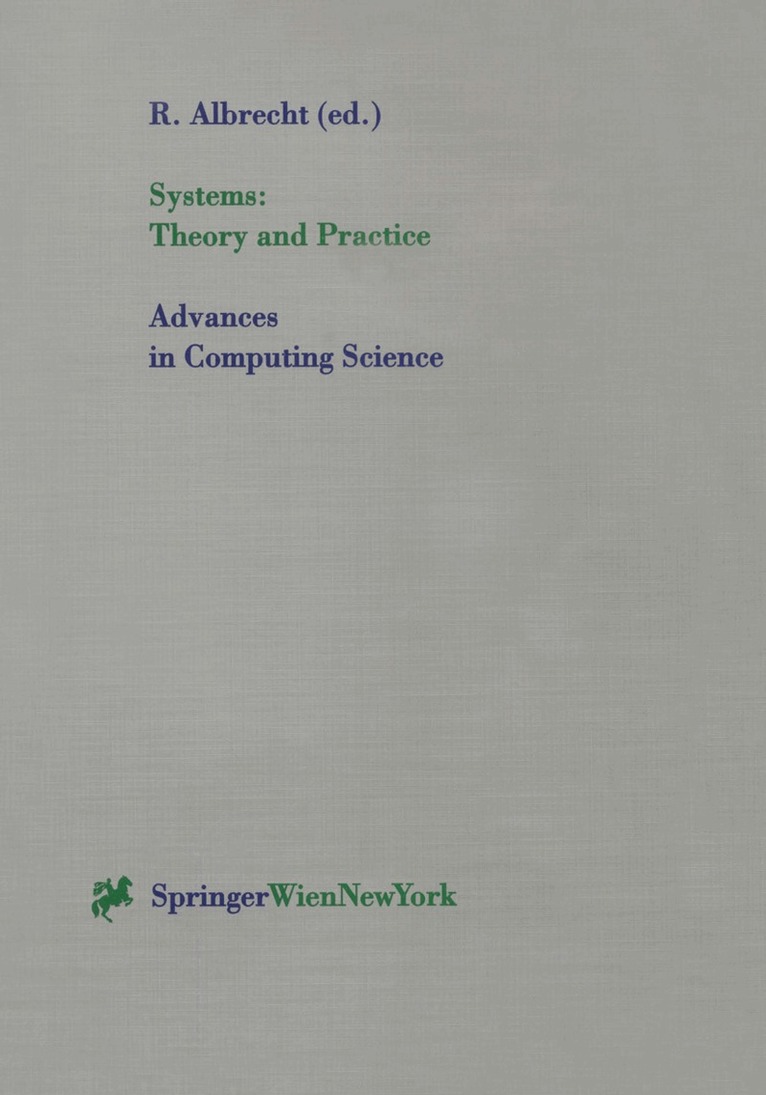
    Systems: Theory and Practice

    AvRudolf Albrecht

    Häftad, Engelska, 1998

    Del i serien Advances in Computing Sciences

    563 kr

    Beställningsvara. Skickas inom 10-15 vardagar. Fri frakt över 249 kr.

    Beskrivning

    There is hardly a science that is without the notion of "system". We have systems in mathematics, formal systems in logic, systems in physics, electrical and mechanical engineering, architectural-, operating-, infonnation-, programming systems in computer science, management-and PJoduction systems in industrial applications, economical-, ecological-, biological systems, and many more. In many of these disciplines formal tools for system specification, construction, verification, have been developed as well as mathematical concepts for system modeling and system simulation. Thus it is quite natural to expect that systems theory as an interdisciplinary and well established science offering general concepts and methods for a wide variety of applications is a subject in its own right in academic education. However, as can be seen from the literature and from the curricula of university studies -at least in Central Europe-, it is subordinated and either seen as part of mathematics with the risk that mathematicians, who may not be familiar with applications, define it in their own way, or it is treated separately within each application field focusing on only those aspects which are thought to be needed in the particular application. This often results in uneconomical re-inventing and re-naming of concepts and methods within one field, while the same concepts and methods are already well introduced and practiced in other fields. The fundamentals on general systems theory were developed several decades ago. We note the pioneering work of M. A. Arbib, R. E. Kalman, G. 1. Klir, M. D.

    Produktinformation

    • Utgivningsdatum:1998-08-17
    • Mått:170 x 244 x undefined mm
    • Vikt:568 g
    • Format:Häftad
    • Språk:Engelska
    • Serie:Advances in Computing Sciences
    • Antal sidor:314
    • Förlag:Springer Verlag GmbH
    • ISBN:9783211832066

    Utforska kategorier

    • Systemvetenskap och AI inom Data och IT
    • Referensverk och tvärvetenskap inom Samhälle och politik

    Innehållsförteckning

    • Abstract modelling complex systems.- Formal specification.- On mathematical systems theory.- An introduction to discrete event modeling formalisms.- Design of microsystems: Systems-theoretical aspects.- A formal representation of DSS generator.- Structure and functions of operating systems.- Object-oriented system development — concepts and tools.- Model-based software engineering for interactive systems.- Modeling fault-tolerant system behavior.- Applications of artificial neural networks.- The method of equivalence in robotics.- Manufacturing algebra: a new mathematical tool for discrete event modelling of manufacturing systemss.- List of contributors.