• Fri frakt över 249 kr
  • •
  • Snabba leveranser
  • •
  • Billiga böcker
Kundservice

Du är på sajten för privatpersoner.

Företag, bibliotek eller offentlig verksamhet?

Du handlar på classic.bokus.com, där alla dina funktioner finns intakta.
Till classic.bokus.com
Bokus logotyp. Gå till startsidan.
  • Erbjudanden
  • Nyheter
  • Student
  • Topplistor
  • Barn & ungdom
  • Bokus Play
  • E-böcker
  • Pocketböcker
  • Spel & pussel

10% rabatt på allt med kod NYSTART10 →

Sidfot

Mina sidor

    Hjälp

    • Kundservice
    • Vanliga frågor och svar
    • Frakt och leverans
    • Retur vid ångerrätt
    • Reklamera vara
    • Betalning
    • Köpvillkor
    • Allmänna villkor
    • Information om webbplatsens tillgänglighet

    Om Bokus

    • Om oss
    • Pressrum
    • För studenter
    • För företag
    • För bibliotek och offentlig verksamhet
    • För leverantörer
    • Hållbarhet

    Populärt

    • Aktuella erbjudanden
    • Presentkort
    • Studentlitteratur
    • Nya böcker
    • Topplistor
    • Signerade böcker
    • Engelska böcker

    Inspiration

    • Boktips
    • BookTok
    • Populära bokserier
    • Barnbokskaraktärer
    • Populära författare
    Logotyp för Bokus
    Följ oss på Facebook (extern länk)Följ oss på Instagram (extern länk)Följ oss på YouTube (extern länk)Följ oss på TikTok (extern länk)
    bokus @ CookiesAnpassa cookiesIntegritetspolicyKöpvillkor
    Till Citymail hemsida (extern länk)Till Budbee hemsida (extern länk)Till Postnord hemsida (extern länk)Till Schenker hemsida (extern länk)Till Early Bird hemsida (extern länk)Till Walleys hemsida (extern länk)
    1. Naturvetenskap och teknik
    2. Matematik och naturvetenskap
    3. Matematik
    4. Topologi

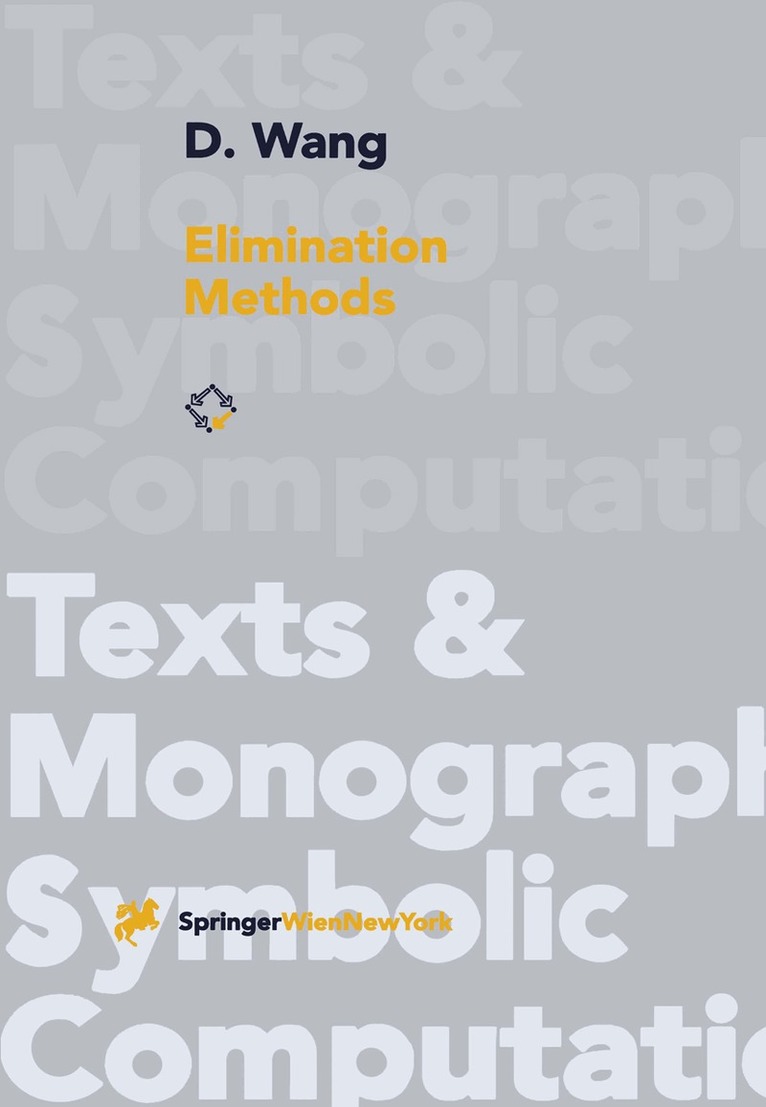
    Elimination Methods

    AvD. Wang

    Häftad, Engelska, 2000

    Del i serien Texts & Monographs in Symbolic Computation

    1 085 kr

    Beställningsvara. Skickas inom 10-15 vardagar. Fri frakt över 249 kr.

    Fler format och utgåvor

    E-bok

    1 416 kr

    Beskrivning

    The development of polynomial-elimination techniques from classical theory to modern algorithms has undergone a tortuous and rugged path. This can be observed L. van der Waerden's elimination of the "elimination theory" chapter from from B. his classic Modern Algebra in later editions, A. Weil's hope to eliminate "from algebraic geometry the last traces of elimination theory," and S. Abhyankar's sug­ gestion to "eliminate the eliminators of elimination theory. " The renaissance and recognition of polynomial elimination owe much to the advent and advance of mod­ ern computing technology, based on which effective algorithms are implemented and applied to diverse problems in science and engineering. In the last decade, both theorists and practitioners have more and more realized the significance and power of elimination methods and their underlying theories. Active and extensive research has contributed a great deal of new developments on algorithms and soft­ ware tools to the subject, that have been widely acknowledged. Their applications have taken place from pure and applied mathematics to geometric modeling and robotics, and to artificial neural networks. This book provides a systematic and uniform treatment of elimination algo­ rithms that compute various zero decompositions for systems of multivariate poly­ nomials. The central concepts are triangular sets and systems of different kinds, in terms of which the decompositions are represented. The prerequisites for the concepts and algorithms are results from basic algebra and some knowledge of algorithmic mathematics.

    Produktinformation

    • Utgivningsdatum:2000-11-30
    • Mått:170 x 244 x 15 mm
    • Vikt:462 g
    • Format:Häftad
    • Språk:Engelska
    • Serie:Texts & Monographs in Symbolic Computation
    • Antal sidor:244
    • Förlag:Springer Verlag GmbH
    • ISBN:9783211832417

    Utforska kategorier

    • Topologi inom Naturvetenskap och teknik
    • Matematik inom Naturvetenskap och teknik
    • Algebra inom Naturvetenskap och teknik

    Recensioner i media

    "... the algorithms are presented in a 'crescendo' sequence, that is, the versions are improved step by step with the introduction of new techniques and concepts, which allows the readers to follow the construction of the ideas; furthermore, this style makes it a very good textbook ... it is a very good text to have on hand for anyone interested in the theories and techniques of elimination methods." American Mathematical Society "... This book, therefore, is not only topical, but is also the first book that contains all major currently available algorithmic approaches on elimination theory in one conceptional frame ... The book is well suited both as a textbook and as a research reference for the state of the art in algorithmic elimination theory. Theorems and proofs are presented in such a way that the correctness of the algorithms based on them can easily be verified. Well-chosen examples make it easy to understand the concepts and the methods. The main contents of this book - altough not all details - should enter standard curricula on algebra." Association for Computing Machinery

    Innehållsförteckning

    • Polynomial arithmetic and zeros.- 1.1 Polynomials.- 1.2 Greatest common divisor, pseudo-division, and polynomial remainder sequences.- 1.3 Resultants and subresultants.- 1.4 Field extension and factorization.- 1.5 Zeros and ideals.- 1.6 Hilbert’s Nullstellensatz.- Zero decomposition of polynomial systems.- 2.1 Triangular systems.- 2.2 Characteristic-set-based algorithm.- 2.3 Seidenberg’s algorithm refined.- 2.4 Subresultant-based algorithm.- Projection and simple systems.- 3.1 Projection.- 3.2 Zero decomposition with projection.- 3.3 Decomposition into simple systems.- 3.4 Properties of simple systems.- Irreducible zero decomposition.- 4.1 Irreducibility of triangular sets.- 4.2 Decomposition into irreducible triangular systems.- 4.3 Properties of irreducible triangular systems.- 4.4 Irreducible simple systems.- Various elimination algorithms.- 5.1 Regular systems.- 5.2 Canonical triangular sets.- 5.3 Gröbner bases.- 5.4 Resultant elimination.- Computational algebraic geometry and polynomial-ideal theory.- 6.1 Dimension.- 6.2 Decomposition of algebraic varieties.- 6.3 Ideal and radical ideal membership.- 6.4 Primary decomposition of ideals.- Applications.- 7.1 Solving polynomial systems.- 7.2 Automated geometry theorem proving.- 7.3 Automatic derivation of unknown relations.- 7.4 Other geometric applications.- 7.5 Algebraic factorization.- 7.6 Center conditions for certain differential systems.- Bibliographic notes.- References.