• Fri frakt över 249 kr
  • •
  • Snabba leveranser
  • •
  • Billiga böcker
Kundservice

Du är på sajten för privatpersoner.

Företag, bibliotek eller offentlig verksamhet?

Du handlar på classic.bokus.com, där alla dina funktioner finns intakta.
Till classic.bokus.com
Bokus logotyp. Gå till startsidan.
  • Erbjudanden
  • Nyheter
  • Student
  • Topplistor
  • Barn & ungdom
  • Bokus Play
  • E-böcker
  • Pocketböcker
  • Spel & pussel

10% rabatt på allt med kod: NYSTART10 →

Sidfot

Mina sidor

    Hjälp

    • Kundservice
    • Vanliga frågor och svar
    • Frakt och leverans
    • Retur vid ångerrätt
    • Reklamera vara
    • Betalning
    • Köpvillkor
    • Allmänna villkor
    • Information om webbplatsens tillgänglighet

    Om Bokus

    • Om oss
    • Pressrum
    • För studenter
    • För företag
    • För bibliotek och offentlig verksamhet
    • För leverantörer
    • Hållbarhet

    Populärt

    • Aktuella erbjudanden
    • Presentkort
    • Studentlitteratur
    • Nya böcker
    • Topplistor
    • Signerade böcker
    • Engelska böcker

    Inspiration

    • Boktips
    • BookTok
    • Populära bokserier
    • Barnbokskaraktärer
    • Populära författare
    Logotyp för Bokus
    Följ oss på Facebook (extern länk)Följ oss på Instagram (extern länk)Följ oss på YouTube (extern länk)Följ oss på TikTok (extern länk)
    bokus @ CookiesAnpassa cookiesIntegritetspolicyKöpvillkor
    Till Citymail hemsida (extern länk)Till Budbee hemsida (extern länk)Till Postnord hemsida (extern länk)Till Schenker hemsida (extern länk)Till Early Bird hemsida (extern länk)Till Walleys hemsida (extern länk)
    1. Naturvetenskap och teknik
    2. Geovetenskap
    3. Geovetenskap

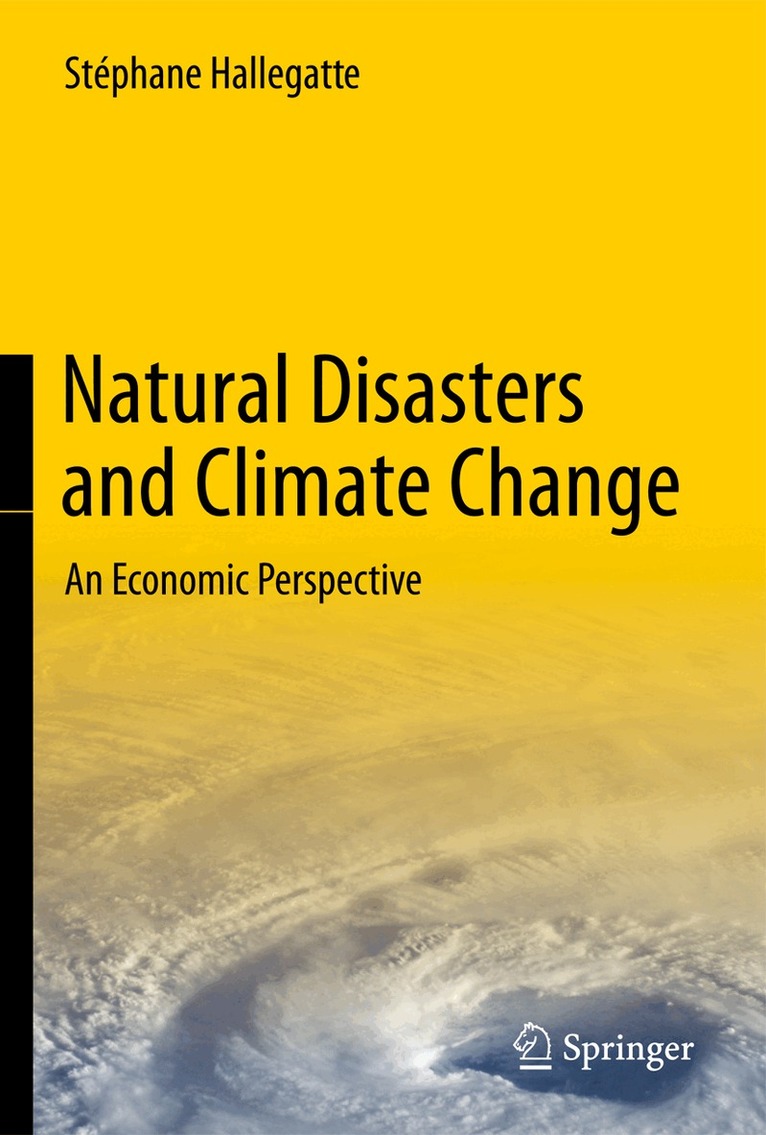
    Natural Disasters and Climate Change

    An Economic Perspective

    AvStéphane Hallegatte

    Inbunden, Engelska, 2014

    1 086 kr

    Beställningsvara. Skickas inom 10-15 vardagar. Fri frakt över 249 kr.

    Fler format och utgåvor

    E-bok

    1 413 kr

    Häftad

    1 086 kr

    Beskrivning

    This book explores economic concepts related to disaster losses, describes mechanisms that determine the economic consequences of a disaster, and reviews methodologies for making decisions regarding risk management and adaptation. The author addresses the need for better understanding of the consequences of disasters and reviews and analyzes three scientific debates on linkage between disaster risk management and adaptation to climate change. The first involves the existence and magnitude of long-term economic impact of natural disasters on development. The second is the disagreement over whether any development is the proper solution to high vulnerability to disaster risk. The third debate involves the difficulty of drawing connections between natural disasters and climate change and the challenge in managing them through an integrated strategy. The introduction describes economic views of disaster, including direct and indirect costs, output and welfare losses, and use of econometric tools to measure losses. The next section defines disaster risk, delineates between “good” and “bad” risk-taking, and discusses a pathway to balanced growth. A section entitled “Trends in Hazards and the Role of Climate Change” sets scenarios for climate change analysis, discusses statistical and physical models for downscaling global climate scenarios to extreme event scenarios, and considers how to consider extremes of hot and cold, storms, wind, drought and flood. Another section analyzes case studies on hurricanes and the US coastline; sea-level rises and storm surge in Copenhagen; and heavy precipitation in Mumbai. A section on Methodologies for disaster risk management includes a study on cost-benefit analysis of coastal protections in New Orleans, and one on early-warning systems in developing countries. The next section outlines decision-making in disaster risk management, including robust decision-making, No-regret and No-risk strategies; and strategies that reduce time horizons for decision-making. Among the conclusions is the assertion that risk management policies must recognize the benefits of risk-taking and avoid suppressing it entirely. The main message is that a combination of disaster-risk-reduction, resilience-building and adaptation policies can yield large potential gains and synergies.

    Produktinformation

    • Utgivningsdatum:2014-09-29
    • Mått:155 x 235 x 18 mm
    • Vikt:494 g
    • Format:Inbunden
    • Språk:Engelska
    • Antal sidor:194
    • Upplaga:2014
    • Förlag:Springer International Publishing AG
    • ISBN:9783319089324

    Utforska kategorier

    • Geovetenskap inom Naturvetenskap och teknik
    • Miljövetenskap och miljöpolitik inom Naturvetenskap och teknik
    • Miljöekonomi inom Ekonomi och Ledarskap

    Recensioner i media

    "Hallegatte's effort has potential to be recommended to academics and government officials who wish to investigate economic consequences of a disaster and constitute future course of actions considering multiple uncertainties and climate scenarios. We found that the book consists of easy-to-understand theoretical discussions, logical explanations, clear language and impressive illustrations with a combination of vivid economic analysis. We believe that many institutions, academicians, decision makers and earth science scholars would find the book a worthwhile acquisition." (D. Bhatt, R. K. Mall and T. Banerjee, Natural Hazards, Vol. 78 (1), August, 2015)

    Innehållsförteckning

    • 1 Introduction and summary.- 2 What is a disaster? An economic point of view.- 3 Disaster risks: evidence and theory.- 4 Trends in Hazards and the Role of Climate Change.- 5 Climate change impact on natural disaster losses.- 6 Methodologies for disaster risk management in a changing environment.- 7 Decision making for disaster risk management in a changing climate.- 8 References.