• Fri frakt över 249 kr
  • •
  • Snabba leveranser
  • •
  • Billiga böcker
Kundservice

Du är på sajten för privatpersoner.

Företag, bibliotek eller offentlig verksamhet?

Du handlar på classic.bokus.com, där alla dina funktioner finns intakta.
Till classic.bokus.com
Bokus logotyp. Gå till startsidan.
  • Erbjudanden
  • Nyheter
  • Student
  • Topplistor
  • Barn & ungdom
  • Bokus Play
  • E-böcker
  • Pocketböcker
  • Spel & pussel

10% rabatt på allt med kod NYSTART10 →

Sidfot

Mina sidor

    Hjälp

    • Kundservice
    • Vanliga frågor och svar
    • Frakt och leverans
    • Retur vid ångerrätt
    • Reklamera vara
    • Betalning
    • Köpvillkor
    • Allmänna villkor
    • Information om webbplatsens tillgänglighet

    Om Bokus

    • Om oss
    • Pressrum
    • För studenter
    • För företag
    • För bibliotek och offentlig verksamhet
    • För leverantörer
    • Hållbarhet

    Populärt

    • Aktuella erbjudanden
    • Presentkort
    • Studentlitteratur
    • Nya böcker
    • Topplistor
    • Signerade böcker
    • Engelska böcker

    Inspiration

    • Boktips
    • BookTok
    • Populära bokserier
    • Barnbokskaraktärer
    • Populära författare
    Logotyp för Bokus
    Följ oss på Facebook (extern länk)Följ oss på Instagram (extern länk)Följ oss på YouTube (extern länk)Följ oss på TikTok (extern länk)
    bokus @ CookiesAnpassa cookiesIntegritetspolicyKöpvillkor
    Till Citymail hemsida (extern länk)Till Budbee hemsida (extern länk)Till Postnord hemsida (extern länk)Till Schenker hemsida (extern länk)Till Early Bird hemsida (extern länk)Till Walleys hemsida (extern länk)
    1. Ekonomi och Ledarskap
    2. Nationalekonomi

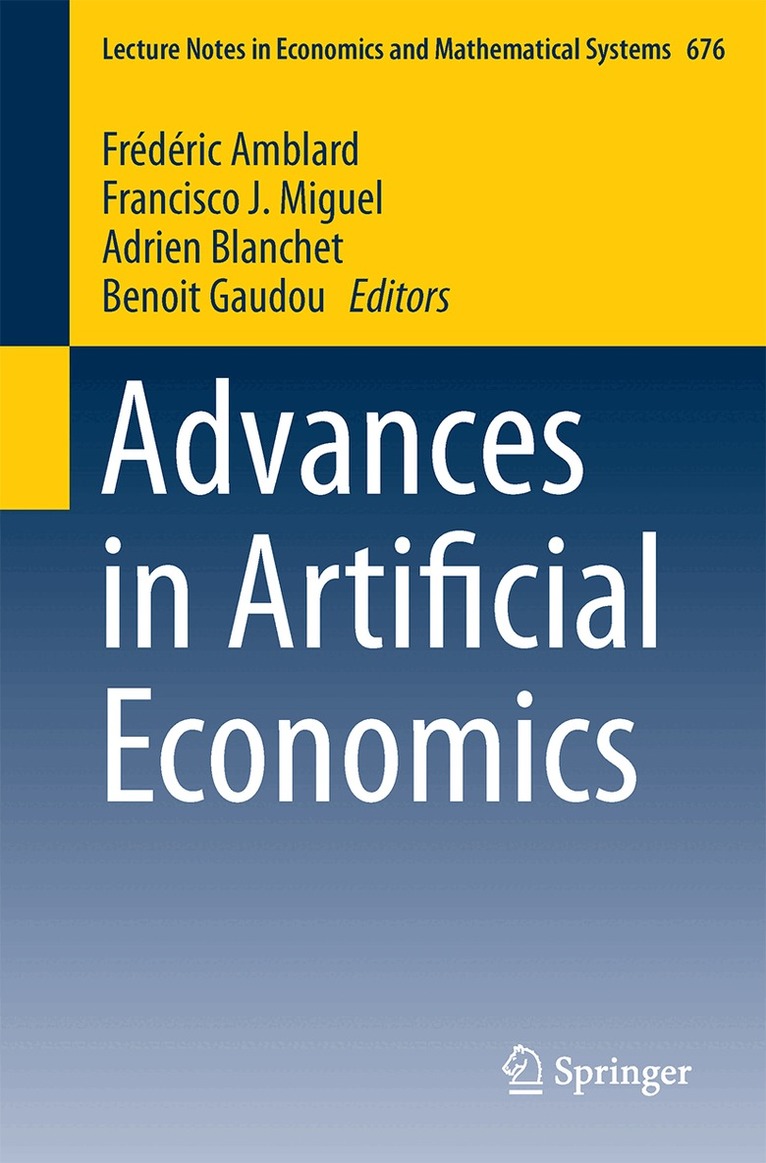
    Advances in Artificial Economics

    AvFrédéric Amblard,Francisco J. Miguel

    Häftad, Engelska, 2014

    Del 676 i serien Lecture Notes in Economics and Mathematical Systems

    1 086 kr

    Beställningsvara. Skickas inom 10-15 vardagar. Fri frakt över 249 kr.

    Beskrivning

    ​The book presents a peer-reviewed collection of papers presented during the 10th issue of the Artificial Economics conference, addressing a variety of issues related to macroeconomics, industrial organization, networks, management and finance, as well as purely methodological issues. The field of artificial economics covers a broad range of methodologies relying on computer simulations in order to model and study the complexity of economic and social phenomena. The grounding principle of artificial economics is the analysis of aggregate properties of simulated systems populated by interacting adaptive agents that are equipped with heterogeneous individual behavioral rules. These macroscopic properties are neither foreseen nor intended by the artificial agents but generated collectively by them. They are emerging characteristics of such artificially simulated systems.

    Produktinformation

    • Utgivningsdatum:2014-11-19
    • Mått:155 x 235 x 15 mm
    • Vikt:394 g
    • Format:Häftad
    • Språk:Engelska
    • Serie:Lecture Notes in Economics and Mathematical Systems
    • Antal sidor:243
    • Upplaga:2015
    • Förlag:Springer International Publishing AG
    • ISBN:9783319095776

    Utforska kategorier

    • Nationalekonomi inom Ekonomi och Ledarskap
    • Optimering inom Naturvetenskap och teknik
    • Systemvetenskap och AI inom Data och IT

    Mer om författaren

    Frédéric Amblard was awarded a PhD degree (agent-based social simulation) in 2003 from the University Blaise Pascal, Clermont-Ferrand. He then spend one year as a post-doc at the ENS-Ulm. In 2004, he became associate professor in Computer Science at the University Toulouse 1 Capitole and joined the IRIT-SMAC team. He has been implied in several European projects (FP6 IMAGES, FP7 COSIN, FP7 QLectives) and ANR projects (MAGeo, COSMAGEMS) and currently participates in the coordination of the MAELIA project, dedicated to the multi-agent simulation for the management of water resources. He coordinated several industrial projects with major actors (EDF R&D, France Télécom R&D). In 2013 he received an award for scientific excellence (PES). Francesc Josep Miguel holds a PhD in Sociology from the Universitat Autònoma de Barcelona (UAB) and a University Specialist Degree in Sociology of Consumption from the Universidad Complutense de Madrid. Miguel Quesada is an Associate Professor at UAB responsible for courses in Methodology for the Social Sciences, Sociology of Consumption and Applied Statistics for Marketing Analysis. He has conducted research in the fields of sociology of consumption, social indicators in relation to the situation of women in contemporary society, and the analysis of school-to-work transitions. At present he mainly works in the domain of “computational sociology” - an applied branch of artificial intelligence that merges social science and computer simulation techniques to model complex policy issues and societal dynamics - and, as GSADI member and as Director of the “Laboratory for Socio-Historical Dynamics Simulation” (LSDS) he is involved in several projects about the use of agent-based social simulation for the modelling of social networks dynamics and evolution of social behavior. Adrien Blanchet became Associate Professor at the GREMAQ in 2008. He earned a PhD degree in 2005 fromthe University Paris Dauphine. With a background in mathematical physics, Adrien focused at the end of his PhD degree on models coming from Biology. From his recruitment at the GREMAQ in 2008, he worked on the applications of partial differential equations in Economics. In 2009 he received an award for scientific excellence (PES) as well as an Outstanding Viae Award of the Toulouse School of Economics (TSE) in 2010. Benoit Gaudou was awarded a PhD degree in Artificial Intelligence in 2008 from the Toulouse University. In 2010, he became Associate Professor at the University Toulouse 1 Capitole and joined the IRIT-SMAC research team. His research topics are the agent-based modeling and simulation of social environmental systems including complex agents.

    Innehållsförteckning

    • Does Collaboration Pay?- Why Do Firms Exist?- The "Win-Continue, Lose-Reverse" Rule in Cournot Oligopolies.- Organizational Change for Its Own Sake?- Best Practices in Programming Agent-Based Models in Economics and Finance.- Building Artificial Economies.- Spontaneous Segregation of Agents Across Double Auction Markets.- The J-Curve and Transaction Taxes.- Insights from an Artificial Stock Market.- What Is the Impact of Heterogeneous Knowledge About Fundamentals on Market Liquidity and Efficiency.- An Agent Based Propagation Model of Bank Failures.- Direct vs. Side Effects in Financial Contagion.- Saudis and Expats - an Agent-Based Model of the Saudi Arabian Labor Market.- Forbidding Fixed Duration Contracts.- ​Shadow Economy and Wealth Distribution.- Distribution Effects of Extortion Racket Systems.- Impacts on Stability of Interdependencies Between Markets in a Cobweb Model.- Detecting Key Variables in System Dynamics Modelling by Using Social Network Metrics.- Trade-in Programs in the Context of Technological Innovation with Herding.- Evaluating Scenarios for Upgrading Sustainability of the Meat Supply Chain.