• Fri frakt över 249 kr
  • •
  • Snabba leveranser
  • •
  • Billiga böcker
Kundservice

Du är på sajten för privatpersoner.

Företag, bibliotek eller offentlig verksamhet?

Du handlar på classic.bokus.com, där alla dina funktioner finns intakta.
Till classic.bokus.com
Bokus logotyp. Gå till startsidan.
  • Erbjudanden
  • Nyheter
  • Student
  • Topplistor
  • Barn & ungdom
  • Bokus Play
  • E-böcker
  • Pocketböcker
  • Spel & pussel

10% rabatt på allt med kod: NYSTART10 →

Sidfot

Mina sidor

    Hjälp

    • Kundservice
    • Vanliga frågor och svar
    • Frakt och leverans
    • Retur vid ångerrätt
    • Reklamera vara
    • Betalning
    • Köpvillkor
    • Allmänna villkor
    • Information om webbplatsens tillgänglighet

    Om Bokus

    • Om oss
    • Pressrum
    • För studenter
    • För företag
    • För bibliotek och offentlig verksamhet
    • För leverantörer
    • Hållbarhet

    Populärt

    • Aktuella erbjudanden
    • Presentkort
    • Studentlitteratur
    • Nya böcker
    • Topplistor
    • Signerade böcker
    • Engelska böcker

    Inspiration

    • Boktips
    • BookTok
    • Populära bokserier
    • Barnbokskaraktärer
    • Populära författare
    Logotyp för Bokus
    Följ oss på Facebook (extern länk)Följ oss på Instagram (extern länk)Följ oss på YouTube (extern länk)Följ oss på TikTok (extern länk)
    bokus @ CookiesAnpassa cookiesIntegritetspolicyKöpvillkor
    Till Citymail hemsida (extern länk)Till Budbee hemsida (extern länk)Till Postnord hemsida (extern länk)Till Schenker hemsida (extern länk)Till Early Bird hemsida (extern länk)Till Walleys hemsida (extern länk)
    1. Naturvetenskap och teknik
    2. Teknik och industri
    3. Energiteknik

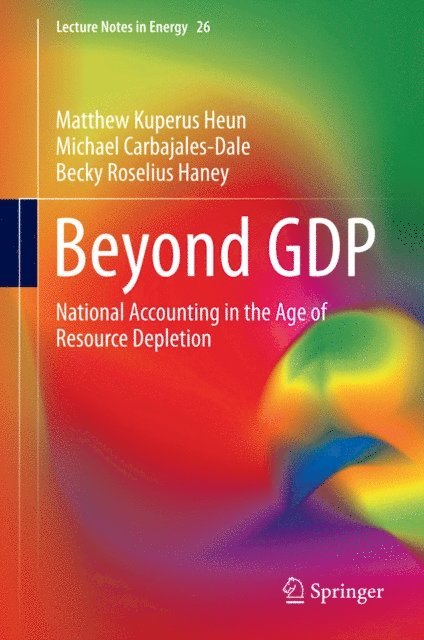
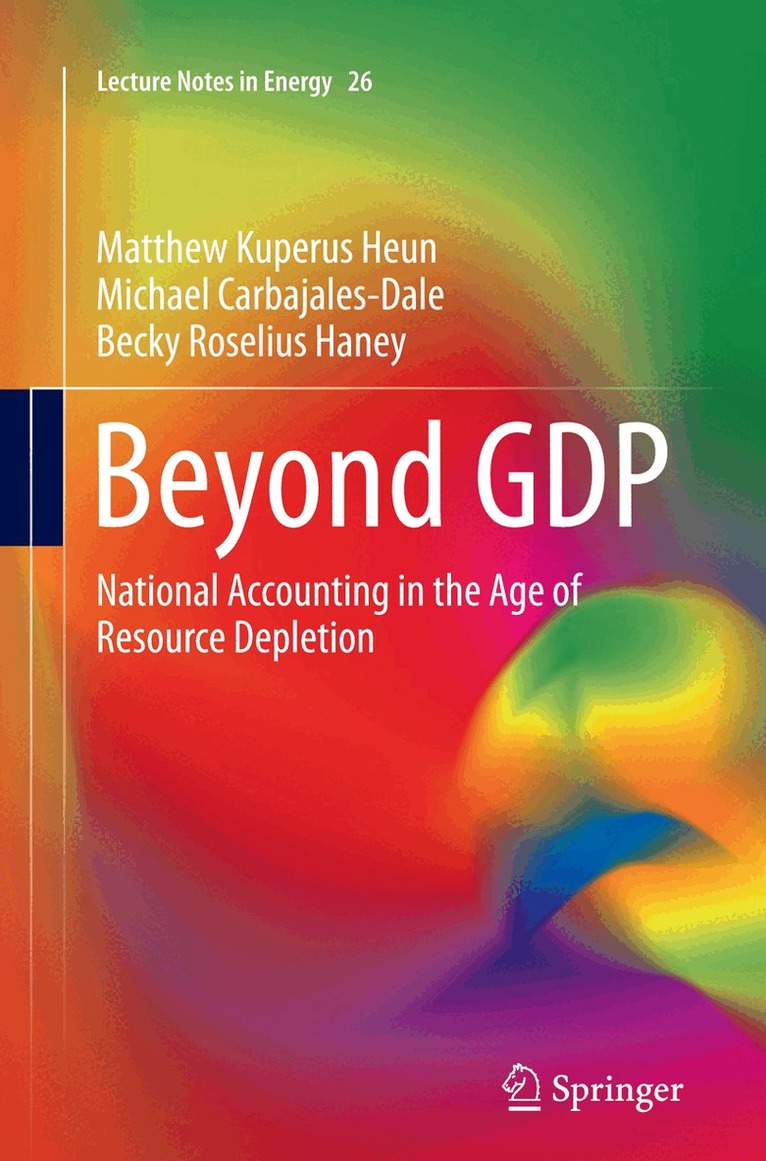
    Beyond GDP

    National Accounting in the Age of Resource Depletion

    AvMatthew Kuperus Heun,Michael Carbajales-Dale

    Inbunden, Engelska, 2015

    Del 26 i serien Lecture Notes in Energy

    546 kr

    Beställningsvara. Skickas inom 10-15 vardagar. Fri frakt över 249 kr.

    Fler format och utgåvor

    Häftad

    546 kr

    Beskrivning

    This book uses the metaphor “The economy is society's metabolism” as a springboard to develop a rigorous theoretical framework for a better system of national accounts which goes “Beyond GDP” and is relevant to the age of resource depletion. Society is entering a new era in which biophysical limits related to natural resource extraction rates and the biosphere's waste assimilation capacity are becoming binding constraints on mature economies. Unfortunately, the data needed for policy-makers to understand and manage economic growth in this new era are not universally available. All stakeholders need a new way to understand our economy in the context of the biosphere’s ability to provide essential natural capital, and we suggest that detailed information about materials, energy, embodied energy, and energy intensity should be routinely gathered, analyzed, and disseminated from a centralized location to provide markets and policymakers with a more comprehensive understanding of the biophysical economy. However, a firm theoretical foundation is needed before proceeding along this new path, which this book is intended to provide.After arguing that the stock of manufactured capital is an important driver of material and energy demands imposed upon the biosphere, a new accounting framework is derived from the laws of thermodynamics to reflect the fact that material and embodied energy accumulate within the capital stock of economic sectors. This framework extends the Energy Input-Output (EI-O) techniques first developed by Bullard, Herendeen, and others to estimate energy intensity of economic products. Implications from the new framework are discussed, including the value of economic metrics for policy-making, the need for physically-based rather than product-based EI-O formulations, a re-assessment of the concept of economic “growth,” and an evaluation of recycling, reuse, and dematerialization. The framework also provides anopportunity to assess an array of definitions for Daly's “steady-state economy” in relation to the ideal of a sustainable economy.The book ends with a list of steps to be taken in creating a more comprehensive system of national accounts:National accounting agencies worldwide should develop and maintain balance sheets of both natural and manufactured capital in addition to national income statementsAll stocks and inter-sector flows should be provided in physical as well as financial unitsIn the US, the Bureau for Economic Analysis (BEA) should restart detailed Capital, Labor, Energy, Material, and Services (KLEMS) reportingNational accounting agencies should routinely estimate the energy intensity of economic products, and all of the above should be estimated and disseminated on an annual basis.

    Produktinformation

    • Utgivningsdatum:2015-05-22
    • Mått:155 x 235 x 17 mm
    • Vikt:518 g
    • Format:Inbunden
    • Språk:Engelska
    • Serie:Lecture Notes in Energy
    • Antal sidor:201
    • Upplaga:2015
    • Förlag:Springer International Publishing AG
    • ISBN:9783319128191

    Utforska kategorier

    • Energiteknik inom Naturvetenskap och teknik
    • Miljövetenskap och miljöpolitik inom Naturvetenskap och teknik
    • Miljöekonomi inom Ekonomi och Ledarskap

    Recensioner i media

    "The authors make a fundamental advance in economic thought, one that also provides a policy tool. They sharpen the concept of economic metabolism with a detailed analytical accounting of the metabolic flow from nature through the economy and back to nature, with attention to the different roles of stocks and flows, matter, energy, and value. They carefully distinguish value added from that to which value is added. The book is scholarly, well referenced, and full of insights. Highly recommended!" -Herman Daly, Emeritus Professor, School of Public Policy, University of Maryland "Heun, Dale, and Haney present a powerful and insightful overview of our economic system and how GDP is connected to biological and physical systems at the extractive interface (agriculture and mining sectors). It begins with a rigorous analytical framework that tracks the flows of materials, energy, and embodied energy to characterize the "footprints" we leave on the planet as our lifestyles "consume" the various components of GDP. The book's major contribution is to show how the incomplete national accounting data systematically underestimates the impact of these footprints, especially during rapid energy infrastructure transitions like the one currently underway. With incomplete data we do the wrong things! For academics, policymakers, and students alike, the book provides a fresh perspective and constructive proposals based on a solid analytical foundation. -Clark W. Bullard, Professor Emeritus, Mechanical Sciences and Engineering, University of Illinois at Urbana-Champaign

    Innehållsförteckning

    • Introduction: The end of an era.- Accounting for the wealth of nations.- Stocks and flows of materials.- Flows of Direct Energy.- Stocks and flows of embodied energy.- Stocks and flows of economic value.- Energy intensity.- Implications.- Next steps.