• Fri frakt över 249 kr
  • •
  • Snabba leveranser
  • •
  • Billiga böcker
Kundservice

Du är på sajten för privatpersoner.

Företag, bibliotek eller offentlig verksamhet?

Du handlar på classic.bokus.com, där alla dina funktioner finns intakta.
Till classic.bokus.com
Bokus logotyp. Gå till startsidan.
  • Erbjudanden
  • Nyheter
  • Student
  • Topplistor
  • Barn & ungdom
  • Bokus Play
  • E-böcker
  • Pocketböcker
  • Spel & pussel

10% rabatt på allt med kod NYSTART10 →

Sidfot

Mina sidor

    Hjälp

    • Kundservice
    • Vanliga frågor och svar
    • Frakt och leverans
    • Retur vid ångerrätt
    • Reklamera vara
    • Betalning
    • Köpvillkor
    • Allmänna villkor
    • Information om webbplatsens tillgänglighet

    Om Bokus

    • Om oss
    • Pressrum
    • För studenter
    • För företag
    • För bibliotek och offentlig verksamhet
    • För leverantörer
    • Hållbarhet

    Populärt

    • Aktuella erbjudanden
    • Presentkort
    • Studentlitteratur
    • Nya böcker
    • Topplistor
    • Signerade böcker
    • Engelska böcker

    Inspiration

    • Boktips
    • BookTok
    • Populära bokserier
    • Barnbokskaraktärer
    • Populära författare
    Logotyp för Bokus
    Följ oss på Facebook (extern länk)Följ oss på Instagram (extern länk)Följ oss på YouTube (extern länk)Följ oss på TikTok (extern länk)
    bokus @ CookiesAnpassa cookiesIntegritetspolicyKöpvillkor
    Till Citymail hemsida (extern länk)Till Budbee hemsida (extern länk)Till Postnord hemsida (extern länk)Till Schenker hemsida (extern länk)Till Early Bird hemsida (extern länk)Till Walleys hemsida (extern länk)
    1. Samhälle och politik
    2. Politik och statsskick
    3. Politisk aktivism

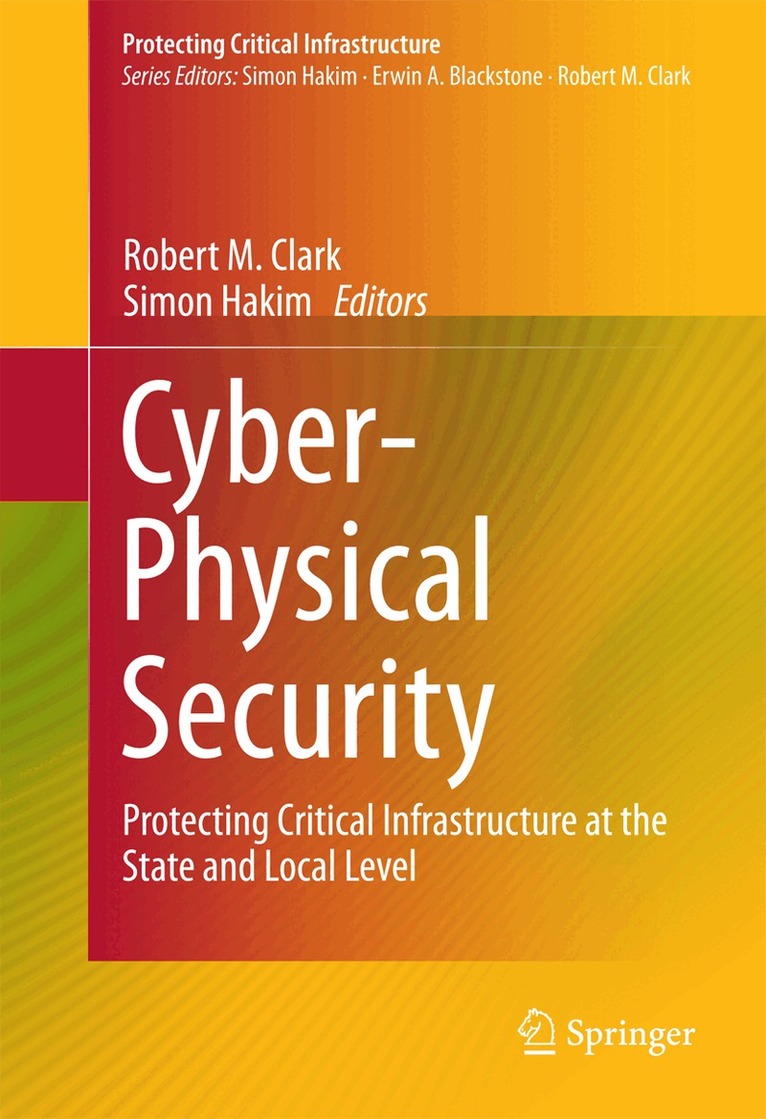
    Cyber-Physical Security

    Protecting Critical Infrastructure at the State and Local Level

    AvRobert M. Clark,Simon Hakim

    Inbunden, Engelska, 2016

    Del 3 i serien Protecting Critical Infrastructure

    1 517 kr

    Beställningsvara. Skickas inom 10-15 vardagar. Fri frakt över 249 kr.

    Beskrivning

    This book focuses on the vulnerabilities of state and local services to cyber-threats and suggests possible protective action that might be taken against such threats. Cyber-threats to U.S. critical infrastructure are of growing concern to policymakers, managers and consumers. Information and communications technology (ICT) is ubiquitous and many ICT devices and other components are interdependent; therefore, disruption of one component may have a negative, cascading effect on others.  Cyber-attacks might include denial of service, theft or manipulation of data.  Damage to critical infrastructure through a cyber-based attack could have a significant impact on the national security, the economy, and the livelihood and safety of many individual citizens.  Traditionally cyber security has generally been viewed as being focused on higher level threats such as those against the internet or the Federal government.  Little attention has been paid to cyber-security at the state and local level.  However, these governmental units play a critical role in providing services to local residents and consequently are highly vulnerable to cyber-threats. The failure of these services, such as waste water collection and water supply, transportation, public safety, utility services, and communication services, would pose a great threat to the public.  Featuring contributions from leading experts in the field, this volume is intended for state and local government officials and managers, state and Federal officials, academics, and public policy specialists.

    Produktinformation

    • Utgivningsdatum:2016-08-18
    • Mått:155 x 235 x 22 mm
    • Vikt:617 g
    • Format:Inbunden
    • Språk:Engelska
    • Serie:Protecting Critical Infrastructure
    • Antal sidor:281
    • Upplaga:16001
    • Förlag:Springer International Publishing AG
    • ISBN:9783319328225

    Utforska kategorier

    • Politisk aktivism inom Samhälle och politik

    Mer om författaren

    Robert M. Clark is currently an independent consultant in environmentalengineering and public health. He is an Adjunct Professor in Civil andEnvironmental Engineering at the University of Cincinnati and recentlycompleted service as a member of the National Research Council’s Committeeon ‘‘Public Water Distribution Systems: Assessing and Reducing Risks.’’ As aconsultant Dr. Clark has worked on homeland security issues with Sandia NationalLaboratories, the US Environmental Protection Agency (USEPA) and RutgersUniversity (Newark Campus), among others. He served as an environmentalengineer in the U.S. Public Health Service and the U.S. EPA from 1961 to August2002 and was Director of the USEPA’s Water Supply and Water ResourcesDivision (WSWRD) for 14 years (1985–1999). In 1999 he was appointed to aSenior Expert Position in the USEPA with the title Senior Research EngineeringAdvisor and retired from the USEPA in August of 2002. Dr. Clark was a memberof USEPA’s Water Protection Task Force and was USEPA’s liaison for homelandsecurity research. Dr. Clark has published over 380 papers and 5 books and hasbeen professionally active in several organizations where he served in numerousleadership positions. He is a lifetime member of both the American Water WorksAssociation (AWWA) and the American Society of Civil Engineers (ASCE).Dr. Clark is recognized both nationally and internationally and has receivednumerous awards for his work. Dr. Clark holds B.S. degrees in Civil Engineeringfrom Oregon State University (1960), and in Mathematics from Portland StateUniversity (1961), M.S. degrees in Mathematics from Xavier University (1964),and Civil Engineering from Cornell University (1968) and a Ph.D. inEnvironmental Engineering from the University of Cincinnati (1976). He is aregistered engineer in the State of OhioSimon Hakim is a professor of economics and director of the Center forCompetitive Government at Temple University. He is currently editing a bookseries on Protecting Critical Infrastructures with Springer Publisher. He earnedM.A. and Ph.D. degrees in Regional Science from the University of Pennsylvania.He also holds an M.Sc. degree in City and Regional Planning from the Technion,Israel Institute of Technology, and a B.A. in Economics at Hebrew University inJerusalem. His special areas of research and teaching are privatization, publicpolicy, private/public police, and homeland security. Dr. Hakim has published 58scientific articles in leading economic, criminal justice, security, and public policyjournals. He has written over 40 professional articles and edited 14 books. Hecollaborated with Professor Blackstone on a major textbook dealing with thesecurity industry. He is constantly invited to teach classes on privatization, andinternational economics in MBA programs worldwide. Dr. Hakim has conductedseveral funded research and consulting projects for the U.S. Departments of Justiceand Labor, the Commonwealth Foundation, the Independent Institute, the AlarmIndustry Research and Education Foundation, the City of Philadelphia, the Philadelphia International Airport, ADT, Vector Security, and other leadingsecurity companies.

    Innehållsförteckning

    • Protecting Critical Infrastructure at the State Provincial and Local Level: Issues in Cyber-Physical Security.- Cybersecurity Terminology and Frameworks.- Assessing Cyber Threats and Solutions for Municipalities.- Cyber Perimeters for Critical Infrastructures.- A Security Evaluation of a Municipal Computer Network: The Case of Collaboration between the City of Pittsburgh and Carnegie Mellon University.- Cyber Risks in the Marine Transportation System.- Creating a Cybersecurity Culture for Your Water/Waste Water Utility.- The Community Cyber Security Maturity Model.- Fighting Cybercrime: A Joint Effort.- Cybersecurity Challenges: The Israeli Water Sector Example.- Efforts to Get People Involved In Cyber-Physical Security: Case Studies of Australia And Singapore.- Cyber Security, Trust-Building and Trust-Management:  As Tools for Multi-Agency Cooperation within the Functions Vital To SocietyAn Analysis of the Nature of Spam as Cybercrime.- Securing theAutomotive Critical Infrastructure