Häftad, Engelska, 2016
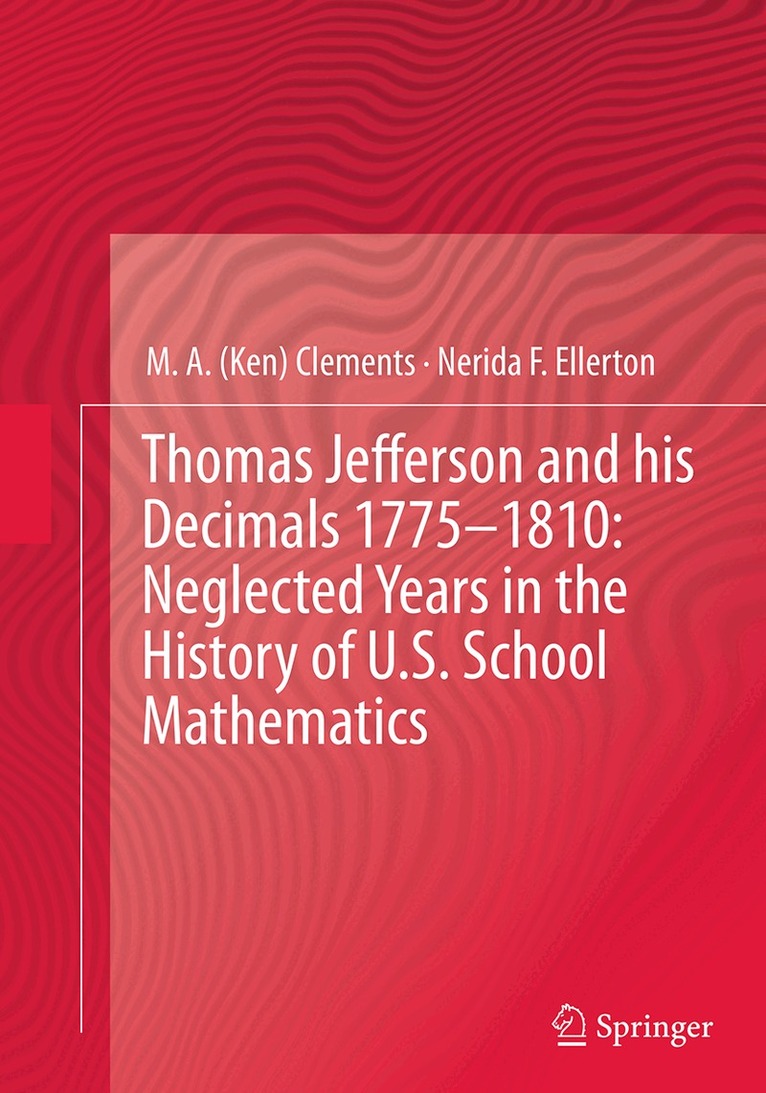
Thomas Jefferson and his Decimals 1775–1810: Neglected Years in the History of U.S. School Mathematics
Av M.A. (Ken) Clements, Nerida F. Ellerton
551 kr
Beställningsvara. Skickas inom 10-15 vardagar. Fri frakt över 249 kr.
Beskrivning
This well-illustrated book, by two established historians of school mathematics, documents Thomas Jefferson’s quest, after 1775, to introduce a form of decimal currency to the fledgling United States of America. The book describes a remarkable study showing how the United States’ decision to adopt a fully decimalized, carefully conceived national currency ultimately had a profound effect on U.S. school mathematics curricula.The book shows, by analyzing a large set of arithmetic textbooks and an even larger set of handwritten cyphering books, that although most eighteenth- and nineteenth-century authors of arithmetic textbooks included sections on vulgar and decimal fractions, most school students who prepared cyphering books did not study either vulgar or decimal fractions. In other words, author-intended school arithmetic curricula were not matched by teacher-implemented school arithmetic curricula. Amazingly, that state of affairs continued even after the U.S. Mint began minting dollars, cents and dimes in the 1790s. In U.S. schools between 1775 and 1810 it was often the case that Federal money was studied but decimal fractions were not. That gradually changed during the first century of the formal existence of the United States of America. By contrast, Chapter 6 reports a comparative analysis of data showing that in Great Britain only a minority of eighteenth- and nineteenth-century school students studied decimal fractions. Clements and Ellerton argue that Jefferson’s success in establishing a system of decimalized Federal money had educationally significant effects on implemented school arithmetic curricula in the United States of America.The lens through which Clements and Ellerton have analyzed their large data sets has been the lag-time theoretical position which they have developed. That theory posits that the time between when an important mathematical “discovery” is made (or a concept is“created”) and when that discovery (or concept) becomes an important part of school mathematics is dependent on mathematical, social, political and economic factors. Thus, lag time varies from region to region, and from nation to nation.Clements and Ellerton are the first to identify the years after 1775 as the dawn of a new day in U.S. school mathematics—traditionally, historians have argued that nothing in U.S. school mathematics was worthy of serious study until the 1820s. This book emphasizes the importance of the acceptance of decimal currency so far as school mathematics is concerned. It also draws attention to the consequences for school mathematics of the conscious decision of the U.S. Congress not to proceed with Thomas Jefferson’s grand scheme for a system of decimalized weights and measures.
Produktinformation
- Utgivningsdatum: 2016-08-23
- Mått: 178 x 254 x 13 mm
- Vikt: 431 g
- Format: Häftad
- Språk: Engelska
- Antal sidor: 204
- Förlag: Springer International Publishing AG
- ISBN: 9783319347103
Utforska kategorier
Betyg & recensioner
0 recensioner
Inga recensioner tillgängliga.