• Fri frakt över 249 kr
  • •
  • Snabba leveranser
  • •
  • Billiga böcker
Kundservice

Du är på sajten för privatpersoner.

Företag, bibliotek eller offentlig verksamhet?

Du handlar på classic.bokus.com, där alla dina funktioner finns intakta.
Till classic.bokus.com
Bokus logotyp. Gå till startsidan.
  • Erbjudanden
  • Nyheter
  • Student
  • Topplistor
  • Barn & ungdom
  • Bokus Play
  • E-böcker
  • Pocketböcker
  • Spel & pussel

10% rabatt på allt med kod NYSTART10 →

Sidfot

Mina sidor

    Hjälp

    • Kundservice
    • Vanliga frågor och svar
    • Frakt och leverans
    • Retur vid ångerrätt
    • Reklamera vara
    • Betalning
    • Köpvillkor
    • Allmänna villkor
    • Information om webbplatsens tillgänglighet

    Om Bokus

    • Om oss
    • Pressrum
    • För studenter
    • För företag
    • För bibliotek och offentlig verksamhet
    • För leverantörer
    • Hållbarhet

    Populärt

    • Aktuella erbjudanden
    • Presentkort
    • Studentlitteratur
    • Nya böcker
    • Topplistor
    • Signerade böcker
    • Engelska böcker

    Inspiration

    • Boktips
    • BookTok
    • Populära bokserier
    • Barnbokskaraktärer
    • Populära författare
    Logotyp för Bokus
    Följ oss på Facebook (extern länk)Följ oss på Instagram (extern länk)Följ oss på YouTube (extern länk)Följ oss på TikTok (extern länk)
    bokus @ CookiesAnpassa cookiesIntegritetspolicyKöpvillkor
    Till Citymail hemsida (extern länk)Till Budbee hemsida (extern länk)Till Postnord hemsida (extern länk)Till Schenker hemsida (extern länk)Till Early Bird hemsida (extern länk)Till Walleys hemsida (extern länk)
    1. Samhälle och politik
    2. Sociologi och antropologi
    3. Sociologi

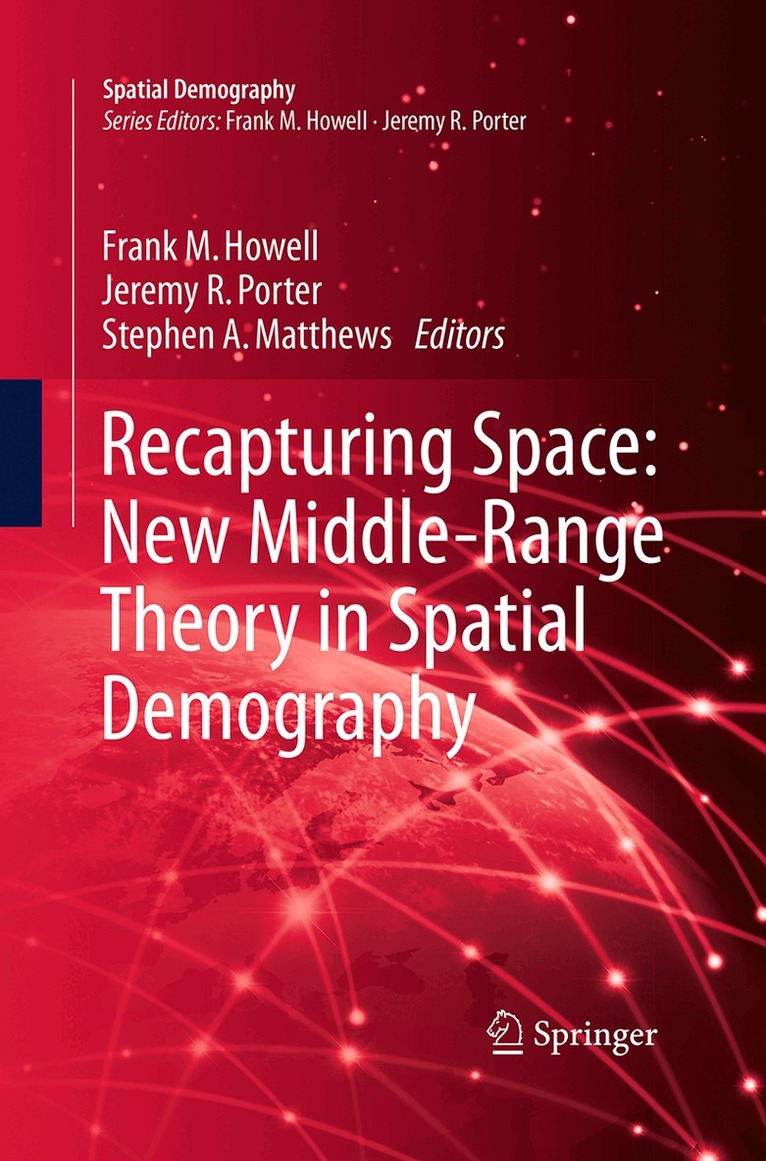
    Recapturing Space: New Middle-Range Theory in Spatial Demography

    AvFrank M. Howell,Jeremy R. Porter

    Häftad, Engelska, 2016

    Del 1 i serien Spatial Demography Book Series

    1 086 kr

    Beställningsvara. Skickas inom 10-15 vardagar. Fri frakt över 249 kr.

    Beskrivning

    With a unique focus on middle-range theory, this book details the application of spatial analysis to demographic research as a way of integrating and better understanding the different transitional components of the overall demographic transition.This book first details key concepts and measures in modern spatial demography and shows how they can be applied to middle-range theory to better understand people, places, communities and relationships throughout the world. Next, it shows middle-range theory in practice, from using spatial data as a proxy for social science statistics to examining the effect of "fracking” in Pennsylvania on the formation of new coalitions among environmental advocacy organizations. The book also traces future developments and offers some potential solutions to promoting and facilitating instruction in spatial demography.This volume is an ideal resource for advanced undergraduate and graduate students enrolled in courses involving spatial analyses in the social sciences, from sociology and political science to economics and educational research. In addition, scholars and others interested in the role that geographic context plays in relation to their research will find this book a helpful guide in further developing their work.

    Produktinformation

    • Utgivningsdatum:2016-08-23
    • Mått:155 x 235 x 21 mm
    • Vikt:587 g
    • Format:Häftad
    • Språk:Engelska
    • Serie:Spatial Demography Book Series
    • Antal sidor:379
    • Förlag:Springer International Publishing AG
    • ISBN:9783319371245

    Utforska kategorier

    • Sociologi inom Samhälle och politik
    • Regional planering inom Naturvetenskap och teknik
    • Geografi inom Naturvetenskap och teknik

    Recensioner i media

    “This edited volume, the first in Springer’s Spatial Demography series, identifies priorities and challenges in the field of spatial demography. … anyone who reads it from beginning to end will be exposed to much of the core theory as well as a sampling of contemporary tools.” (John Casterline, Population and Development Review, Vol. 42 (3), September, 2016)

    Innehållsförteckning

    • Introduction: Chapter 1. Recapturing Spatial Approaches to Social Science Problems: Frank M. Howell, Jeremy R. Porter and Stephen Mathews.- Part I. Theory, Concept, and Measures: Chapter 2. Challenges of Spatial Thinking: John R. Logan, Brown University.- Chapter 3. Extending the Boundaries of Place: Carlos Siordia and Stephen A. Matthews.- Chapter 4.  Using Place-and Person-Based Interventions to Measure Neighborhood Effects: Noli Brazil.- Chapter 5. From aspatial to spatial, from global to local and individual: Are we on the right track to spatialize segregation measures?: David W. Wong.- Chapter 6. Demography Is an Inherently Spatial Science: John R. Weeks.- Part II. Research Practice in Spatial Demography: Chapter 7. Modeling 'Dependence of Relevant Alternatives' in Consumer Choice: A Synthesis From Disparate Literatures: Lee Rivers Mobley and Gloria Bazzoli.- Chapter 8. Bringing Together Spatial Demography and Political Science: Reexamining The Big Sort: David Darmofal and Ryan Strickler.- Part III. Middle Range Theory in Application: Chapter 9. Demography and Democracy:  Exploring the linkage between age and voter turnout in Italy with geospatial analysis: Michael Shin and John Agnew.- Chapter 10. A Spatial Decomposition of County Population Growth in the United States: Population Redistribution in the Rural-to-Urban Continuum, 1980-2010: Jeremy R. Porter and Frank M. Howell.- Chapter 11. Socio-spatial holes in the advocacy umbrella: The spatial diffusion of risk and network response among environmental organizations in the Marcellus hydro-fracturing region: Michael Irwin and Erin Pischke.- Chapter 12. American Civic Community over Space and Time: Charles Tolbert, F. Carson Menken, Troy Blanchard and Jing Li.- Chapter 13. Revisiting the Rural Paradox in US Counties with Spatial Durbin Modeling: Tse-Chuan Yang, Aggie J. Noah and Carla Shoff.- Chapter 14. Race, place, and space: Ecosocial theory and spatiotemporal patternsof  pregnancy outcomes: Michael R. Kramer.- Chapter 15. Using Nighttime lights Data as a Proxy in Social Scientific Research: Xi Chen.- Chapter 16. Human Migration and Spatial Synchrony: Spatial Patterns in Temporal Trends: Daniel M. Parker.- Part IV. Instruction in Spatial Demography and Concluding Remarks: Chapter 17. Instruction in Spatial Demography: Stephen A. Mathews.- Chapter 18. Concluding Remarks: Developing Spatial Demography: Frank M. Howell, Jeremy R. Porter and Stephen A. Mathews.- Bibliography.