• Fri frakt över 249 kr
  • •
  • Snabba leveranser
  • •
  • Billiga böcker
Kundservice

Du är på sajten för privatpersoner.

Företag, bibliotek eller offentlig verksamhet?

Du handlar på classic.bokus.com, där alla dina funktioner finns intakta.
Till classic.bokus.com
Bokus logotyp. Gå till startsidan.
  • Erbjudanden
  • Student
  • Topplistor
  • Barn & ungdom
  • Bokus Play
  • E-böcker
  • Ljudböcker
  • Pocketböcker
  • Spel och pussel

Pocketfynda! Hundratals böcker för 49 kr/st →

Sidfot

Mina sidor

    Hjälp

    • Kundservice
    • Vanliga frågor och svar
    • Frakt och leverans
    • Retur vid ångerrätt
    • Reklamera vara
    • Betalning
    • Köpvillkor
    • Allmänna villkor
    • Information om webbplatsens tillgänglighet

    Om Bokus

    • Om oss
    • Pressrum
    • För studenter
    • För företag
    • För bibliotek och offentlig verksamhet
    • För leverantörer
    • Hållbarhet

    Populärt

    • Aktuella erbjudanden
    • Presentkort
    • Studentlitteratur
    • Nya böcker
    • Topplistor
    • Signerade böcker
    • Engelska böcker

    Inspiration

    • Boktips
    • BookTok
    • Barnbokskaraktärer
    • Populära författare
    Logotyp för Bokus
    Följ oss på Facebook (extern länk)Följ oss på Instagram (extern länk)Följ oss på YouTube (extern länk)Följ oss på TikTok (extern länk)
    bokus @ CookiesAnpassa cookiesIntegritetspolicyKöpvillkor
    Till Citymail hemsida (extern länk)Till Budbee hemsida (extern länk)Till Postnord hemsida (extern länk)Till Schenker hemsida (extern länk)Till Early Bird hemsida (extern länk)Till Walleys hemsida (extern länk)
    1. Psykologi och pedagogik
    2. Pedagogik
    3. Pedagogisk psykologi

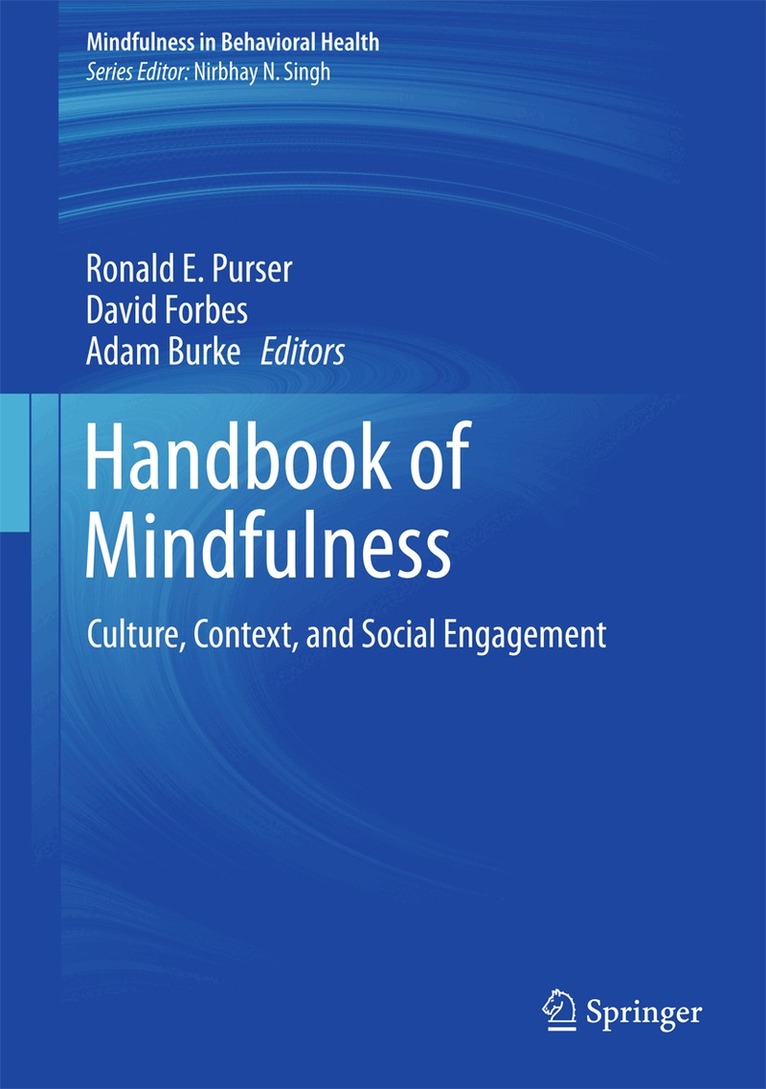
    Handbook of Mindfulness

    Culture, Context, and Social Engagement

    AvRonald E. Purser,David Forbes

    Inbunden, Engelska, 2016

    Del i serien Mindfulness in Behavioral Health

    2 364 kr

    Beställningsvara. Skickas inom 10-15 vardagar. Fri frakt över 249 kr.

    Beskrivning

    This handbook explores mindfulness philosophy and practice as it functions in today’s socioeconomic, cultural, and political landscape. Chapters discuss the many ways in which classic concepts and practices of mindfulness clash, converge, and influence modern theories and methods, and vice versa. Experts across many disciplines address the secularization and commercialization of Buddhist concepts, the medicalizing of mindfulness in therapies, and progressive uses of mindfulness in education. The book addresses the rise of the, “mindfulness movement”, and the core concerns behind the critiques of the growing popularity of mindfulness. It covers a range of dichotomies, such as traditional versus modern, religious versus secular, and commodification versus critical thought and probes beyond the East/West binary to larger questions of economics, philosophy, ethics, and, ultimately, meaning.Featured topics include:A compilation of Buddhist meditativepractices.Selling mindfulness and the marketing of mindful products.A meta-critique of mindfulness critiques - from McMindfulness to critical mindfulnessMindfulness-based interventions in clinical psychology and neuroscience.Corporate mindfulness and usage in the workplace.Community-engaged mindfulness and its role in social justice.The Handbook of Mindfulness is a must-have resource for clinical psychologists, complementary and alternative medicine professionals/practitioners, neuroscientists, and educational and business/management leaders and policymakers as well as related mental health, medical, and educational professionals/practitioners.

    Produktinformation

    • Utgivningsdatum:2016-11-04
    • Mått:178 x 254 x 36 mm
    • Vikt:1 230 g
    • Format:Inbunden
    • Språk:Engelska
    • Serie:Mindfulness in Behavioral Health
    • Antal sidor:514
    • Upplaga:16001
    • Förlag:Springer International Publishing AG
    • ISBN:9783319440170

    Utforska kategorier

    • Pedagogisk psykologi inom Psykologi och pedagogik
    • Utbildningsstrategier och utbildningspolitik inom Psykologi och pedagogik
    • Biovetenskap inom Naturvetenskap och teknik

    Mer om författaren

    Ronald E. Purser, Ph.D., is a Professor of Management at San Francisco State University where he has taught the in the MBA and undergraduate business programs, as well in the doctoral program in the College of Education. Prior to his current appointment, he was an Associate Professor of Organization Development at Loyola University of Chicago. His recent research has been exploring the challenges and issues of introducing mindfulness into secular contexts, particularly critical perspectives of mindfulness in corporate settings. Author and co-editor of five books, including 24/7: Time and Temporality in the Network Society (Stanford University Press, 2007). He sits on the editorial board of the Mindfulness journal, as well as the executive board of the Consciousness, Mindfulness and Compassion (CMC) International Association. A student and Buddhist practitioner since 1981, he was recently ordained as a Dharma instructor in the Korean Zen Buddhist Taego order. His article “Beyond McMindfulness” (with David Loy) in the Huffington Post went viral in 2013.David Forbes, Ph.D., (U.C. Berkeley), LMHC, is Associate Professor in the School Counseling program in the School of Education at Brooklyn College/CUNY and affiliate faculty in the Urban Education doctoral program at the CUNY Graduate Center. He was a co-recipient of a program grant from the Center for Contemplative Mind in Society and wrote Boyz 2 Buddhas: Counseling Urban High School Male Athletes in the Zone (Peter Lang, 2004) about counseling and teaching mindfulness meditation to a Brooklyn high school football team.  Forbes teaches critical and integral approaches to mindfulness. He writes on the social and cultural context of mindfulness in education and wrote “Occupy Mindfulness” and "Search Outside Yourself: Google Misses a Lesson in Wisdom 101” with Ron Purser. He consults with schools in New York on developing integral mindfulness programs and practices meditation with a group from the New York Insight Meditation Center.‬‬ ‬‬‬‬‬‬‬‬‬Adam Burke, Ph.D., M.P.H., is a Professor in Health Education and Director of the Institute for Holistic Health Studies at San Francisco State University. He holds advanced degrees in the social/behavioral sciences from UCLA and UC Santa Cruz, and is a licensed acupuncturist, trained in San Francisco and Sichuan, China. Meditation training and practice commenced in the 1970’s and continues across diverse traditions. Research and publication interests focus on student achievement and education equity, meditation and imagery, and cross-cultural studies of traditional health practices. Recent published works include Learning Life (Rainor Media, 2016). He has served on the American Public Health Association’s Governing Council, as chair of the California Acupuncture Board, editor-in-chief of the American Acupuncturist, and as an Advisory Council member of the NIH’s National Center for Complementary and Integrative Health (NCCIH).

    Innehållsförteckning

    • PART I: Between Tradition and Modernity.- Chapter 1. The Transformations of Mindfulness.- Chapter 2. The Challenge of Mindful Engagement.- Chapter 3. Paying Attention in a Digital Economy: Reflections on The Role of Analysis and Judgment Within Contemporary Discourses of Mindfulness and Comparisons with Classical Buddhist Accounts of Sati.- Chapter 4. Exploring the Full Range of Buddhist Meditative Practices: Moving Beyond One Size Fits All.- Chapter 5. Mindfulness: Traditional and Utilitarian.- Chapter 6. Can Secular Mindfulness be Separated from Religion?.- Chapter 7. The Mindful Self in Space Time.- PART II: Neoliberal Mindfulness vs. Critical Mindfulness.- Chapter 8. Selling Mindfulness: Commodity Lineages and the Marketing of Mindful Products.- Chapter 9. Mindfulness and the Moral Imperative for the Self to Improve the Self.- Chapter 10. The Critique of Mindfulness and the Mindfulness of Critique: Paying Attention with Foucault’s Analytic of Governmentality.- Chapter11. A Meta-Critique of Mindfulness Critiques: From McMindfulness to Critical Mindfulness.- Chapter 12. Notes Towards a Coming Backlash: Mindfulness as an Opiate of the Middle-Classes.- Chapter 13. Is There a Corporate Takeover of the Mindfulness Industry?.- Chapter 14. Corporate Mindfulness and the Pathologization of Workplace Stress.- Chapter 15. Mindfulness in the Working Life: In Search for New Spaces of Awareness and Equanimity.- PART III: Genealogies of Mindfulness-Based Interventions.- Chapter 16. Against One Method: Contemplation in Context.- Chapter 17. Mindfulness-Based Interventions: Clinical Psychology, Buddhadharma, or Both? A Wisdom Perspective.- Chapter 18. Mindfulness: The Bottled Water of the Psychotherapy Industry.- Chapter 19. The Fourth Treasure: Psychotherapy’s Contribution to the Dharma.- Chapter 20. Constructing the Mindful Subject: A Discourse Analysis of 'Inquiry' in Mindfulness-Based Stress Reduction.- Chapter 21. Saving the World: Personalized Communication of Mindfulness Neuroscience.- Chapter 22. The Ultimate Rx: Cutting Through the Delusion of Self-Cherishing.- PART IV: Mindfulness as Critical Pedagogy.- Chapter 23. Critical Integral Contemplative Education.- Chapter 24. What is the Sound of One Invisible Hand Clapping?: Neoliberalism, the Invisibility of Asian and Asian American Buddhists, and Secular Mindfulness in Education.- Chapter 25. Looking Through a Glass Darkly: The Neglect of Ethical and Educational Elements in Mindfulness-Based Interventions.- Chapter 26. Education as the Practice of Freedom: A Social Justice Approach for Mindfulness Educators.- Chapter 27. The Curriculum of Right Mindfulness: The Relational Self and the Capacity for Compassion.- Chapter 28. ​Community-Engaged Mindfulness and Social Justice: An Inquiry and Call to Action.- Chapter 29. A Critical and Comprehensive Review of Mindfulness in the Early Years.- Chapter 30. A “Mechanism of Hope”: Mindfulness, Education and the Developing Brain.- Chapter 31. Using a Mindfulness-Oriented Academic Success Course toReduce Self-Limiting Social Stereotypes in a Higher Education Context.- PART V: Commentary.- Chapter 32. Meditation Matters: Replies to the Anti-McMindfulness Bandwagon.- Chapter 33. Criticism Matters: A Response to Rick Repetti.