• Fri frakt över 249 kr
  • •
  • Snabba leveranser
  • •
  • Billiga böcker
Kundservice

Du är på sajten för privatpersoner.

Företag, bibliotek eller offentlig verksamhet?

Du handlar på classic.bokus.com, där alla dina funktioner finns intakta.
Till classic.bokus.com
Bokus logotyp. Gå till startsidan.
  • Erbjudanden
  • Nyheter
  • Student
  • Topplistor
  • Barn & ungdom
  • Bokus Play
  • E-böcker
  • Pocketböcker
  • Spel & pussel

Må bättre, för mindre! Upp till 50% rabatt på hälsoböcker

Sidfot

Mina sidor

    Hjälp

    • Kundservice
    • Vanliga frågor och svar
    • Frakt och leverans
    • Retur vid ångerrätt
    • Reklamera vara
    • Betalning
    • Köpvillkor
    • Allmänna villkor
    • Information om webbplatsens tillgänglighet

    Om Bokus

    • Om oss
    • Pressrum
    • För studenter
    • För företag
    • För bibliotek och offentlig verksamhet
    • För leverantörer
    • Hållbarhet

    Populärt

    • Aktuella erbjudanden
    • Presentkort
    • Studentlitteratur
    • Nya böcker
    • Topplistor
    • Signerade böcker
    • Engelska böcker

    Inspiration

    • Boktips
    • BookTok
    • Populära bokserier
    • Barnbokskaraktärer
    • Populära författare
    Logotyp för Bokus
    Följ oss på Facebook (extern länk)Följ oss på Instagram (extern länk)Följ oss på YouTube (extern länk)Följ oss på TikTok (extern länk)
    bokus @ CookiesAnpassa cookiesIntegritetspolicyKöpvillkor
    Till Citymail hemsida (extern länk)Till Budbee hemsida (extern länk)Till Postnord hemsida (extern länk)Till Schenker hemsida (extern länk)Till Early Bird hemsida (extern länk)Till Walleys hemsida (extern länk)
    1. Psykologi och pedagogik
    2. Pedagogik
    3. Pedagogisk psykologi

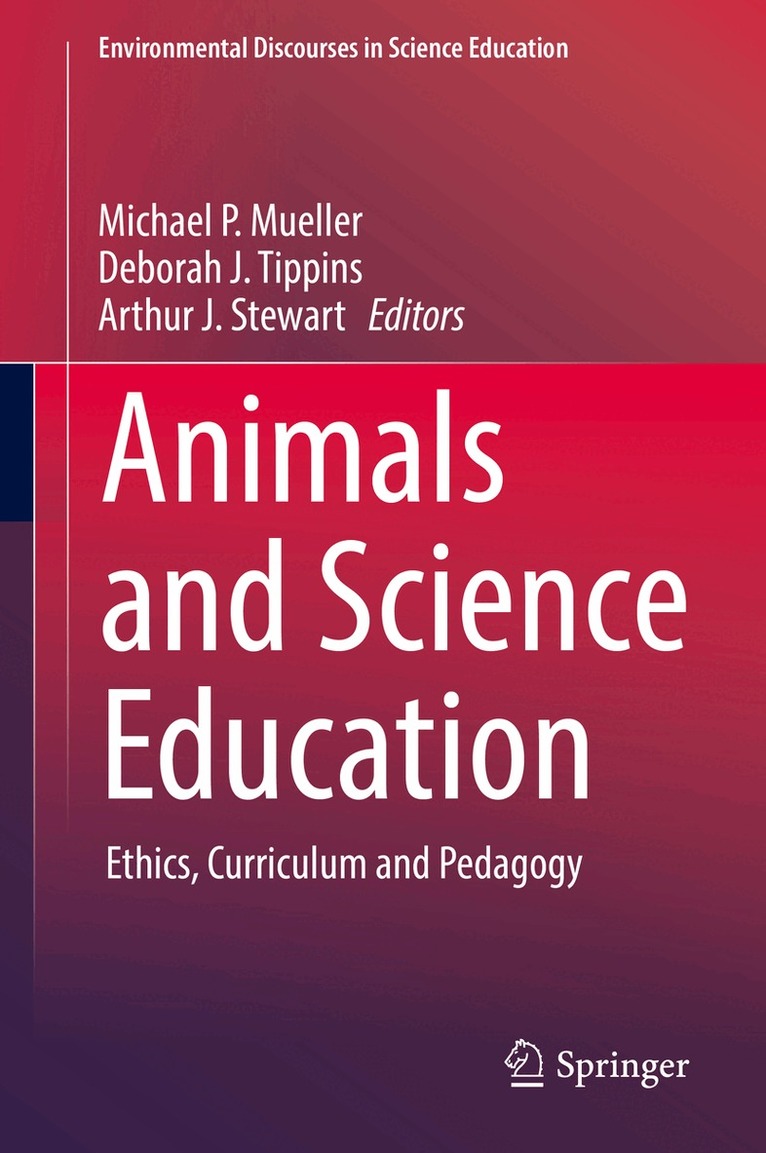
    Animals and Science Education

    Ethics, Curriculum and Pedagogy

    AvMichael P. Mueller,Deborah J. Tippins

    Inbunden, Engelska, 2017

    Del i serien Environmental Discourses in Science Education

    1 626 kr

    Beställningsvara. Skickas inom 10-15 vardagar. Fri frakt över 249 kr.

    Beskrivning

    This book discusses how we can inspire today’s youth to engage in challenging and productive discussions around the past, present and future role of animals in science education. Animals play a large role in the sciences and science education and yet they remain one of the least visible topics in the educational literature. This book is intended to cultivate research topics, conversations, and dispositions for the ethical use of animals in science and education. This book explores the vital role of animals with/in science education, specimens, protected species, and other associated issues with regards to the role of animals in science. Topics explored include ethical, curriculum and pedagogical dimensions, involving invertebrates, engineering solutions that contribute to ecosystems, the experiences of animals under our care, aesthetic and contemplative practices alongside science, school-based ethical dialogue, nature study for promoting inquiry and sustainability, the challenge ofwhether animals need to be used for science whatsoever, reconceptualizing museum specimens, cultivating socioscientific issues and epistemic practice, cultural integrity and citizen science, the care and nurturance of gender-balanced curriculum choices for science education, and theoretical conversations around cultivating critical thinking skills and ethical dispositions. The diverse authors in this book take on the logic of domination and symbolic violence embodied within the scientific enterprise that has systematically subjugated animals and nature, and emboldened the anthropocentric and exploitative expressions for the future role of animals.At a time when animals are getting excluded from classrooms (too dangerous! too many allergies!  too dirty!), this book is an important counterpoint. Interacting with animals helps students develop empathy, learn to care for living things, engage with content. We need more animals in the science curriculum, not less.David Sobel, Senior Faculty, Education Department, Antioch University New England

    Produktinformation

    • Utgivningsdatum:2017-06-26
    • Mått:155 x 235 x 21 mm
    • Vikt:594 g
    • Format:Inbunden
    • Språk:Engelska
    • Serie:Environmental Discourses in Science Education
    • Antal sidor:265
    • Upplaga:17001
    • Förlag:Springer International Publishing AG
    • ISBN:9783319563749

    Utforska kategorier

    • Pedagogisk psykologi inom Psykologi och pedagogik
    • Läroplaner och kursplaner inom Psykologi och pedagogik
    • Biologi inom Naturvetenskap och teknik

    Recensioner i media

    “This text is an approachable, informative, and playful resource to augment curricular and other pedagogical practices in science education with a dimension of animal ethics. … Readers involved in education at the grade school level will find this text inspiring, as will readers in educational studies. Scholars interested in practical applications of ideas from animal ethics, ecological ethics, and/or interspecies justice will find this text useful for its case studies. … Summing Up: Highly recommended. All readers.” (S. M. Weiss, Choice, Vol. 55 (10), June, 2018)

    Innehållsförteckning

    • Foreword: Wild Awakedness and Animalistic Inquiry: Introducing a Book on the Role of Animals with/in Science Education, Michael P. Mueller (University of Alaska Anchorage), Arthur J. Stewart (Oak Ridge Associated Universities), and Deborah J. Tippins (University of Georgia).- Chapter 1: Worm Spit: Integrating Curriculum through a Study of Silk and the Amazing Silk Worm, Michael L. Bentley (Virginia Museum of Natural History) and Teresa Auldridge (Full Option Science System).- Chapter 2: You Can Give a Bee Some Water, But You Can’t Make Her Drink: A Socioscientific Approach to Honey Bees in Science Education, Jonathan Snow and Maria S. Rivera Maulucci (Barnard College).- Chapter 3: Engineering a Solution for Fish Waste Management, Alexandra E. West (University of Alaska Anchorage).- Chapter 4: Learning Science in Aquariums and on Whalewatching Boats—The Hidden Curriculum of the Deployment of Other Animals, Teresa Lloro-Bidart (California State Polytechnic University at Pomona) and Connie Russell (Lakehead University).- Chapter 5: Tracing the Anthrozoological Landscape of Central Iowa: Place and Pedagogical Possibilities, Cori Jakubiak (Grinnell College).- Chapter 6: Life After the Fact(ory)—Pedagogy of Care at An Animal Sanctuary, Christopher Bentley and Steve Alsop (York University).- Chapter 7: Ethical-Ecological Holism in Science Pedagogy—In Honor of Sea Urchins, Lee Beavington, Heesoon Bai, (Simon Fraser University)and Serenna Celeste Romanycia.- Chapter 8: A Story of Chicks, Science Fairs and the Ethics of Biomedical Research, Sophia Jeong, Deborah Tippins (University of Georgia), Shakhnoza Kayumova (Dartmouth University).- Chapter 9: Spiders, Rats, and Education, Jimmy Karlan (Antioch University New England).- Chapter 10: Leave the Pets Alone, Eduardo Dopico and Eva Garcia-Vazquez (University of Oviedo).- Chapter 11: Using Object-based Learning to Understand Animal Evolution, Paul Davies and Joanne Nicholl (University College London).- Chapter 12: Death in a Jar—The Study of Life, Mary Rebecca Warbington Wells (Armstrong State University).- Chapter 13: Socio-Scientific Issues for Scientific Literacy – The Evolution of an Environmental Education Program with a Focus on Birds, Andrew T. Kinslow and Troy D. Sadler (University of Missouri).- Chapter 14: Hawaiian Citizen Science—Journeys of Self Discovery and Understanding of Scientific Concepts through Culture and Nature Study in School Science Classes, Jennifer Kuwahara (University of Hawaii).- Chapter 15: Care-based Citizen Science: Nurturing an Ethic of Care to Support the Preservation of Biodiversity, Renée Lyons, Cassie Quigley and Michelle Cook (Clemson University).- Chapter 16: Mapping Conceptions of Wolf Hunting onto a Worldview ConceptualFramework—Hunting for a Worldview Theory, Teresa J. Shume (North Dakota State University).- Chapter 17: A Framework within which to Determine How We Should Use Animals in Science Education, Michael J. Reiss (University College London).- Index.