
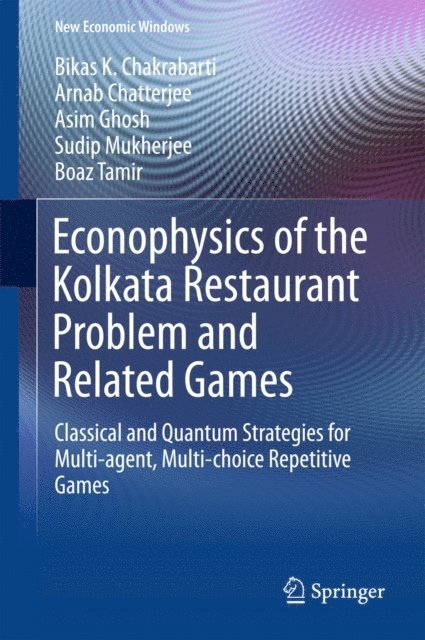
Econophysics of the Kolkata Restaurant Problem and Related Games
Classical and Quantum Strategies for Multi-agent, Multi-choice Repetitive Games
1 104 kr
Beställningsvara. Skickas inom 10-15 vardagar. Fri frakt över 249 kr.
Beskrivning
This book provides the first comprehensive introduction to multi-agent, multi-choice repetitive games, such as the Kolkata Restaurant Problem and the Minority Game. It explains how the tangible formulations of these games, using stochastic strategies developed by statistical physicists employing both classical and quantum physics, have led to very efficient solutions to the problems posed. Further, it includes sufficient introductory notes on information-processing strategies employing both classical statistical physics and quantum mechanics. Games of this nature, in which agents are presented with choices, from among which their goal is to make the minority choice, offer effective means of modeling herd behavior and market dynamics and are highly relevant to assessing systemic risk. Accordingly, this book will be of interest to economists, physicists, and computer scientists alike.
Produktinformation
Utforska kategorier
Mer om författaren
Innehållsförteckning
Hoppa över listan


Mer från samma författare
Del 55
Statistical Physics of Fracture and Breakdown in Disordered Systems
Bikas K. Chakrabarti, L. Gilles Benguigui
Inbunden, 1997
822 kr
Statistics of Linear Polymers in Disordered Media
CHAKRABARTI, Bikas K. Chakrabarti
Inbunden, 2005
1 898 kr
Del 168
Econophysics of Income and Wealth Distributions
Bikas K. Chakrabarti, Anirban Chakraborti, Satya R. Chakravarty, Arnab Chatterjee
Inbunden, 2013
2 199 kr
Quantum Phase Transitions in Transverse Field Spin Models
Amit Dutta, Gabriel Aeppli, Bikas K. Chakrabarti, Uma Divakaran, Thomas F. Rosenbaum, Diptiman Sen
Inbunden, 2015
1 737 kr
Hoppa över listan


Mer från samma serie
New Perspectives and Challenges in Econophysics and Sociophysics
Frédéric Abergel, Bikas K. Chakrabarti, Anirban Chakraborti, Nivedita Deo, Kiran Sharma
Inbunden, 2019
1 433 kr
How Labor Powers the Global Economy
Emmanuel D. Farjoun, Moshé Machover, David Zachariah
Inbunden, 2022
1 104 kr
How Labor Powers the Global Economy
Emmanuel D. Farjoun, Moshé Machover, David Zachariah
Häftad, 2023
1 104 kr
Quantum Decision Theory and Complexity Modelling in Economics and Public Policy
Anirban Chakraborti, Emmanuel Haven, Sudip Patra, Naresh Singh
Inbunden, 2023
2 267 kr
Quantum Decision Theory and Complexity Modelling in Economics and Public Policy
Anirban Chakraborti, Emmanuel Haven, Sudip Patra, Naresh Singh
Häftad, 2024
1 589 kr
Complexity and Emergence in Market Ecosystems
Debora Sarno, Francesco Polese, Stephen Louis Vargo
Inbunden, 2025
1 702 kr
Complexity and Emergence in Market Ecosystems
Debora Sarno, Francesco Polese, Stephen Louis Vargo
Häftad, 2026
1 653 kr
Hoppa över listan
Du kanske också är intresserad av
Econophysics of Agent-Based Models
Frédéric Abergel, Hideaki Aoyama, Bikas K. Chakrabarti, Anirban Chakraborti, Asim Ghosh
Inbunden, 2013
1 653 kr
Econophysics of Systemic Risk and Network Dynamics
Frédéric Abergel, Bikas K. Chakrabarti, Anirban Chakraborti, Asim Ghosh
Inbunden, 2012
1 104 kr
Econophysics of Systemic Risk and Network Dynamics
Asim Ghosh, Anirban Chakraborti, Bikas K. Chakrabarti, Frederic Abergel
E-bok
20121 416 kr
Econophysics and Data Driven Modelling of Market Dynamics
Frédéric Abergel, Hideaki Aoyama, Bikas K. Chakrabarti, Anirban Chakraborti, Asim Ghosh
Inbunden, 2015
556 kr
Econophysics of the Kolkata Restaurant Problem and Related Games
Boaz Tamir, Sudip Mukherjee, Asim Ghosh, Arnab Chatterjee, Bikas K. Chakrabarti
E-bok
20171 413 kr
Econophysics and Data Driven Modelling of Market Dynamics
Asim Ghosh, Anirban Chakraborti, Bikas K. Chakrabarti, Hideaki Aoyama, Frederic Abergel
E-bok
2015718 kr
Econophysics of Systemic Risk and Network Dynamics
Frédéric Abergel, Bikas K. Chakrabarti, Anirban Chakraborti, Asim Ghosh
Häftad, 2014
1 238 kr
Econophysics of Agent-Based Models
Frédéric Abergel, Hideaki Aoyama, Bikas K. Chakrabarti, Anirban Chakraborti, Asim Ghosh
Häftad, 2016
1 653 kr
Econophysics of Agent-Based Models
Asim Ghosh, Anirban Chakraborti, Bikas K. Chakrabarti, Hideaki Aoyama, Frederic Abergel
E-bok
20132 065 kr
Econophysics and Data Driven Modelling of Market Dynamics
Frédéric Abergel, Hideaki Aoyama, Bikas K. Chakrabarti, Anirban Chakraborti, Asim Ghosh
Häftad, 2016
556 kr