• Fri frakt över 249 kr
  • •
  • Snabba leveranser
  • •
  • Billiga böcker
Kundservice

Du är på sajten för privatpersoner.

Företag, bibliotek eller offentlig verksamhet?

Du handlar på classic.bokus.com, där alla dina funktioner finns intakta.
Till classic.bokus.com
Bokus logotyp. Gå till startsidan.
  • Erbjudanden
  • Nyheter
  • Student
  • Topplistor
  • Barn & ungdom
  • Bokus Play
  • E-böcker
  • Pocketböcker
  • Spel & pussel

10% rabatt på allt med kod NYSTART10 →

Sidfot

Mina sidor

    Hjälp

    • Kundservice
    • Vanliga frågor och svar
    • Frakt och leverans
    • Retur vid ångerrätt
    • Reklamera vara
    • Betalning
    • Köpvillkor
    • Allmänna villkor
    • Information om webbplatsens tillgänglighet

    Om Bokus

    • Om oss
    • Pressrum
    • För studenter
    • För företag
    • För bibliotek och offentlig verksamhet
    • För leverantörer
    • Hållbarhet

    Populärt

    • Aktuella erbjudanden
    • Presentkort
    • Studentlitteratur
    • Nya böcker
    • Topplistor
    • Signerade böcker
    • Engelska böcker

    Inspiration

    • Boktips
    • BookTok
    • Populära bokserier
    • Barnbokskaraktärer
    • Populära författare
    Logotyp för Bokus
    Följ oss på Facebook (extern länk)Följ oss på Instagram (extern länk)Följ oss på YouTube (extern länk)Följ oss på TikTok (extern länk)
    bokus @ CookiesAnpassa cookiesIntegritetspolicyKöpvillkor
    Till Citymail hemsida (extern länk)Till Budbee hemsida (extern länk)Till Postnord hemsida (extern länk)Till Schenker hemsida (extern länk)Till Early Bird hemsida (extern länk)Till Walleys hemsida (extern länk)
    1. Data och IT
    2. Programmeringsböcker
    3. Programvaruutveckling

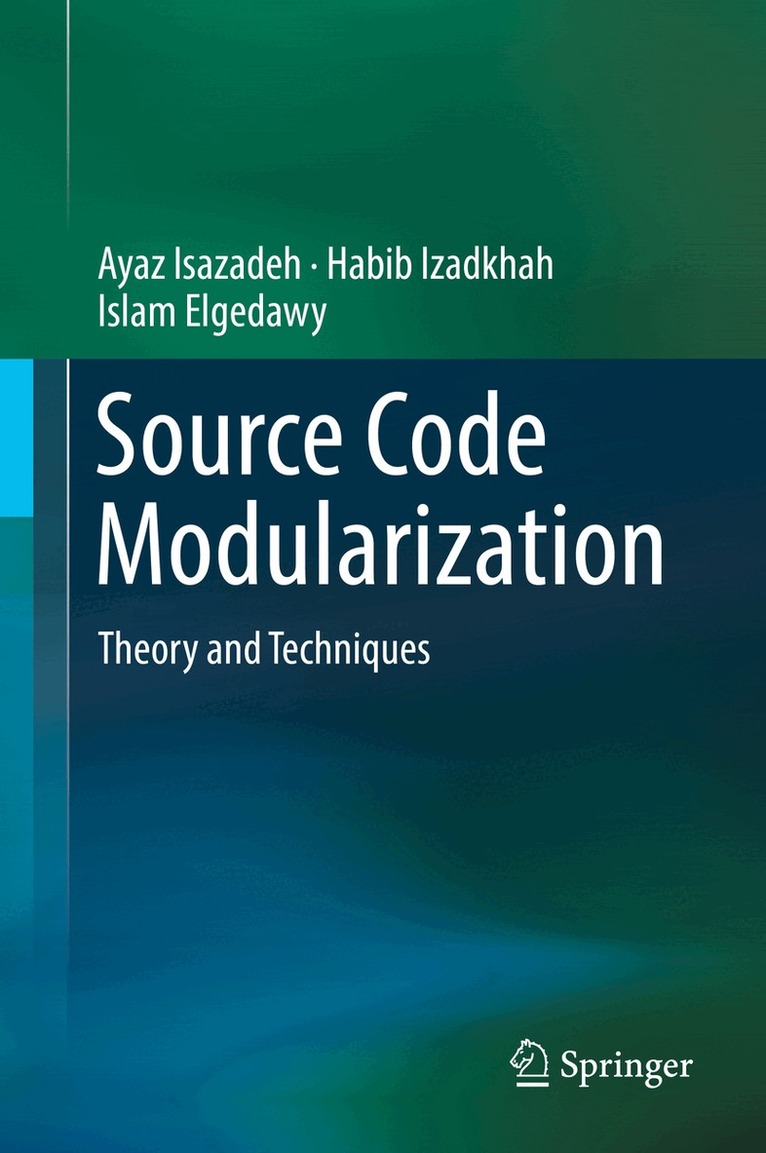
    Source Code Modularization

    Theory and Techniques

    AvAyaz Isazadeh,Habib Izadkhah

    Inbunden, Engelska, 2017

    562 kr

    Beställningsvara. Skickas inom 10-15 vardagar. Fri frakt över 249 kr.

    Fler format och utgåvor

    Häftad

    562 kr

    Beskrivning

    This book presents source code modularization as a key activity in reverse engineering to extract the software architecture from the existing source code. To this end, it provides detailed techniques for source code modularization and discusses their effects on different software quality attributes. Nonetheless, it is not a mere survey of source code modularization algorithms, but rather a consistent and unifying theoretical modularization framework, and as such is the first publication that comprehensively examines the models and techniques for source code modularization.It enables readers to gain a thorough understanding of topics like software artifacts proximity, hierarchical and partitional modularization algorithms, search- and algebraic-based software modularization, software modularization evaluation techniques and software quality attributes and modularization.This book introduces students and software professionals to the fundamental ideas of source code modularization concepts, similarity/dissimilarity metrics, modularization metrics, and quality assurance. Further, it allows undergraduate and graduate students in software engineering, computer science, and computer engineering with no prior experience in the software industry to explore the subject in a step-by-step manner. Practitioners benefit from the structured presentation and comprehensive nature of the materials, while the large number of bibliographic references makes this book a valuable resource for researchers working on source code modularization.

    Produktinformation

    • Utgivningsdatum:2017-10-18
    • Mått:155 x 235 x 21 mm
    • Vikt:588 g
    • Format:Inbunden
    • Språk:Engelska
    • Antal sidor:265
    • Upplaga:17001
    • Förlag:Springer International Publishing AG
    • ISBN:9783319633442

    Utforska kategorier

    • Programvaruutveckling inom Data och IT
    • Affärsförhandlingar inom Ekonomi och Ledarskap
    • Affärsapplikationer inom Data och IT

    Mer om författaren

    Ayaz Isazadeh is Professor and the founding member of the Department of Computer Science, University of Tabriz, Iran. His research interests include software engineering, software architecture, and recently, software structural evolution, with over 100 papers in international journals and conference proceedings. He has served as the chair and honorary chair of numerous national and international conferences. Ayaz received his Master’s degree in Electrical Engineering and Computer Science from Princeton University, in 1978, and Ph.D. degree in Computing and Information Science from Queen's University, Canada, in 1996. Before returning to graduate school in 1992, he worked with AT&T Bell Laboratories for over 8 years on various software systems development.Habib Izadkhah is Assistant Professor at the Department of Computer Science, University of Tabriz, Iran. His research interests include software engineering, software architecture, reverse engineering, and organic software. More recently he has been working on the application of reverse engineering and modularization to the extract of software structure for large scale and multi programming languages source code. He contributed to various research projects, co-authored a number of research papers in international conferences, workshops and journals, and also has written five books.Islam Elgedawy is Associate Professor at the Computer Engineering Department, Middle East Technical University, Northern Cyprus Campus. His research interests include the areas of service-oriented computing, organic computing, and software engineering.  More recently he has been working on designing and building organic composite web services, where different models for machine consciousness and digital brains are incorporated. He led and contributed to various research projects, and co-authored a number of research papers in international conferences, workshops and journals, and he also has a growing record of consultancy and professional services.

    Innehållsförteckning

    • Introduction.- Proximity of Software Artefacts.- Hierarchical and Partitional Modularization Algorithms.- Search-Based Software Modularization.- Algebraically-Based Software Modularization.- Techniques for the Evaluation of Software Modularizations.- Software Quality Attributes and Modularization.- References.- Index.