• Fri frakt över 249 kr
  • •
  • Snabba leveranser
  • •
  • Billiga böcker
Kundservice

Du är på sajten för privatpersoner.

Företag, bibliotek eller offentlig verksamhet?

Du handlar på classic.bokus.com, där alla dina funktioner finns intakta.
Till classic.bokus.com
Bokus logotyp. Gå till startsidan.
  • Erbjudanden
  • Nyheter
  • Student
  • Topplistor
  • Barn & ungdom
  • Bokus Play
  • E-böcker
  • Pocketböcker
  • Spel & pussel

10% rabatt på allt med kod NYSTART10 →

Sidfot

Mina sidor

    Hjälp

    • Kundservice
    • Vanliga frågor och svar
    • Frakt och leverans
    • Retur vid ångerrätt
    • Reklamera vara
    • Betalning
    • Köpvillkor
    • Allmänna villkor
    • Information om webbplatsens tillgänglighet

    Om Bokus

    • Om oss
    • Pressrum
    • För studenter
    • För företag
    • För bibliotek och offentlig verksamhet
    • För leverantörer
    • Hållbarhet

    Populärt

    • Aktuella erbjudanden
    • Presentkort
    • Studentlitteratur
    • Nya böcker
    • Topplistor
    • Signerade böcker
    • Engelska böcker

    Inspiration

    • Boktips
    • BookTok
    • Populära bokserier
    • Barnbokskaraktärer
    • Populära författare
    Logotyp för Bokus
    Följ oss på Facebook (extern länk)Följ oss på Instagram (extern länk)Följ oss på YouTube (extern länk)Följ oss på TikTok (extern länk)
    bokus @ CookiesAnpassa cookiesIntegritetspolicyKöpvillkor
    Till Citymail hemsida (extern länk)Till Budbee hemsida (extern länk)Till Postnord hemsida (extern länk)Till Schenker hemsida (extern länk)Till Early Bird hemsida (extern länk)Till Walleys hemsida (extern länk)
    1. Samhälle och politik
    2. Samhälle och kultur
    3. Kultur och medier
    4. Medievetenskap

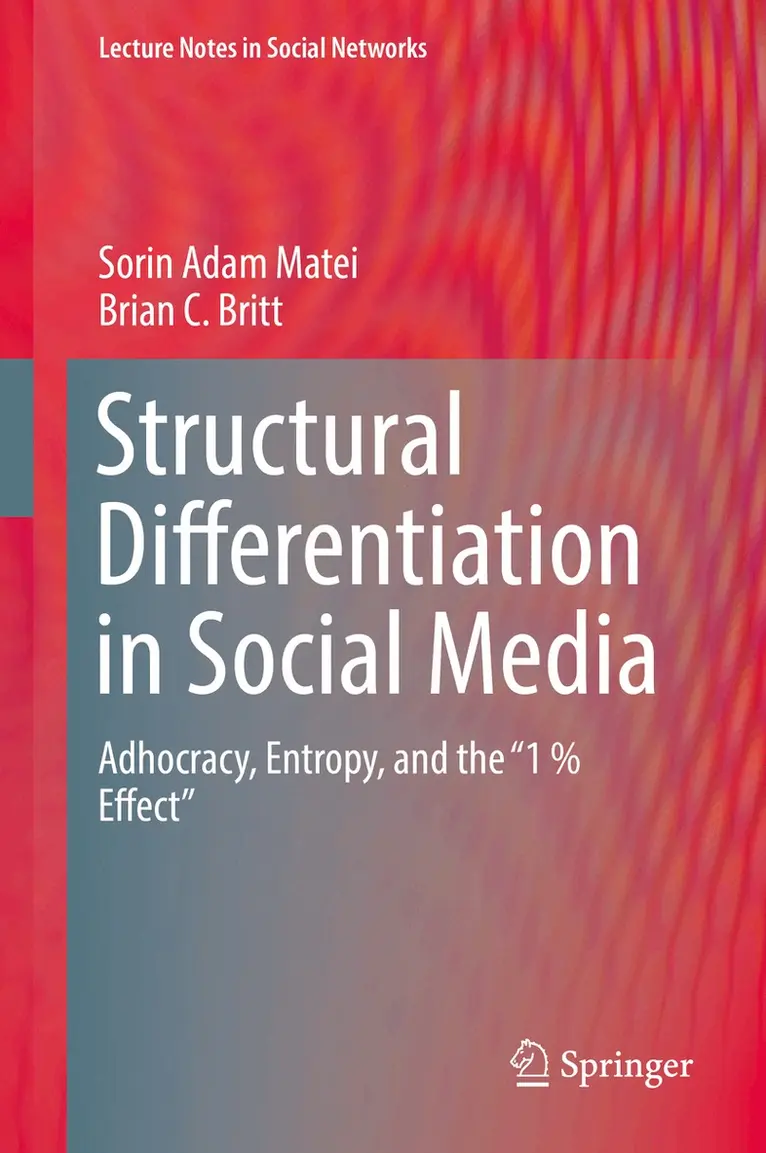
    Structural Differentiation in Social Media

    Adhocracy, Entropy, and the "1 % Effect"

    AvSorin Adam Matei,Brian C. Britt

    Inbunden, Engelska, 2017

    Del i serien Lecture Notes in Social Networks

    1 085 kr

    Beställningsvara. Skickas inom 10-15 vardagar. Fri frakt över 249 kr.

    Fler format och utgåvor

    Häftad

    1 085 kr

    Beskrivning

    This book explores community dynamics within social media. Using Wikipedia as an example, the volume explores communities that rely upon commons-based peer production. Fundamental theoretical principles spanning such domains as organizational configurations, leadership roles, and social evolutionary theory are developed. In the context of Wikipedia, these theories explain how a functional elite of highly productive editors has emerged and why they are responsible for a majority of the content. It explains how the elite shapes the project and how this group tends to become stable and increasingly influential over time. Wikipedia has developed a new and resilient social hierarchy, an adhocracy, which combines features of traditional and new, online, social organizations. The book presents a set of practical approaches for using these theories in real-world practice. This work fundamentally changes the way we think about social media leadership and evolution, emphasizing thecrucial contributions of leadership, of elite social roles, and of group global structure to the overall success and stability of large social media projects. Written in an accessible and direct style, the book will be of interest to academics as well as professionals with an interest in social media and commons-based peer production processes.

    Produktinformation

    • Utgivningsdatum:2017-09-21
    • Mått:155 x 235 x 20 mm
    • Vikt:559 g
    • Format:Inbunden
    • Språk:Engelska
    • Serie:Lecture Notes in Social Networks
    • Antal sidor:247
    • Upplaga:17001
    • Förlag:Springer International Publishing AG
    • ISBN:9783319644240

    Utforska kategorier

    • Medievetenskap inom Samhälle och politik
    • Systemvetenskap och AI inom Data och IT
    • Databaser inom Data och IT

    Mer om författaren

    Sorin Adam Matei, Professor, Brian Lamb School of Communication, Purdue University, Director of the Data Storytelling Network, Purdue University. Dr. Matei specializes in big data research that investigates the evolution of social media collaborative groups. He is also interested in how social ties and social capital emerging in social media groups generate stable social structures and functional roles. His work was funded by the National Science Foundation and was published in article and book format by the Journal of Communication, Communication Research, American Behavioral Scientist, Springer Nature, and other outlets.Brian C. Britt, Assistant Professor, Department of Journalism and Mass Communication, South Dakota State University. Dr. Britt is a computational social scientist who focuses on the intersection between organizational communication and new media, with a particular emphasis on the strategies employed by individuals positioning themselves in online organizations. His work has been funded by the National Science Foundation and the National Institutes of Health and has resulted in several book chapters in edited volumes.

    Innehållsförteckning

    • Introduction.- Part I: Structural Differentiation and Social Media: Theoretical Framework.- Macro-Structural Perspectives on Social Differentiation and Organizational Evolution in Online Groups.- Specifying a Wikipedia-centric Explanatory Model for Online Group Evolution and Structural Differentiation.- Social Structuration Online: Entropy and Social Systems.- Analytic Investigation of a Structural Differentiation Model for Social Media Production Groups.- Part II: Configurational Change Phases and Motors in Online Collaboration.- The Foundations of a Theoretical Model for Organizational Configurations and Change in Online Collaborative Processes.- Organizational Configurations and Configurational Change.- A Synthesized Theoretical Framework for Motors Driving Organizational Configurational Change.- Wikipedia Evolution: Trends and Phases.- Breakpoints and Concurrent Factors.- Part III: Future theoretical and practical directions.- Conclusions.- Appendix A: Data Collection, Management,Pre-Processing, and Analysis.- Appendix B: Historical and Media Analysis of Wikipedia’s Evolutionary Context.- Appendix C: Advantages and Disadvantages of Stepwise Segmented Regression Analysis.