• Fri frakt över 249 kr
  • •
  • Snabba leveranser
  • •
  • Billiga böcker
Kundservice

Du är på sajten för privatpersoner.

Företag, bibliotek eller offentlig verksamhet?

Du handlar på classic.bokus.com, där alla dina funktioner finns intakta.
Till classic.bokus.com
Bokus logotyp. Gå till startsidan.
  • Erbjudanden
  • Nyheter
  • Student
  • Topplistor
  • Barn & ungdom
  • Bokus Play
  • E-böcker
  • Pocketböcker
  • Spel & pussel

10% rabatt på allt med kod NYSTART10 →

Sidfot

Mina sidor

    Hjälp

    • Kundservice
    • Vanliga frågor och svar
    • Frakt och leverans
    • Retur vid ångerrätt
    • Reklamera vara
    • Betalning
    • Köpvillkor
    • Allmänna villkor
    • Information om webbplatsens tillgänglighet

    Om Bokus

    • Om oss
    • Pressrum
    • För studenter
    • För företag
    • För bibliotek och offentlig verksamhet
    • För leverantörer
    • Hållbarhet

    Populärt

    • Aktuella erbjudanden
    • Presentkort
    • Studentlitteratur
    • Nya böcker
    • Topplistor
    • Signerade böcker
    • Engelska böcker

    Inspiration

    • Boktips
    • BookTok
    • Populära bokserier
    • Barnbokskaraktärer
    • Populära författare
    Logotyp för Bokus
    Följ oss på Facebook (extern länk)Följ oss på Instagram (extern länk)Följ oss på YouTube (extern länk)Följ oss på TikTok (extern länk)
    bokus @ CookiesAnpassa cookiesIntegritetspolicyKöpvillkor
    Till Citymail hemsida (extern länk)Till Budbee hemsida (extern länk)Till Postnord hemsida (extern länk)Till Schenker hemsida (extern länk)Till Early Bird hemsida (extern länk)Till Walleys hemsida (extern länk)
    1. Naturvetenskap och teknik
    2. Matematik och naturvetenskap
    3. Matematik
    4. Matematisk statistik

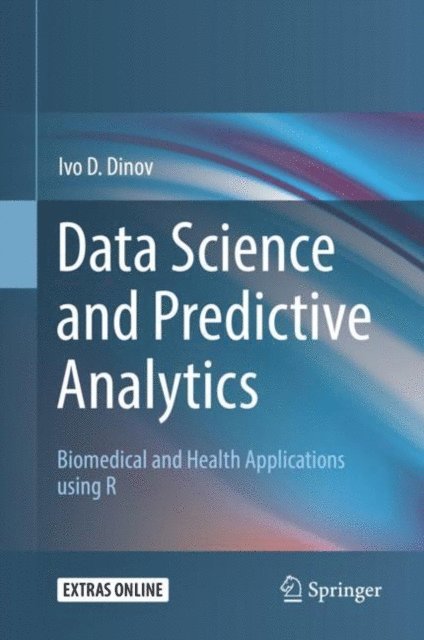
    Data Science and Predictive Analytics

    Biomedical and Health Applications using R

    AvIvo D. Dinov

    E-bok
    Engelska, 2018

    868 kr

    Läs direkt i Bokus Reader – eller ladda ned till din enhet

    Fler format och utgåvor

    Häftad

    712 kr

    Inbunden

    1 339 kr

    E-bok

    1 176 kr

    Häftad

    950 kr

    Beskrivning

    Over the past decade, Big Data have become ubiquitous in all economic sectors, scientific disciplines, and human activities. They have led to striking technological advances, affecting all human experiences. Our ability to manage, understand, interrogate, and interpret such extremely large, multisource, heterogeneous, incomplete, multiscale, and incongruent data has not kept pace with the rapid increase of the volume, complexity and proliferation of the deluge of digital information. There are three reasons for this shortfall. First, the volume of data is increasing much faster than the corresponding rise of our computational processing power (Kryder’s law > Moore’s law). Second, traditional discipline-bounds inhibit expeditious progress. Third, our education and training activities have fallen behind the accelerated trend of scientific, information, and communication advances. There are very few rigorous instructional resources, interactive learning materials, and dynamic trainingenvironments that support active data science learning. The textbook balances the mathematical foundations with dexterous demonstrations and examples of data, tools, modules and workflows that serve as pillars for the urgently needed bridge to close that supply and demand predictive analytic skills gap.

    Exposing the enormous opportunities presented by the tsunami of Big data, this textbook aims to identify specific knowledge gaps, educational barriers, and workforce readiness deficiencies. Specifically, it focuses on the development of a transdisciplinary curriculum integrating modern computational methods, advanced data science techniques, innovative biomedical applications, and impactful health analytics.

    The content of this graduate-level textbook fills a substantial gap in integrating modern engineering concepts, computational algorithms, mathematical optimization, statistical computing and biomedical inference. Big data analytic techniques and predictive scientific methods demand broad transdisciplinary knowledge, appeal to an extremely wide spectrum of readers/learners, and provide incredible opportunities for engagement throughout the academy, industry, regulatory and funding agencies.

     The two examples below demonstrate the powerful need for scientific knowledge, computational abilities, interdisciplinary expertise, and modern technologies necessary to achieve desired outcomes (improving human health and optimizing future return on investment). This can only be achieved by appropriately trained teams of researchers who can develop robust decision support systems using modern techniques and effective end-to-end protocols, like the ones described in this textbook.

     • A geriatric neurologist is examining a patient complaining of gait imbalance and posture instability. To determine if the patient may suffer from Parkinson’s disease, the physician acquires clinical, cognitive, phenotypic, imaging, and genetics data (Big Data). Most clinics and healthcare centers are not equipped with skilled data analytic teams that can wrangle, harmonize and interpret such complex datasets. A learner that completes a course of study using this textbook will have the competency and ability to manage the data, generate a protocol for deriving biomarkers, and provide an actionable decision support system. The results of this protocol will help the physician understand the entire patient dataset and assist in making a holistic evidence-based, data-driven, clinical diagnosis.

    • To improve the return on investment for their shareholders, a healthcare manufacturer needs to forecast the demand for their product subject to environmental, demographic, economic, and bio-social sentiment data (Big Data). The organization’s data-analytics team is tasked with developing a protocol that identifies, aggregates, harmonizes, models and analyzes these heterogeneous data elements to generate a trend forecast. Thissystem needs to provide an automated, adaptive, scalable, and reliable prediction of the optimal investment, e.g., R&D allocation, that maximizes the company’s bottom line. A reader that complete a course of study using this textbook will be able to ingest the observed structured and unstructured data, mathematically represent the data as a computable object, apply appropriate model-based and model-free prediction techniques. The results of these techniques may be used to forecast the expected relation between the company’s investment, product supply, general demand of healthcare (providers and patients), and estimate the return on initial investments.

    Produktinformation

    • Utgivningsdatum:2018-08-27
    • Språk:Engelska
    • Filformat:EPUB
    • Kopieringsskydd:LCP
    • ISBN:9783319723471
    • Förlag:Springer International Publishing

    Utforska kategorier

    • Matematisk statistik inom Naturvetenskap och teknik
    • Databaser inom Data och IT
    • Tillämpad datateknik inom Data och IT