• Fri frakt över 249 kr
  • •
  • Snabba leveranser
  • •
  • Billiga böcker
Kundservice

Du är på sajten för privatpersoner.

Företag, bibliotek eller offentlig verksamhet?

Du handlar på classic.bokus.com, där alla dina funktioner finns intakta.
Till classic.bokus.com
Bokus logotyp. Gå till startsidan.
  • Erbjudanden
  • Student
  • Topplistor
  • Barn & ungdom
  • Bokus Play
  • E-böcker
  • Ljudböcker
  • Pocketböcker
  • Spel och pussel

Pocketfynda! Hundratals böcker för 49 kr/st →

Sidfot

Mina sidor

    Hjälp

    • Kundservice
    • Vanliga frågor och svar
    • Frakt och leverans
    • Retur vid ångerrätt
    • Reklamera vara
    • Betalning
    • Köpvillkor
    • Allmänna villkor
    • Information om webbplatsens tillgänglighet

    Om Bokus

    • Om oss
    • Pressrum
    • För studenter
    • För företag
    • För bibliotek och offentlig verksamhet
    • För leverantörer
    • Hållbarhet

    Populärt

    • Aktuella erbjudanden
    • Presentkort
    • Studentlitteratur
    • Nya böcker
    • Topplistor
    • Signerade böcker
    • Engelska böcker

    Inspiration

    • Boktips
    • BookTok
    • Barnbokskaraktärer
    • Populära författare
    Logotyp för Bokus
    Följ oss på Facebook (extern länk)Följ oss på Instagram (extern länk)Följ oss på YouTube (extern länk)Följ oss på TikTok (extern länk)
    bokus @ CookiesAnpassa cookiesIntegritetspolicyKöpvillkor
    Till Citymail hemsida (extern länk)Till Budbee hemsida (extern länk)Till Postnord hemsida (extern länk)Till Schenker hemsida (extern länk)Till Early Bird hemsida (extern länk)Till Walleys hemsida (extern länk)
    1. Naturvetenskap och teknik
    2. Teknik och industri
    3. Elektronik och kommunikationer

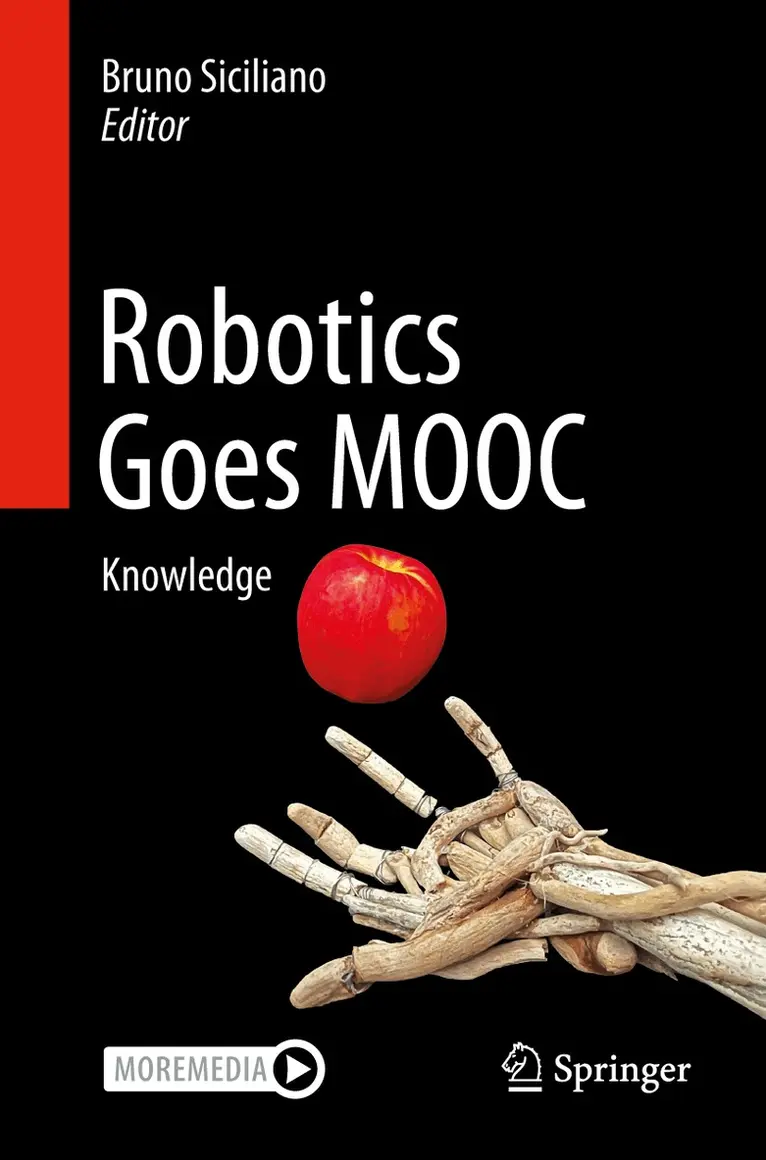
    Robotics Goes MOOC

    Knowledge

    AvBruno Siciliano

    Häftad, Engelska, 2025

    810 kr

    Beställningsvara. Skickas inom 10-15 vardagar. Fri frakt över 249 kr.

    Beskrivning

    The robot “concept” was clearly established by those many creative historical realizations, such as those recalled above. Nonetheless, the emergence of the “physical” robot had to await the advent of its underlying technologies of mechanics, controls, computers, electronics and sensors ―in one word, mechatronics― during the course of the twentieth century. As always, new designs motivate new research and discoveries which, in turn, lead to enhanced solutions and thus to novel concepts. This virtuous circle over time produced that knowledge and understanding which gave birth to the field of Robotics, properly referred to as the science and technology of robots.To make robots and intelligent machines useful to humans it is necessary to have a broad and tight intersection between Robotics and AI. Sophisticated mathematical models are needed that enable the robot from a physical point of view, as well as intelligent algorithms capable of correlating all the information coming from the use of technologically advanced sensors with the data available from experience. It is expected that the synergy of model-based techniques with data-driven approaches will contribute to increasing the level of autonomy of robots and intelligent machines in the near future.The first book of the Robotics Goes MOOC project starts with the journey of robotics in the introductory chapter by Khatib, who has pioneered our field of robotics and has ferried it to the third millennium. Sensing is crucial for the development of intelligent and autonomous robots, as covered in Chapter 2 by Nüchter et al. Model-based control is dealt with in Chapter 3 by Kröeger et al along with motion planning, as well as in Chapter 4 by Villani and Chapter 5 by Chaumette to handle force and visual feedback, respectively, when interacting with the environment. Resorting to AI techniques is the focus of the last part of the book, namely, Chapter 6 by Peters et al on Learning, Chapter 7 byBeetz et al on knowledge representation and reasoning, and Chapter 8 by Burgard et al on graph-based SLAM.

    Produktinformation

    • Utgivningsdatum:2025-06-14
    • Mått:155 x 235 x 20 mm
    • Vikt:498 g
    • Format:Häftad
    • Språk:Engelska
    • Antal sidor:285
    • Förlag:Springer International Publishing AG
    • ISBN:9783319740942

    Utforska kategorier

    • Elektronik och kommunikationer inom Naturvetenskap och teknik
    • Referensverk och tvärvetenskap inom Samhälle och politik
    • Artificiell intelligens inom Data och IT

    Mer om författaren

    Bruno Siciliano is professor of robotics and control at the University of Naples Federico II. He is also Honorary Professor at the University of Óbuda where he holds the Kálmán Chair. His research interests include manipulation and control, human–robot cooperation, and service robotics. Fellow of the scientific societies IEEE, ASME, IFAC, AAIA, he received numerous international prizes and awards, including the recent 2024 IEEE Robotics and Automation Pioneer Award. He was President of the IEEE Robotics and Automation Society from 2008 to 2009. He has delivered more than 150 keynotes and has published more than 300 papers and 7 books. His book “Robotics” is among the most adopted academic texts worldwide, while his edited volume “Springer Handbook of Robotics” received the highest recognition for scientific publishing: the 2008 PROSE Award for Excellence in Physical Sciences & Mathematics. His team has received more than 25 million Euro funding in the last 15 years from competitive European research projects, including two ERC grants.

    Innehållsförteckning

    • 1 Oussama Khatib, The Journey of Robotics.- 2 Dorit Borrmann and Andreas Nüchter, Sensing and Estimation.- 3 Lars Berscheid and Torsten Kröger, Control and Motion Planning.- 4 Luigi Villani, Force Control.- 5 Francois Chaumette, Visual Control.- 6 Joe Watson, Julen Urain, Joao Carvalho, Niklas Funk and Jan Peters, Learning.- 7 Michael Beetz and Daniel Nyga, Knowledge Representation and Reasoning- 8 Giorgio Grisetti, Rainer Kuemmerle, Cyrill Stachniss and Wolfram Burgard, Graph-Based SLAM.