• Fri frakt över 249 kr
  • •
  • Snabba leveranser
  • •
  • Billiga böcker
Kundservice

Du är på sajten för privatpersoner.

Företag, bibliotek eller offentlig verksamhet?

Du handlar på classic.bokus.com, där alla dina funktioner finns intakta.
Till classic.bokus.com
Bokus logotyp. Gå till startsidan.
  • Erbjudanden
  • Nyheter
  • Student
  • Topplistor
  • Barn & ungdom
  • Bokus Play
  • E-böcker
  • Pocketböcker
  • Spel & pussel

10% rabatt på allt med kod: NYSTART10 →

Sidfot

Mina sidor

    Hjälp

    • Kundservice
    • Vanliga frågor och svar
    • Frakt och leverans
    • Retur vid ångerrätt
    • Reklamera vara
    • Betalning
    • Köpvillkor
    • Allmänna villkor
    • Information om webbplatsens tillgänglighet

    Om Bokus

    • Om oss
    • Pressrum
    • För studenter
    • För företag
    • För bibliotek och offentlig verksamhet
    • För leverantörer
    • Hållbarhet

    Populärt

    • Aktuella erbjudanden
    • Presentkort
    • Studentlitteratur
    • Nya böcker
    • Topplistor
    • Signerade böcker
    • Engelska böcker

    Inspiration

    • Boktips
    • BookTok
    • Populära bokserier
    • Barnbokskaraktärer
    • Populära författare
    Logotyp för Bokus
    Följ oss på Facebook (extern länk)Följ oss på Instagram (extern länk)Följ oss på YouTube (extern länk)Följ oss på TikTok (extern länk)
    bokus @ CookiesAnpassa cookiesIntegritetspolicyKöpvillkor
    Till Citymail hemsida (extern länk)Till Budbee hemsida (extern länk)Till Postnord hemsida (extern länk)Till Schenker hemsida (extern länk)Till Early Bird hemsida (extern länk)Till Walleys hemsida (extern länk)
    1. Medicin
    2. Medicin: icke kliniska discipliner
    3. Fysiologi

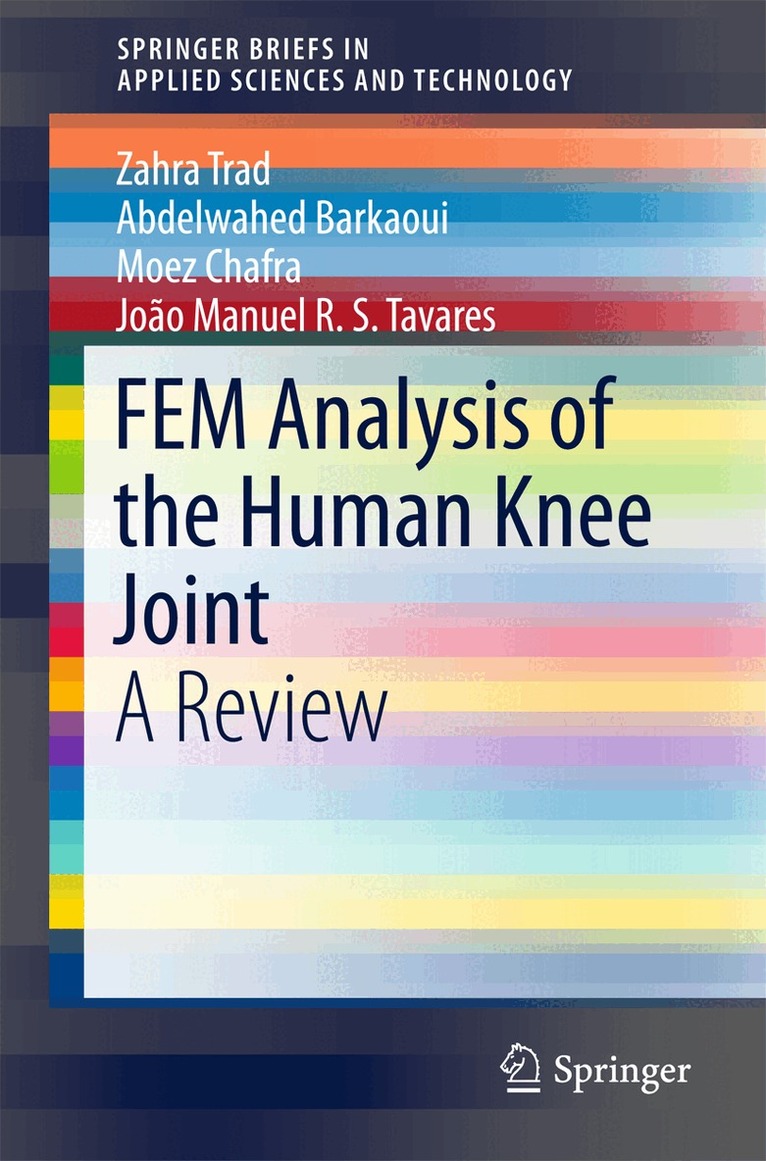
    FEM Analysis of the Human Knee Joint

    A Review

    AvZahra Trad,Abdelwahed Barkaoui

    Häftad, Engelska, 2018

    Del i serien SpringerBriefs in Applied Sciences and Technology

    563 kr

    Beställningsvara. Skickas inom 10-15 vardagar. Fri frakt över 249 kr.

    Beskrivning

    In recent years, numerous scientific investigations have studied the anatomical, biomechanical and functional role of structures involved in the human knee joint. The Finite Element Method (FEM) has been seen as an interesting tool to study and simulate biosystems. It has been extensively used to analyse the knee joint and various types of knee diseases and rehabilitation procedures such as the High Tibial Osteotomy (HTO). This work presents a review on FEM analysis of the human knee joint and HTO knee surgery, and discusses how adequate this computational tool is for this type of biomedical applications. Hence, various studies addressing the knee joint based on Finite Element Analysis (FEA) are reviewed, and an overview of clinical and biomechanical studies on the optimization of the correction angle of the postoperative knee surgery is provided.

    Produktinformation

    • Utgivningsdatum:2018-02-22
    • Mått:155 x 235 x 6 mm
    • Vikt:187 g
    • Format:Häftad
    • Språk:Engelska
    • Serie:SpringerBriefs in Applied Sciences and Technology
    • Antal sidor:79
    • Förlag:Springer International Publishing AG
    • ISBN:9783319741574

    Utforska kategorier

    • Fysiologi inom Medicin
    • Beräkning och matematisk analys inom Naturvetenskap och teknik
    • Biomedicinsk teknik inom Medicin

    Innehållsförteckning

    • Introduction.- 1. Finite element models of the knee joint.- 1.1 Knee joint models geometries.- 1.2 Material properties of hard and soft tissues.- 1.2.1 Material properties of articular cartilage.- 1.2.2 Material properties of menisci.- 1.2.3 Material properties of ligaments.- 1.2.4 Material properties of bony structure.- 2. Finite Element Analysis applications in knee joint biomechanical studies.- 2.1 Current FEA applications on ligament injury.- 2.2 Current FEA applications on meniscus injury.- 2.3 Current FEA applications on knee joint contact analysis and cartilage disease.- 3. Overview of high tibial osteotomy and optimization of correction angle.- 3.1 High tibial osteotomy definition.- 3.2 Current FEA studies on HTO procedure.- 3.3 Current clinical studies on optimizing correction angle.- 3.4 Current biomechanical studies on optimizing correction angle.- 4. Conclusions and future work.- References.