• Fri frakt över 249 kr
  • •
  • Snabba leveranser
  • •
  • Billiga böcker
Kundservice

Du är på sajten för privatpersoner.

Företag, bibliotek eller offentlig verksamhet?

Du handlar på classic.bokus.com, där alla dina funktioner finns intakta.
Till classic.bokus.com
Bokus logotyp. Gå till startsidan.
  • Erbjudanden
  • Nyheter
  • Student
  • Topplistor
  • Barn & ungdom
  • Bokus Play
  • E-böcker
  • Pocketböcker
  • Spel & pussel

10% rabatt på allt med kod: NYSTART10 →

Sidfot

Mina sidor

    Hjälp

    • Kundservice
    • Vanliga frågor och svar
    • Frakt och leverans
    • Retur vid ångerrätt
    • Reklamera vara
    • Betalning
    • Köpvillkor
    • Allmänna villkor
    • Information om webbplatsens tillgänglighet

    Om Bokus

    • Om oss
    • Pressrum
    • För studenter
    • För företag
    • För bibliotek och offentlig verksamhet
    • För leverantörer
    • Hållbarhet

    Populärt

    • Aktuella erbjudanden
    • Presentkort
    • Studentlitteratur
    • Nya böcker
    • Topplistor
    • Signerade böcker
    • Engelska böcker

    Inspiration

    • Boktips
    • BookTok
    • Populära bokserier
    • Barnbokskaraktärer
    • Populära författare
    Logotyp för Bokus
    Följ oss på Facebook (extern länk)Följ oss på Instagram (extern länk)Följ oss på YouTube (extern länk)Följ oss på TikTok (extern länk)
    bokus @ CookiesAnpassa cookiesIntegritetspolicyKöpvillkor
    Till Citymail hemsida (extern länk)Till Budbee hemsida (extern länk)Till Postnord hemsida (extern länk)Till Schenker hemsida (extern länk)Till Early Bird hemsida (extern länk)Till Walleys hemsida (extern länk)
    1. Språk och ordböcker
    2. Språkvetenskap och lingvistik

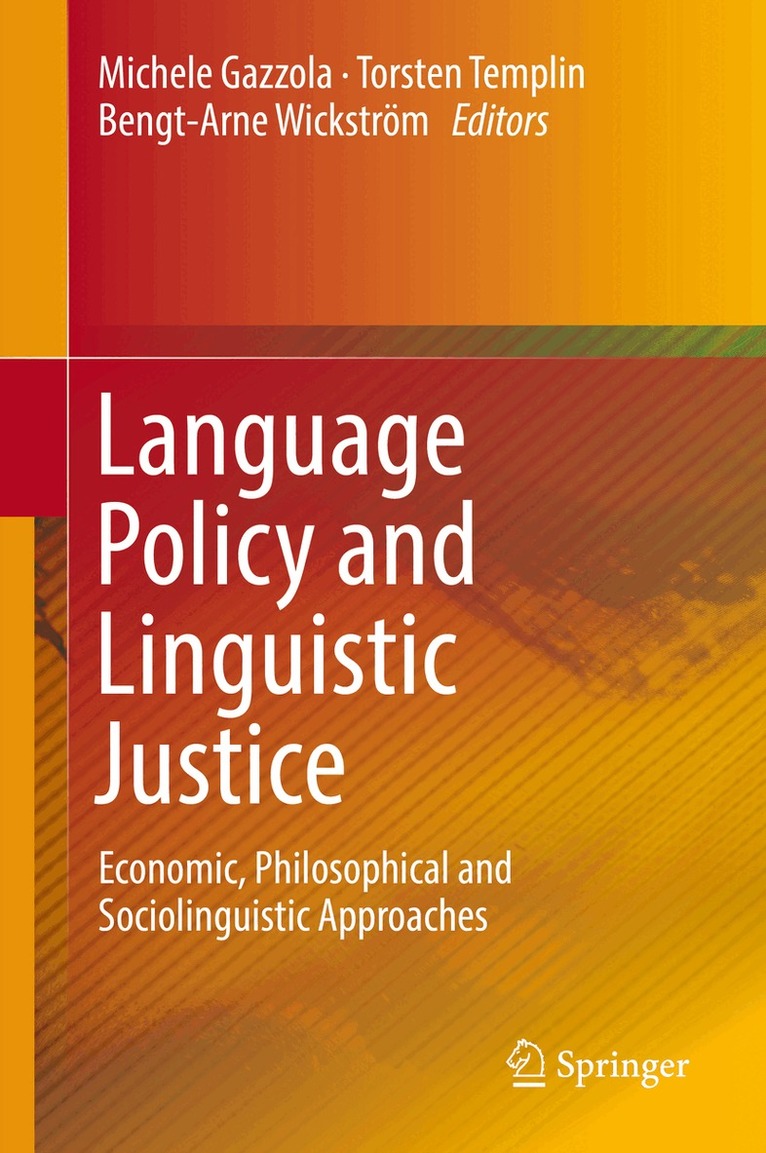
    Language Policy and Linguistic Justice

    Economic, Philosophical and Sociolinguistic Approaches

    AvMichele Gazzola,Torsten Templin

    Inbunden, Engelska, 2018

    2 380 kr

    Beställningsvara. Skickas inom 10-15 vardagar. Fri frakt över 249 kr.

    Beskrivning

    Language policies are increasingly acknowledged as being a necessary component of many decisions taken in the areas of the labor market, education, minority languages, mobility, and social inclusion of migrants. They can affect the democratic control of political organizations, and they can either entrench or reduce inequalities. These are the central topics of this book. Economists, philosophers, political scientists, and sociolinguists discuss – from an interdisciplinary perspective – the distributive socio-economic effects of language policies, their impact on justice and inequality at the national or international level, as well as the connection between language choices and an inclusive access to public services. The range of social and economic issues raised by linguistic diversity in contemporary societies is large, and this requires new approaches to tackle them. This book provides new input to design better, more efficient, and fair language policies in order to manage linguistic diversity in different areas. Topics covered include: theoretical models of linguistic justice and linguistic disadvantage; the assessment of the socio-economic consequences of language policies; the evaluation of the costs, benefits, and degree of inclusion of language planning measures; the politics of migrants’ linguistic integration; as well as multilingualism and economic activities. These topics are discussed in different contexts, including the areas inhabited by linguistic minorities, cities receiving migrants, and supranational organizations.

    Produktinformation

    • Utgivningsdatum:2018-09-14
    • Mått:155 x 235 x 35 mm
    • Vikt:980 g
    • Format:Inbunden
    • Språk:Engelska
    • Antal sidor:535
    • Upplaga:18001
    • Förlag:Springer International Publishing AG
    • ISBN:9783319752617

    Utforska kategorier

    • Språkvetenskap och lingvistik inom Språk och ordböcker
    • Miljöekonomi inom Ekonomi och Ledarskap
    • Statsvetenskap och politisk teori inom Samhälle och politik

    Mer om författaren

    ​Michele Gazzola (1978) is a research fellow at Humboldt-Universität zu Berlin in the Research Group "Economics and Language", as well as a research fellow at the Institute for ethnic studies (Inštitut za narodnostna vprašanja) in Ljubljana, and a teaching fellow at the Università della Svizzera Italiana in Lugano. He is currently working on the research project Mobility and Inclusion in a Multilingual Europe (project MIME). His research areas include language policy and planning, the economics of languages, policy analysis, and multilingualism as a social phenomenon.Torsten Templin (1986) is a research assistant at Humboldt-Universität zu Berlin. In 2012 he graduated in Mathematics. Since 2014 he is part of the EU financed MIME project (Mobility and Inclusion in a Multilingual Europe) and works on modeling the dynamics of language use and language policy evaluation. His research interests include language economics, applied mathematics and optimal control theory.Bengt-Arne Wickström (1948) is guest professor at Andrássy University in Budapest. From 1992 until his retirement in 2013 he held the chair of public economics at Humboldt-Universität zu Berlin and before that chairs at Johannes-Kepler-Universität in Linz, Austria, and the University of Bergen, Norway. He is an honorary professor at Universidad de La Habana. His research is concentrated on economics and language, and he is currently (2014-2018) coordinating a research group working on the dynamics of language use as part of the EU-financed MIME project (Mobility and Inclusion in a Multilingual Europe) involving some 20 universities. In addition to language economics, his research interests include welfare economics, public-choice theory, and evolutionary approaches in economics.

    Innehållsförteckning

    • Introduction: An Economics Approach to Language Policy and Linguistic Justice.- Overview of Literature: Linguistic Justice - an Interdisciplinary Overview of the Literature.- Political and Philosophical Perspectives on Linguistic Justice: Justice in the Linguistic Environment.- Towards an Adaptive Approach to Linguistic Justice.- Language Proficiency and Migration.- The Myth of English as a Common Language in the EU, and Some of Its Political Consequences.- Economic Approaches to Language Policy and Linguistic Justice: The Case of Canadian Provinces.- Evidence from Catalonia.- Languages, Human Capital and Well-Being in Sub-Saharan Africa.- Linguistic Disenfranchisement and Labour Mobility in Europe.- Choosing Working Languages in a Multilingual Organization.- Sociolinguistic Views and Applications: The Assessment of Sociolinguistic Justice - Parameters and Models of Analysis.- Regulatory Environment, Linguistic Inequalities and New Opportunities for Hungarian Minority Interest Representation in Romania.- The Economic Value of Mastering Languages - the Case of Ethnically Mixed Areas in Slovenia.- Language and Translation Policies in Context of Urban Super-Diversity.- Language Policies for Migrants in Italy.- Esperanto and Linguistic Justice - an Empirical Response to Skeptics.