• Fri frakt över 249 kr
  • •
  • Snabba leveranser
  • •
  • Billiga böcker
Kundservice

Du är på sajten för privatpersoner.

Företag, bibliotek eller offentlig verksamhet?

Du handlar på classic.bokus.com, där alla dina funktioner finns intakta.
Till classic.bokus.com
Bokus logotyp. Gå till startsidan.
  • Erbjudanden
  • Nyheter
  • Student
  • Topplistor
  • Barn & ungdom
  • Bokus Play
  • E-böcker
  • Pocketböcker
  • Spel & pussel

Må bättre, för mindre! Upp till 50% rabatt på hälsoböcker

Sidfot

Mina sidor

    Hjälp

    • Kundservice
    • Vanliga frågor och svar
    • Frakt och leverans
    • Retur vid ångerrätt
    • Reklamera vara
    • Betalning
    • Köpvillkor
    • Allmänna villkor
    • Information om webbplatsens tillgänglighet

    Om Bokus

    • Om oss
    • Pressrum
    • För studenter
    • För företag
    • För bibliotek och offentlig verksamhet
    • För leverantörer
    • Hållbarhet

    Populärt

    • Aktuella erbjudanden
    • Presentkort
    • Studentlitteratur
    • Nya böcker
    • Topplistor
    • Signerade böcker
    • Engelska böcker

    Inspiration

    • Boktips
    • BookTok
    • Populära bokserier
    • Barnbokskaraktärer
    • Populära författare
    Logotyp för Bokus
    Följ oss på Facebook (extern länk)Följ oss på Instagram (extern länk)Följ oss på YouTube (extern länk)Följ oss på TikTok (extern länk)
    bokus @ CookiesAnpassa cookiesIntegritetspolicyKöpvillkor
    Till Citymail hemsida (extern länk)Till Budbee hemsida (extern länk)Till Postnord hemsida (extern länk)Till Schenker hemsida (extern länk)Till Early Bird hemsida (extern länk)Till Walleys hemsida (extern länk)
    1. Historia och arkeologi
    2. Historia
    3. Forntidens historia

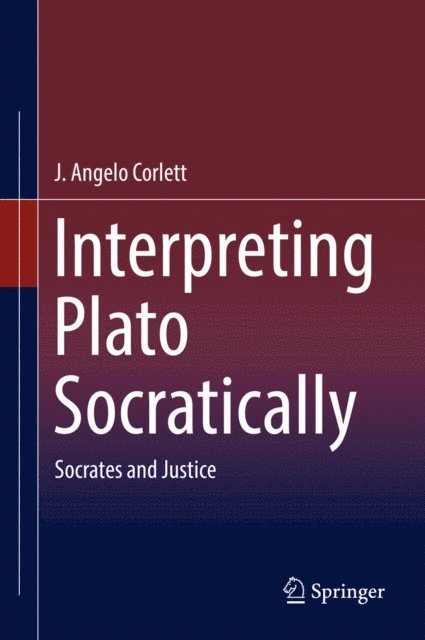
    Interpreting Plato Socratically

    Socrates and Justice

    AvJ. Angelo Corlett

    Inbunden, Engelska, 2018

    1 190 kr

    Beställningsvara. Skickas inom 10-15 vardagar. Fri frakt över 249 kr.

    Fler format och utgåvor

    Häftad

    398 kr

    E-bok

    484 kr

    Beskrivning

    J. Angelo Corlett’s new book, Interpreting Plato Socratically continues the critical discussion of the Platonic Question where Corlett’s book, Interpreting Plato’s Dialogues concluded. New arguments in favor of the Mouthpiece Interpretation of Plato’s works are considered and shown to be fallacious, as are new objections to some competing approaches to Plato’s works.The Platonic Question is the problem of how to approach and interpret Plato’s writings most of which are dialogues. How, if at all, can Plato’s beliefs, doctrines, theories and such be extracted from dialogues where there is no direct indication from Plato that his own views are even to be found therein? Most philosophers of Plato attempt to decipher from Plato’s texts seemingly all manner of ideas expressed by Socrates which they then attribute to Plato. They seek to ascribe to Plato particular views about justice, art, love, virtue, knowledge, and the like because, they believe, Socrates is Plato’s mouthpiece through the dialogues. But is such an approach justified? What are the arguments in favor of such an approach? Is there a viable alternative approach to Plato’s dialogues?In this rigorous account of the dominant approach to Plato’s dialogues, there is no room left for reasonable doubt about the problematic reasons given for the notion that Plato’s dialogues reveal either Plato’s or Socrates’ beliefs, doctrines or theories about substantive philosophical matters.Corlett’s approach to Plato’s dialogues is applied to a variety of passages throughout Plato’s works on a wide range of topics concerning justice. In-depth discussions of themes such as legal obligation, punishment and compensatory justice are clarified and with some surprising results. Plato’s works serve as a rich source of philosophical thinking about such matters.  A central question in today’s Platonic studies is whether Socrates, or any other protagonist in the dialogues, presents viewsthat the author wanted to assert or defend. Professor Corlett offers a detailed defense of his view that the role of Socrates is to raise questions rather than to provide the author’s answers to them. This defense is timely as intellectual historians consider the part played by Academic scholars centuries after Plato in systematizing Platonism. J. J. Mulhern, University of Pennsylvania

    Produktinformation

    • Utgivningsdatum:2018-04-26
    • Mått:155 x 235 x 20 mm
    • Vikt:559 g
    • Format:Inbunden
    • Språk:Engelska
    • Antal sidor:243
    • Upplaga:18001
    • Förlag:Springer International Publishing AG
    • ISBN:9783319773193

    Utforska kategorier

    • Forntidens historia inom Historia och arkeologi
    • Filosofiska discipliner inom Filosofi och religion
    • Litteraturvetenskap inom Skönlitteratur

    Mer om författaren

    J. Angelo Corlett, PhD, serves as Professor of Philosophy and Ethics at San Diego State University. He is the author of more than 100 books and articles in philosophy and ethics, including the books: Analyzing Social Knowledge (Rowman & Littlefield Publishers: 1996); Responsibility and Punishment (Kluwer and Springer: 2001, 2003, 2009 and 2014); Terrorism: A Philosophical Analysis (Kluwer: 2003); Race, Racism, and Reparations (Cornell University Press: 2003); Interpreting Plato’s Dialogues (Parmenides: 2005); Race, Rights, and Justice (Springer: 2009); The Errors of Atheism (Continuum: 2010); Heirs of Oppression (Rowman & Littlefield Publishers: 2010). Many of his articles has been published in leading philosophy journals, including the American Philosophical Quarterly; Analysis; The Classical Quarterly; International Journal for the Philosophy of Religion; Journal of Social Philosophy;The Journal of Ethics: An International Philosophical Review; Journal of Medicine and Philosophy; Philosophy, among others. He is also the founding Editor-in-Chief of The Journal of Ethics: An International Philosophical Review (1995-present).

    Innehållsförteckning

    • Preface.- Introduction,- Chapter 1: Interpreting Plato Socratically,- Chapter 2: Defending The Socratic Interpretation of Plato’s Dialogues.- Chapter 3: In Defense of Socratic Studies.- Chapter 4: Socrates and Distributive Justice.- Chapter 5: Legal Obligation in Plato’s Crito.- Chapter 6: The Socratic Roots of Retributivism.- Chapter 7: Socrates and Compensatory Justice.- Conclusion.- Appendix I: Gerson on Cherniss On Aristotle On Plato.- Appendix II: The Concept of Art of Mimêsis in Plato’s Dialogues.- additional Bibliography.- Index.