• Fri frakt över 249 kr
  • •
  • Snabba leveranser
  • •
  • Billiga böcker
Kundservice

Du är på sajten för privatpersoner.

Företag, bibliotek eller offentlig verksamhet?

Du handlar på classic.bokus.com, där alla dina funktioner finns intakta.
Till classic.bokus.com
Bokus logotyp. Gå till startsidan.
  • Erbjudanden
  • Nyheter
  • Student
  • Topplistor
  • Barn & ungdom
  • Bokus Play
  • E-böcker
  • Pocketböcker
  • Spel & pussel

10% rabatt på allt med kod: NYSTART10 →

Sidfot

Mina sidor

    Hjälp

    • Kundservice
    • Vanliga frågor och svar
    • Frakt och leverans
    • Retur vid ångerrätt
    • Reklamera vara
    • Betalning
    • Köpvillkor
    • Allmänna villkor
    • Information om webbplatsens tillgänglighet

    Om Bokus

    • Om oss
    • Pressrum
    • För studenter
    • För företag
    • För bibliotek och offentlig verksamhet
    • För leverantörer
    • Hållbarhet

    Populärt

    • Aktuella erbjudanden
    • Presentkort
    • Studentlitteratur
    • Nya böcker
    • Topplistor
    • Signerade böcker
    • Engelska böcker

    Inspiration

    • Boktips
    • BookTok
    • Populära bokserier
    • Barnbokskaraktärer
    • Populära författare
    Logotyp för Bokus
    Följ oss på Facebook (extern länk)Följ oss på Instagram (extern länk)Följ oss på YouTube (extern länk)Följ oss på TikTok (extern länk)
    bokus @ CookiesAnpassa cookiesIntegritetspolicyKöpvillkor
    Till Citymail hemsida (extern länk)Till Budbee hemsida (extern länk)Till Postnord hemsida (extern länk)Till Schenker hemsida (extern länk)Till Early Bird hemsida (extern länk)Till Walleys hemsida (extern länk)
    1. Psykologi och pedagogik
    2. Psykologi

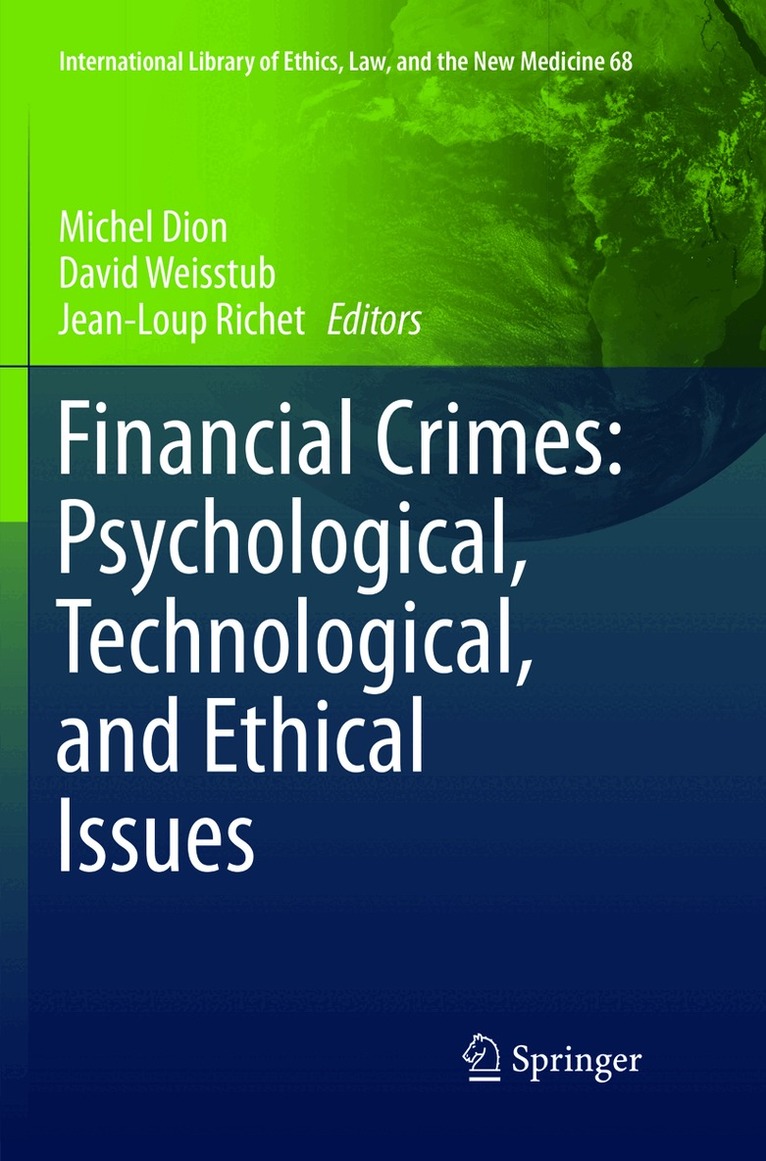
    Financial Crimes: Psychological, Technological, and Ethical Issues

    AvMichel Dion,David Weisstub

    Häftad, Engelska, 2018

    Del 68 i serien International Library of Ethics, Law, and the New Medicine

    1 086 kr

    Beställningsvara. Skickas inom 10-15 vardagar. Fri frakt över 249 kr.

    Beskrivning

    This book on the psychology of white collar criminals discusses various cases of financial crime, while also attempting to delve into the minds of the criminals in question. The literature on this topic is growing as it gains momentum in the scientific field, as a result of the extremely negative impact white collar crime has on its victims. Because there is considerable damage and vulnerability from these crimes, it is important to begin to classify them, and to understand the minds of those that commit these offenses. While the current literature is not extensive, this work provides a closer look into the various ethical and legal facets of financial crime, and helps to uncover the social, psychological and neurobiological factors that intersect in the minds of those criminals.

    Produktinformation

    • Utgivningsdatum:2018-05-31
    • Mått:155 x 235 x 22 mm
    • Vikt:598 g
    • Format:Häftad
    • Språk:Engelska
    • Serie:International Library of Ethics, Law, and the New Medicine
    • Antal sidor:376
    • Förlag:Springer International Publishing AG
    • ISBN:9783319812793

    Utforska kategorier

    • Psykologi inom Psykologi och pedagogik
    • Finansiering inom Ekonomi och Ledarskap
    • Filosofiska discipliner inom Filosofi och religion

    Mer om författaren

    Michel Dion is Full Professor of business ethics at the Faculté d’administration, Université de Sherbrooke (Québec, Canada). He is the Chairholder of the CIBC Research Chair on Financial Integrity. His main fields of research include business ethics, corporate governance, and financial crime. His most recent book is: Financial Crime and Existential Philosophy (Springer, 2014).David N. Weisstub (born 1944) is the Philippe Pinel professor of legal psychiatry and biomedical ethics at the Université de Montréal. He is the honorary life president of the International Academy of Law and Mental Health, and the editor-in-chief both of its International Journal of Law and Psychiatry and of Springer's International Library on Ethics, Law and the New Medicine. He sits on the editorial board of the Journal of Ethics in Mental Health. He has been made a Chevalier of the Légion d'honneur in France, a Knight of the Order of the Dutch Lion, and Grande Ufficiale in Italy.Jean-Loup Richet. Since March 2013, Research Fellow at ESSEC Business School – Institute for Strategic Innovation & Services. Since June 2013, adjunct lecturer in Informations Systems at Sorbonne Graduate Business School (International MBA and MBA-MAE) and guest lecturer at HEC Paris (Crisis Communication) and Telecom Business School (Hacking and Information Security, Project Management, Risk and Crisis management).

    Innehållsförteckning

    • Table of Contents.- Introduction -Financial Crimes. Psychological, Technological, and Ethical Issues.- Financial crimes, its determinants and policy implications.- Chapter 1- Anti-Corruption Measures: The Panacea to a Financial Cliff (Andreas Kapardis, Maria Krambia-Kapardis and Nestor Courakis).- Chapter 2- The Determinants of Tax Evasion: A Cross-Country Study (Grant Richardson).- Chapter 3- What Determines Information Sharing for Income Tax Purposes: The Swedish Case (Jenny Ligthart, Barbara M. Sadaba and Rene van Stralen).- Chapter 4- The Duty of Financial Institutions to Investigate and Report Suspicions of Fraud, Financial Crime and Corruption (Fletcher Baldwin and Jeffrey A. Gadboys).- Psychological and Psychiatric Aspects of Financial Crimes.- Chapter 5- Forensic Psychiatric Contributions to Understanding Financial Crime (Sara Brady, Erick Rabin, Daniel Wu, Omar Sultan Haque, and Harold J. Bursztajn).- Chapter 6- Cognitive Factors to Financial Crime Victimization (Stacey Wood,Yaniv Hanoch, and George W. Woods).- Chapter 7- Personal and Situational Contributors to Fraud Victimization: Implications of a Four-Factor Model of Gullible Investing (Stephen Greenspan and George W. Woods).- Chapter 8- Villains, Victims and Bystanders in Financial Crime (Bruce Baer Arnold and Wendy Bonython).- Bribery, Corporate Governance and ethical aspect of financial crime.- Chapter 9- Complicity in Organizational Deviance: The Role of Internal and External Unethical Pressures (Anne Sachet-Milliat).- Chapter 10- Corporate Governance and Bribery: Evidence from the World Business Environment Survey (Xun Wu, Krishnan Chandramohan and Azad Singh Bali).- Chapter 11- Integrity in a Context of Institutionalized Corruption: A Theological-Ethical Clarification/Approach of a Complex Issue (Johan Verstraeten).- Chapter 12- Bribery and the Grey Areas of Morality (Michel Dion).- Tax Evasion, Money Laundering and technological aspect of financial crime.- Chapter 13- Applying evidence-based profiling to disaggregated fraud offenders (Andreas Kapardis and Maria Krambia-Kapardis).- Chapter 14- Globalization and the challenge of regulating transnational financial crimes (Nlerum S. Okogbule).- Chapter 15- The transnational organization of the drugs trade (Peter Enderwick).- Chapter 16- Money Laundering: The Challenges of Technology (Louis De Koker).- Chapter 17- New Technologies and Money Laundering Vulnerabilities (Jun Tang and Lishan Ai).- Concluding Remarks – Financial Crimes Research, Theoretical and Practical Implications.