Beställningsvara. Skickas inom 10-15 vardagar. Fri frakt över 249 kr.
Beskrivning
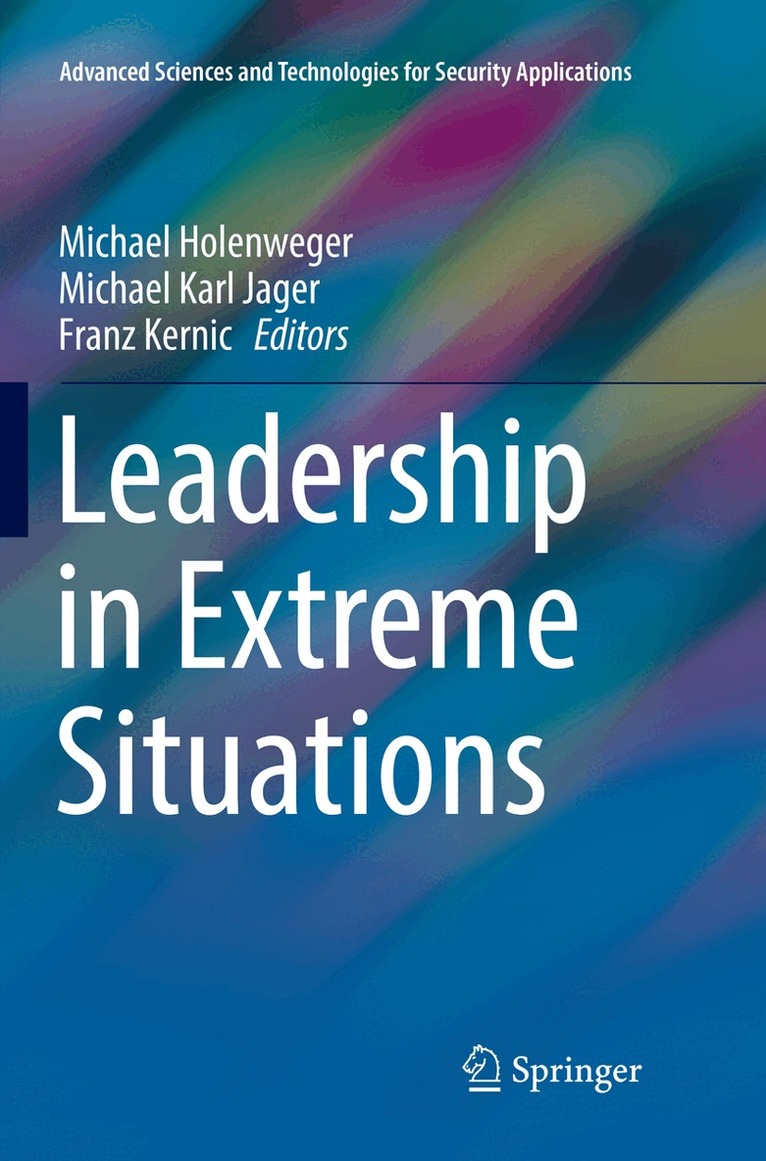
This book covers various aspects of leadership in critical situations and under extreme conditions. Insights from the study of in extremis leadership can help researchers and practitioners understand the individual, team and contextual factors that influence leadership and, ultimately, organizational efficiency and effectiveness.
Michael Holenweger has a PhD in political science. At the Military Academy at ETH Zurich, he is the project leader of a research project that is concerned with strategic communication. He studied political science, communication studies and ethnology at the University of Zurich and teaches, among others, courses on the topics of leadership and communication. In addition, he acts as a consultant in politics, particularly in the area of security and foreign policy and as a consultant for crisis management in international companies. He is the editor of the forthcoming book „Anwendungsgebiete und Grundlagen strategischer Kommunikation” (“Application and foundations of strategic communication”), published by Nomos. Michael Jager has a master’s degree in political science, film studies and German philology from the University of Zurich. Since 2013, he has been working as a project assistant at the Military Academy at ETH Zurich. His areas of interest include political leadership, leadership and film as well as civil-military leadership. Franz Kernic is head of Leadership and Communication Studies at the Military Academy at ETH Zurich. He is also professor of sociology at the Swedish Defense University in Stockholm (on leave) and a senior research fellow at the Austrian National Defense Academy in Vienna (on leave). He received his PhD in history from the University of Vienna, his habilitation (post-doctoral qualification) in political science from the University of Innsbruck and in sociology from the University of the German Armed Forces in Munich. He has been a visiting scholar and professor at many universities in Europe, North and South America, including Stanford University, University of Minnesota, Texas State University, Carleton University and the Catholic University of Santiago de Chile. His main fields of interest include leadership and communication, security policy, military sociologyas well as peace and conflict research.
Recensioner i media
“This book, the broadest and most pragmatic written to date, is designed to be used across a wide target audience of military, political, civic, and economic leaders. … Chapter by chapter, Leadership in Extreme Situations pulls the reader quickly through clean writing across multiple disciplinary perspectives on in extremis leadership … . Those who will take on that challenge, and all of us who are fascinated by leadership in dangerous situations, should begin with this book.” (Thomas A. Kolditz,Res Militaris, Vol. 8 (1), 2018)
Innehållsförteckning
Part I: General Part.- Introduction.- Facing Death: The Dynamics of Leadership and Group Behavior in Extreme Situations when Death Strikes without Warning.- Crisis, Leadership, and Extreme Contexts.- Team Leadership in Extremis: Enschede, Uruzgan, Kathmandu and Beyond.- Leadership, Morale and Cohesion: What Should be Changed?.- Leadership in Extreme Conditions and under Severe Stress: Case Study Analysis.- Part II: Leadership in Extreme Situations and Military Settings.- The Role of Short Term Volunteers in Responding to Humanitarian Crises: Lessons from the 2010 Haiti Earthquake. Leadership Norms as a Form of Internal (Self-)Control of the Armed Forces.- Cultural Dimensions of Violence in the Military.- Fighting for Strangers? Military Duty in Contemporary War.- Social Navigation and the Emergence of Leadership: Tactical Command in the IDF Ground Forces in the Second Lebanon War.- Leadership in Extreme Situations: Case Study of an Indonesian Special Forces Soldier during the BoxingDay Tsunami.- Constructing ‘Crisis Events’ in Military Contexts – An Israeli Perspective.- Part III: Leadership in Extreme Situations and Lessons Learned/Education.- Leading in Extremis Situations: How Can Leaders Improve?.- How Leaders Learn from Experience in Extreme Situations: The Case of the U.S. Military in Takur Ghar, Afghanistan.- What Difference Does a Difference Make? Considerations about Lessons Learned from Difficult Operational Situations.- Officer Socialization as Prelude to in Extremis Leadership.- Combat Leadership on Guadalcanal: In Extremis Leadership of the Japanese and American Soldiers in World War.- Magnanimous Valor in Arturo Prat (1848-1879): A Necessary Quality for Leadership in Extreme Situations.