• Fri frakt över 249 kr
  • •
  • Snabba leveranser
  • •
  • Billiga böcker
Kundservice

Du är på sajten för privatpersoner.

Företag, bibliotek eller offentlig verksamhet?

Du handlar på classic.bokus.com, där alla dina funktioner finns intakta.
Till classic.bokus.com
Bokus logotyp. Gå till startsidan.
  • Erbjudanden
  • Nyheter
  • Student
  • Topplistor
  • Barn & ungdom
  • Bokus Play
  • E-böcker
  • Pocketböcker
  • Spel & pussel

10% rabatt på allt med kod: NYSTART10 →

Sidfot

Mina sidor

    Hjälp

    • Kundservice
    • Vanliga frågor och svar
    • Frakt och leverans
    • Retur vid ångerrätt
    • Reklamera vara
    • Betalning
    • Köpvillkor
    • Allmänna villkor
    • Information om webbplatsens tillgänglighet

    Om Bokus

    • Om oss
    • Pressrum
    • För studenter
    • För företag
    • För bibliotek och offentlig verksamhet
    • För leverantörer
    • Hållbarhet

    Populärt

    • Aktuella erbjudanden
    • Presentkort
    • Studentlitteratur
    • Nya böcker
    • Topplistor
    • Signerade böcker
    • Engelska böcker

    Inspiration

    • Boktips
    • BookTok
    • Populära bokserier
    • Barnbokskaraktärer
    • Populära författare
    Logotyp för Bokus
    Följ oss på Facebook (extern länk)Följ oss på Instagram (extern länk)Följ oss på YouTube (extern länk)Följ oss på TikTok (extern länk)
    bokus @ CookiesAnpassa cookiesIntegritetspolicyKöpvillkor
    Till Citymail hemsida (extern länk)Till Budbee hemsida (extern länk)Till Postnord hemsida (extern länk)Till Schenker hemsida (extern länk)Till Early Bird hemsida (extern länk)Till Walleys hemsida (extern länk)
    1. Ekonomi och Ledarskap
    2. Företagsekonomi
    3. Entreprenörskap

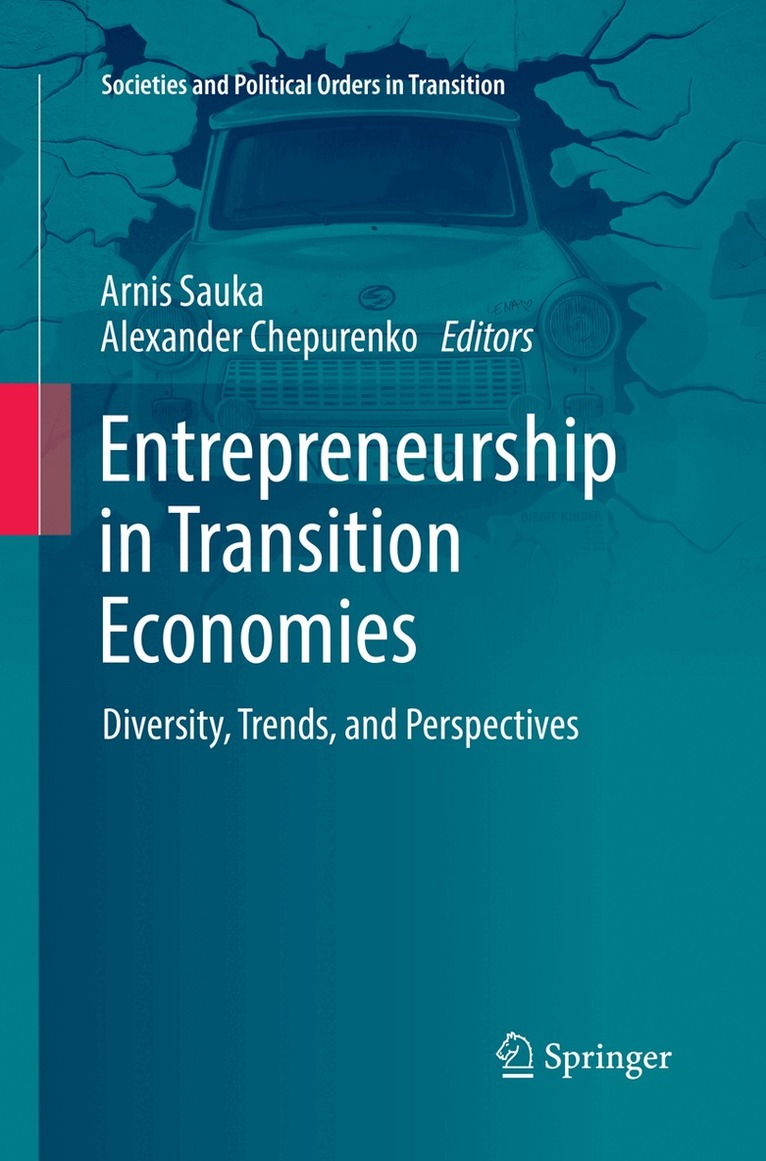
    Entrepreneurship in Transition Economies

    Diversity, Trends, and Perspectives

    AvArnis Sauka,Alexander Chepurenko

    Häftad, Engelska, 2018

    Del i serien Societies and Political Orders in Transition

    1 285 kr

    Beställningsvara. Skickas inom 10-15 vardagar. Fri frakt över 249 kr.

    Beskrivning

    This book presents a state-of-the-art portrait of entrepreneurship in the transition economies of Central and Eastern Europe (CEE) and the Commonwealth of Independent States (CIS) as well as Georgia and Ukraine. Based on new empirical evidence, it highlights major trends in, characteristics and forms of entrepreneurship common to countries in transition. The contributions cover topics such as levels of opportunity-based entrepreneurship, incentives for innovation, dominance of large-scale international corporations, the role of family businesses, and opportunities for grass-roots entrepreneurship.The first part of the book focuses on theoretical considerations regarding the establishment of sustainable entrepreneurial ecosystems and private business. In turn, the second part offers cross-border studies of entrepreneurial environments and activities, while the third and fourth present case studies on the current state and unique characteristics of entrepreneurship in various countries of the CEE and CIS as well as Georgia and Ukraine. Finally, the last parts discuss the role of institutions and policy recommendations.

    Produktinformation

    • Utgivningsdatum:2018-08-04
    • Mått:155 x 235 x 25 mm
    • Vikt:692 g
    • Format:Häftad
    • Språk:Engelska
    • Serie:Societies and Political Orders in Transition
    • Antal sidor:444
    • Förlag:Springer International Publishing AG
    • ISBN:9783319861388

    Utforska kategorier

    • Entreprenörskap inom Ekonomi och Ledarskap
    • Referensverk och tvärvetenskap inom Samhälle och politik
    • Internationell ekonomi inom Ekonomi och Ledarskap

    Mer om författaren

    Dr. Arnis Sauka is an Associate Professor and Director of the Centre for Sustainable Business at the Stockholm School of Economics in Riga. Arnis has a Ph.D. from the University of Siegen (Germany) and has been a Visiting Scholar at Jönköping International Business School (Sweden) and University College London (U.K.). His academic research findings, which deal with the shadow economy, tax morale, competitiveness, social responsibility, internationalisation of companies and entrepreneurship policies, have been published in a number of peer-reviewed journals and books. Arnis has also been extensively involved in applied research, including studies contracted by the OECD and various industry associations and NGOs in the Baltic countries.  Prof. Alexander Chepurenko is Head of the Sociology department of the National research university Higher School of Economics (Moscow), he has over 25 years of experience incomparative analysis of transitional societies, focusing especially on entrepreneurship and private sector development in CIS and CEE economies. He contributed to several monographs on socio-economic models, SME and SME policy in Russia and former Socialist countries. Participated in several international projects, among them the Global Entrepreneurship Monitor (2006-2011), is member of international academic associations and societies (ESBE, EACES).

    Innehållsförteckning

    • Part I. Different Parthways: Concepts and Theories.- 1. Introduction: Systematic ‘transition’ and entrepreneurship theory.- 2. Staying in the Family: The impact of institutions and mental models on entrepreneurship development in post-Soviet transition countries.- Part II.  Entreprenuurship Ecosystems: Cross Country Analysis.- 3. A multidimensional, comparative analysis of the regional entrepreneurship performance in the Central and Eastern European EU member countries.- 4. Institutions and export performance in 26 transition economies.- 5. Technology-Driven Internationalization. Central-Eastern European Perspective.- 6. Is innovation a determinant for SME performance? Cross-country analysis of the economies of former USSR countries.- Part III.  Country Studies  from the CEE region.- 7.Entrepreneurship in Estonia: combination of political and entrepreneurial agenda.- 8. The business cycle and early-stage entrepreneurship in Latvia.-  9. The role of education on entrepreneurship in Lithuania.- 10. Entrepreneurship ecosystem and policy development in Slovenia.- 11. Entrepreneurship in Poland- determinants and development perspectives.- 12. Entrepreneurship development in the Czech Republic.- 13.Entrepreneurship development in Slovakia.- 14. The Network Entrepreneur in Small Businesses: The Bulgarian Case.- part IV. Country Studies: Evidence from Selected CIS Countries, Georgia and Ukraine.- 15. Entrepreneurial intentions and initiatives in Georgia. 16. The path of Belarusian entrepreneurship to a socially oriented market economy.- 17. Small and medium enterprises' sector in an adverse business environment of Ukraine: the role of cooperation.- 18. Cross-regional variations in the motivation of entrepreneurial activity in Russia: determining factors.- Part V. Role of Institutions: Special Topics.- 19. The Entrepreneurial role of families in transitional economies: the case of Lithuania.- 20.The impact of competition on the economic behavior and performance of industrial SMEs in Russia.- 21. Motivation of women business owners: case of Russia and Norway.- 22. Entrepreneurial potential in the informal freelance economy: evidence from the Russian-language Internet.- Part VI. Conclusions and Policy Suggestions.- 23. Diverging paths of entrepreneurship in transition countries. A comparative view.