• Fri frakt över 249 kr
  • •
  • Snabba leveranser
  • •
  • Billiga böcker
Kundservice

Du är på sajten för privatpersoner.

Företag, bibliotek eller offentlig verksamhet?

Du handlar på classic.bokus.com, där alla dina funktioner finns intakta.
Till classic.bokus.com
Bokus logotyp. Gå till startsidan.
  • Erbjudanden
  • Nyheter
  • Student
  • Topplistor
  • Barn & ungdom
  • Bokus Play
  • E-böcker
  • Pocketböcker
  • Spel & pussel

10% rabatt på allt med kod NYSTART10 →

Sidfot

Mina sidor

    Hjälp

    • Kundservice
    • Vanliga frågor och svar
    • Frakt och leverans
    • Retur vid ångerrätt
    • Reklamera vara
    • Betalning
    • Köpvillkor
    • Allmänna villkor
    • Information om webbplatsens tillgänglighet

    Om Bokus

    • Om oss
    • Pressrum
    • För studenter
    • För företag
    • För bibliotek och offentlig verksamhet
    • För leverantörer
    • Hållbarhet

    Populärt

    • Aktuella erbjudanden
    • Presentkort
    • Studentlitteratur
    • Nya böcker
    • Topplistor
    • Signerade böcker
    • Engelska böcker

    Inspiration

    • Boktips
    • BookTok
    • Populära bokserier
    • Barnbokskaraktärer
    • Populära författare
    Logotyp för Bokus
    Följ oss på Facebook (extern länk)Följ oss på Instagram (extern länk)Följ oss på YouTube (extern länk)Följ oss på TikTok (extern länk)
    bokus @ CookiesAnpassa cookiesIntegritetspolicyKöpvillkor
    Till Citymail hemsida (extern länk)Till Budbee hemsida (extern länk)Till Postnord hemsida (extern länk)Till Schenker hemsida (extern länk)Till Early Bird hemsida (extern länk)Till Walleys hemsida (extern länk)
    1. Historia och arkeologi
    2. Arkeologi
    3. Arkeologi: metod och teknik

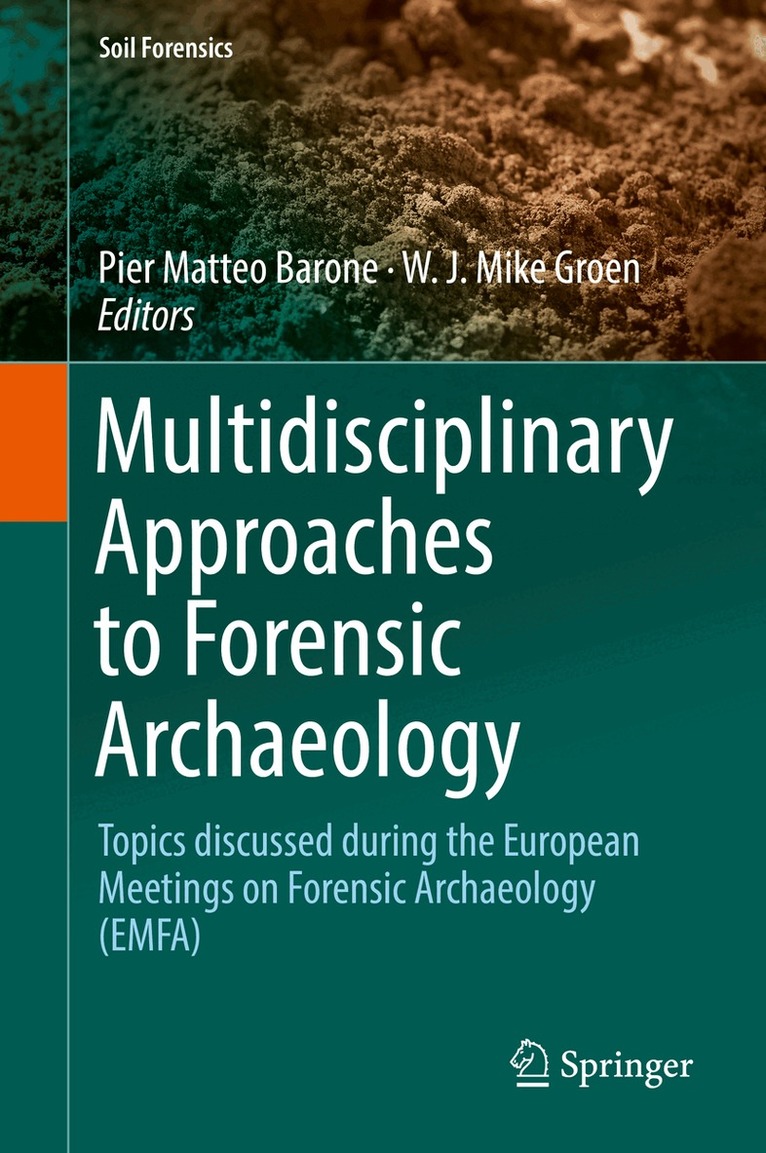
    Multidisciplinary Approaches to Forensic Archaeology

    Topics discussed during the European Meetings on Forensic Archaeology (EMFA)

    AvPier Matteo Barone,W. J. Mike Groen

    Inbunden, Engelska, 2018

    Del i serien Soil Forensics

    1 896 kr

    Beställningsvara. Skickas inom 10-15 vardagar. Fri frakt över 249 kr.

    Beskrivning

    This book will present the most advanced research on forensic archaeology presented during the annual European meetings in the last 3 years. Thanks to the broad nature of the chapters presented, this book will show not only different approaches and different crime scenes around Europe, but also how every single European law enforcement has faced forensic investigations. This book shows forensic archaeology as practiced in this legal context, emerging and solidifying in many European countries, differing in some respects because of differences in legal systems but ultimately sharing common grounds. Differently from similar books, this will be not only a collection of research and case studies in which forensic practitioners demonstrate the extent and complexity of the various aspects of forensic archaeology, but also it will show the necessity of co-operation as a condition for any work in forensic archaeology among scientists of different disciplines and law enforcers.

    Produktinformation

    • Utgivningsdatum:2018-11-03
    • Mått:155 x 235 x 21 mm
    • Vikt:659 g
    • Format:Inbunden
    • Språk:Engelska
    • Serie:Soil Forensics
    • Antal sidor:279
    • Upplaga:18001
    • Förlag:Springer International Publishing AG
    • ISBN:9783319943961

    Utforska kategorier

    • Arkeologi: metod och teknik inom Historia och arkeologi
    • Brottsutredning och kriminalteknik inom Samhälle och politik

    Mer om författaren

    PIER MATTEO BARONE: Pier Matteo Barone is an adjunct professor at the American University of Rome teaching courses on archaeological methodology, geophysical techniques (GPR, in particular) and forensic archaeology, as well as courses on the archaeology and heritage of Rome and the eastern Mediterranean. His research is centered on different remote sensing applications to better understand the archaeological landscape. He is also a recognized expert in forensic archaeology employed to testify in criminal and civil cases. He was a co-investigator in a three-year research project (FIRB 2012) with the geological institute of CNR (IGAG) investigating marble quarries of the Greco-Roman world in Turkey.Finally, he has authored over a hundred of publications on these topics, he has presented several papers in national and international conferences, he has appeared on national public/private radio, TV, and magazines, and heis co-editor and reviewer of several international peer-reviewed journals.WJ MIKE GROEN: Mike Groen is a forensic archaeologist employed by the Netherlands Forensic Institute (NFI) and a staff member at the Leiden University, Faculty of Archaeology. His past academic and professional experience relates to GIS modelling, field archaeology, human taphonomy and physical anthropology. He is responsible for the introduction of forensic archaeology in the Netherlands in 2005 and for the creation of the Forensic Archaeology group within the European Network of Forensic Science Institutes (ENFSI) in 2013. Since 2014 he chairs the Dutch Association of Physical Anthropologists (NVFA). His current research interest include forensic archaeology, GIS predictive modelling forensic taphonomy and scene of crime science.

    Innehållsförteckning

    • Preface.- Chapter 01: Introduction: Forensic Archaeology: Combining Archaeology with Criminalistics and Criminology.- Part I: Forensic Archaeology and NDTs.- Chapter 02: Forensic archaeological remote sensing and geospatial analysis.- Chapter 03: Geophysics and Archaeology at crime scenes.- Chapter 04: Forensic Geophysics and the Search of Building Interiors, Peat Bogs, and Freshwater.- Part II: Forensic Archaeology and Human Remains.- Chapter 05: The increasing role of the forensic anthropologist in the search for the missing.- Chapter 06: Forensic archaeology: State-of-the-art archeological technology in France and other latest developments. A case study in Toulouse region (South West of France).- Chapter 07: Actualistic experimental taphonomy of inhumation burial.- Chapter 08: The use of 3-dimensional scanning and surface capture methods in recording forensic taphonomic traces: issues of technology, visualisation, and validation.- Chapter 09: Human remains in marineenvironments: Challenges and Future developments.- Chapter 10: Interrogating the ground – an archaeologist at a crime scene.- Chapter 11: Forensic Archaeology in Denmark – A Work in Progress.- Chapter 12: Recent recruitment of forensic anthropologist and odontologist in Carabinieri scientific investigation: multi-disciplinary approach and scene investigation in case of hidden corpse.- Chapter 13: Forensic Archaeology in Russia: Past Developments and Future Approaches.- Chapter 14: Operation Nobility: The identification of a missing soldier from the Battle of Arnhem, 1944.- Chapter 15: The Independent Commission for the Location of Victims’ Remains in Ireland: A case study – the abduction, murder and secret burial of Victim B.- Part III: Forensic Archaeology and Antiquity Crimes.- Chapter 16: Not just body and decomposition: Forensic Archaeology preventing Antiquities Crimes.- Chapter 17: Problems of Archaeological Heritage Protection—The Background of Crime Against Monuments and Works of Art.- Chapter 18; Preventing Art and Antiquities Crimes using Forensic Geology.