• Fri frakt över 249 kr
  • •
  • Snabba leveranser
  • •
  • Billiga böcker
Kundservice

Du är på sajten för privatpersoner.

Företag, bibliotek eller offentlig verksamhet?

Du handlar på classic.bokus.com, där alla dina funktioner finns intakta.
Till classic.bokus.com
Bokus logotyp. Gå till startsidan.
  • Erbjudanden
  • Nyheter
  • Student
  • Topplistor
  • Barn & ungdom
  • Bokus Play
  • E-böcker
  • Pocketböcker
  • Spel & pussel

10% rabatt på allt med kod NYSTART10 →

Sidfot

Mina sidor

    Hjälp

    • Kundservice
    • Vanliga frågor och svar
    • Frakt och leverans
    • Retur vid ångerrätt
    • Reklamera vara
    • Betalning
    • Köpvillkor
    • Allmänna villkor
    • Information om webbplatsens tillgänglighet

    Om Bokus

    • Om oss
    • Pressrum
    • För studenter
    • För företag
    • För bibliotek och offentlig verksamhet
    • För leverantörer
    • Hållbarhet

    Populärt

    • Aktuella erbjudanden
    • Presentkort
    • Studentlitteratur
    • Nya böcker
    • Topplistor
    • Signerade böcker
    • Engelska böcker

    Inspiration

    • Boktips
    • BookTok
    • Populära bokserier
    • Barnbokskaraktärer
    • Populära författare
    Logotyp för Bokus
    Följ oss på Facebook (extern länk)Följ oss på Instagram (extern länk)Följ oss på YouTube (extern länk)Följ oss på TikTok (extern länk)
    bokus @ CookiesAnpassa cookiesIntegritetspolicyKöpvillkor
    Till Citymail hemsida (extern länk)Till Budbee hemsida (extern länk)Till Postnord hemsida (extern länk)Till Schenker hemsida (extern länk)Till Early Bird hemsida (extern länk)Till Walleys hemsida (extern länk)
    1. Naturvetenskap och teknik
    2. Matematik och naturvetenskap
    3. Kemi
    4. Analytisk kemi

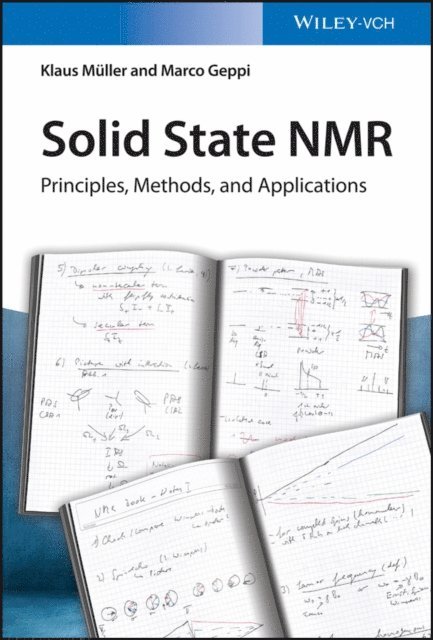
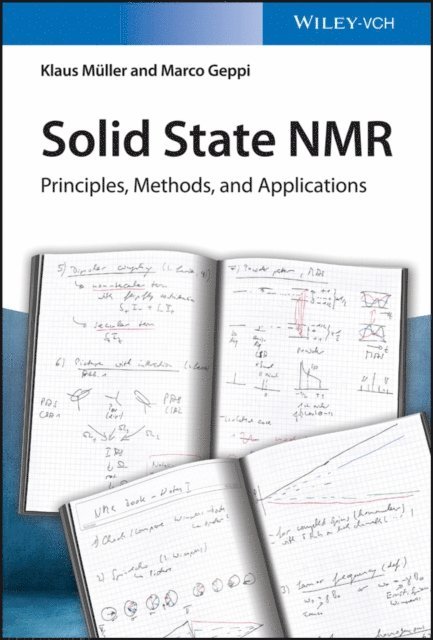
    Solid State NMR

    Principles, Methods, and Applications

    AvKlaus Müller,Marco Geppi

    Häftad, Engelska, 2021

    1 064 kr

    Skickas . Fri frakt över 249 kr.

    Beskrivning

    Solid State NMR A thorough and comprehensive textbook covering the theoretical background, experimental approaches, and major applications of solid-state NMR spectroscopyNuclear Magnetic Resonance (NMR) spectroscopy is a powerful non-destructive technique capable of providing information about the molecular structure and dynamics of molecules. Alongside solution-state NMR, a well-established technique to study chemical structures and investigate physico-chemical properties of molecules in solutions, solid-state NMR (SSNMR) offers many exciting possibilities for the analysis of solid and soft materials across scientific fields. SSNMR shows unique capabilities for a detailed investigation of structural and dynamic properties of materials over wide space and time ranges. For this reason, and thanks to significant advances in the past several years, the application of SSNMR to materials is rapidly increasing in disciplines such as chemistry, physics, and materials and life sciences.Solid State NMR: Principles, Methods, and Applications offers a systematic introduction to the theory, methodological concepts, and major experimental methods of SSMR spectroscopy. Exploring the unique potential of SSNMR for the structural and dynamic characterization of soft and either amorphous or crystalline solid materials, this comprehensive textbook provides foundational knowledge and recent developments of SSNMR, covering physical and theoretical background, experimental methods, and applications to pharmaceuticals, polymers, inorganic and hybrid materials, liquid crystals, and model membranes. Written by two expert authors to ensure a clear and consistent presentation of the subject, this textbook:Includes a brief introduction to the historical aspects and broad theoretical background of solid-state NMR spectroscopyProvides helpful illustrations to explain the various SSNMR concepts and methodsFeatures accessible descriptive text with self-consistent use of quantum mechanicsCovers the experimental aspects of SSNMR spectroscopy and in particular a description of many useful pulse sequencesContains references to relevant literatureSolid State NMR: Principles, Methods, and Applications is the ideal textbook for university courses on SSNMR, advanced spectroscopies, and a valuable single-volume reference for spectroscopists, chemists, and researchers in the field of materials.

    Produktinformation

    • Utgivningsdatum:2021-07-28
    • Mått:170 x 241 x 28 mm
    • Vikt:1 066 g
    • Format:Häftad
    • Språk:Engelska
    • Antal sidor:560
    • Förlag:Wiley-VCH Verlag GmbH
    • ISBN:9783527318162

    Utforska kategorier

    • Analytisk kemi inom Naturvetenskap och teknik

    Mer om författaren

    Marco Geppi, PhD, is a Professor of Physical Chemistry in the Department of Chemistry and Industrial Chemistry at the University of Pisa, Italy, where he leads the solid-state NMR group. Klaus Müller, PhD, was a Professor of Physical Chemistry at the University of Stuttgart, Germany. Now deceased, Professor Müller’s main research activities were applications of solid-state NMR techniques for the characterization of different types of materials.

    Innehållsförteckning

    • Foreword xiiiPreface xvForeword xvii1 Introductory NMR Concepts 11.1 Historical Aspects 11.2 Basic Description of NMR Spectroscopy 51.2.1 Nuclear Spins and Nuclear Zeeman Effect 81.2.2 Spin Ensembles 111.2.3 Single Pulse Experiment, Bloch Equations, and Fourier Transformation 171.2.4 Populations and Coherences 271.3 Liquid-state NMR Spectroscopy: Basic Concepts 291.3.1 Chemical Shift 291.3.2 Indirect Spin–Spin Coupling and Spin Decoupling 321.3.3 Nuclear Spin Relaxation 381.3.4 Nuclear Overhauser Effect 441.4 Liquid-state NMR Spectroscopy: Some Experiments 471.4.1 Relaxation Experiments 471.4.2 Insensitive Nuclei Enhanced by Polarization Transfer 531.4.3 2D NMR Spectroscopy 531.4.4 Chemical Exchange 571.5 Solid Materials and NMR Spectroscopy 63References 692 Mathematical and Quantum-mechanical Tools 732.1 Definitions and Basic Concepts 732.1.1 Operators and Functions 732.1.2 Eigenvalue Equations 742.1.3 Eigenstates and Superposition States: Pure and Mixed Ensembles 752.1.4 Nuclear Spin and Angular Momentum 762.2 Rotations and Frame Transformations 772.2.1 Active and Passive Transformations 782.2.2 Rotation Operators 782.2.3 Rotation Matrices and Euler Angles 792.3 Time-Independent Features: Energy Levels and Related Aspects 812.3.1 Time-Independent Schrödinger Equation and Spin Hamiltonians 812.3.2 Time-Independent Perturbation Theory 812.3.3 Matrix Representation of Operators and Density Matrix Theory 832.3.3.1 Isolated Nucleus with Spin 1/2 842.3.3.2 Isolated Nucleus with Spin 1 872.3.3.3 Pair of Coupled Nuclei with Spin 1/2 872.3.4 Spin Temperature 892.4 Dealing with Time Dependence 902.4.1 Time-Dependent Schrödinger and Liouville–von Neumann Equations 902.4.2 Average Hamiltonian Theory 91References 933 Nuclear Spin Interactions 953.1 Introduction 953.2 Interactions with External Magnetic Fields 973.3 Internal Interactions 1003.3.1 Shielding or Chemical Shift Interaction 1003.3.2 Knight Shift Interaction 1053.3.3 Quadrupolar Interaction 1063.3.4 Dipolar Coupling 1123.3.5 Indirect Spin–Spin (J) Coupling 1163.3.6 Paramagnetic Coupling 117References 1194 Broadline NMR Spectroscopy 1214.1 Introductory Remarks 1214.2 Finite Pulse Duration and Adiabatic Pulses 1334.2.1 Finite Pulse Duration: Excitation Profile and Spectral Distortions 1334.2.2 Adiabatic Pulses 1384.3 Inhomogeneous and Homogeneous Line Broadening Mechanisms 1414.4 Dilute Spin-1/2 Nuclei 1424.4.1 Broadline NMR Spectra 1424.4.2 Cross-polarization 1494.4.2.1 Pulse Sequence and Hartmann–Hahn Conditions 1494.4.2.2 CP Explained by AHT 1514.4.2.3 CP Explained by the Thermodynamic Model 1574.4.2.4 CP Dynamics 1604.4.2.5 CP-related Techniques 1674.4.3 Heteronuclear Spin Decoupling 1694.4.3.1 CWHeteronuclear Spin Decoupling Explained by AHT 1714.4.3.2 Beyond CW: Off-resonance Effects and Pulse Decoupling Schemes 1724.4.4 Echo Experiments 1764.5 Abundant Spin-1/2 Nuclei 1844.5.1 Broadline NMR Spectra 1844.5.2 Spin Diffusion 1874.5.2.1 Fick’s Equation of Diffusion 1874.5.2.2 The Goldman–Shen Experiment 1894.5.2.3 Influence of Spin Diffusion on Spin-Lattice Relaxation Times 1914.5.3 Moment Analysis 1924.5.4 Echo Experiments for Refocusing the Homonuclear Dipolar Interaction 1944.5.4.1 Solid Echo 1944.5.4.2 Magic-sandwich Echo 1974.6 Quadrupolar Nuclei 2004.6.1 Broadline NMR Spectra 2004.6.2 Selective and Non-selective RF Pulses 2054.6.3 Cross-polarization 2094.6.4 Echo and Sensitivity Enhancement Experiments 2104.6.4.1 Quadrupolar Echo 2104.6.4.2 Solomon and Hahn Echoes 2114.6.4.3 Quadrupolar Carr–Purcell–Meiboom–Gill 2184.6.4.4 Other Sensitivity Enhancement Techniques 219References 2245 1D High-resolution Solid-state NMR Spectroscopy 2275.1 Dilute Spin-1/2 Nuclei 2275.1.1 Sample Rotation 2285.1.2 Spinning Sideband Suppression 2365.1.3 Heteronuclear Spin Decoupling and Sample Spinning 2445.1.4 Cross-polarization and Sample Spinning 2575.1.5 Basic Pulse Experiments Under MAS Conditions 2685.1.5.1 Pulse Sequences for the Measurement of Relaxation Times 2695.1.5.2 Pulse Sequences for Spectral Editing: Distinguishing Components with Different Dynamic Properties 2705.1.5.3 Pulse Sequences for Spectral Editing: Distinguishing Rare Nuclei With Different Chemical Bonds 2715.1.5.4 Pulse Sequences for Quantitative Determinations: CP vs SPE 2735.2 Abundant Spin-1/2 Nuclei 2755.2.1 Sample Rotation 2755.2.2 Multiple Pulse Experiments 2755.2.3 Combined Pulse and Sample Rotation Experiments 2825.3 Quadrupolar Nuclei 2895.3.1 Sample Rotation 2895.3.2 Integer Spin Nuclei 2905.3.3 Half-integer Spin Nuclei 2915.3.3.1 CT Spectra 2945.3.3.2 Double Angle Rotation 2975.3.3.3 Satellite Transition Spectroscopy 3005.3.4 Sensitivity Enhancement 301References 3056 2D Solid-State NMR Spectroscopy 3096.1 Basic Concepts 3116.1.1 Basic Structure of 2D Experiments 3116.1.2 Need for Recoupling 3136.1.3 Double (Multiple) Quantum Spectroscopy 3166.2 Experiments Based on Chemical Shift Anisotropy 3176.2.1 MAH, MAT, 5-π, and Related Experiments 3186.2.2 STAG, S3, SASS 3216.2.3 VACSY 3226.2.4 TOSS–ReverseTOSS and 2D-PASS 3226.2.5 CSA Amplification Methods 3246.2.6 Pulse Sequences Recoupling Chemical Shift Anisotropy 3266.2.7 Pulse Sequences for Abundant Spin-1/2 Nuclei 3266.2.8 Rotary Resonance (RR) 3286.3 Experiments Based on Heteronuclear Dipolar Coupling 3296.3.1 Heteronuclear Correlation Through Dipolar Interaction 3306.3.2 Separated Local Field (SLF) 3336.3.3 Rotary Resonance Recoupling (R3) 3376.3.4 REDOR 3376.3.5 REAPDOR and TRAPDOR 3486.3.6 TEDOR 3526.3.7 HARDSHIP 3546.4 Experiments Based on Homonuclear Dipolar Coupling 3556.4.1 WISE 3556.4.2 Rotational Resonance (R2) 3586.4.3 Broadband Homonuclear Dipolar Recoupling 3606.4.3.1 DRAMA and MELODRAMA 3626.4.3.2 RFDR and SEDRA 3656.4.3.3 2Q-HORROR, MSD-HORROR, and DREAM 3666.4.3.4 BABA 3706.4.3.5 Symmetry-based Recoupling Schemes: C7 and POST-C7 3706.4.3.6 Dipolar Truncation and High-order Recoupling Schemes 3716.4.4 Homonuclear Correlation Through Dipolar Interaction 3726.5 Experiments Based on J-coupling 3756.5.1 Heteronuclear Correlation Through J-coupling 3766.5.2 Homonuclear Correlation Through J-coupling 3786.6 Experiments Based on Quadrupolar Interaction 3806.6.1 Nutation 3806.6.2 DAH and DAS 3816.6.3 MQMAS 3846.6.4 STMAS 388References 3917 Molecular Dynamics by Solid-State NMR 3977.1 Experimental Observables and Motional Timescales 3997.1.1 Spectral Lineshapes 3997.1.1.1 High-Resolution Spectra 4007.1.1.2 Powder Spectra 4017.1.1.3 Spectra Acquired by “Exchange” Experiments 4037.1.2 Relaxation Times in Solids 4047.1.2.1 Spin–Spin Relaxation Times 4067.1.2.2 Spin–Lattice Relaxation Times of Abundant Nuclei 4097.1.2.3 Spin–Lattice Relaxation Times of Rare Nuclei 4107.1.2.4 Dipolar and Quadrupolar Spin–Lattice Relaxation Times 4117.1.2.5 Theory of Relaxation 4127.1.3 Absolute Frequency Regimes 4167.2 Motional Models 4197.2.1 Models for Lineshape Analysis 4197.2.2 Spectral Densities 4227.2.3 Dependence of Correlation Times on Temperature 4237.3 Broadline Experiments 4247.3.1 Acquisition of 1D Spectra 4257.3.2 Measurement of Relaxation Times 4267.3.2.1 Spin–Spin Relaxation Times, FID Analysis, and DQ Techniques 4267.3.2.2 Spin–Lattice Relaxation Times 4327.3.3 Other Techniques 4357.3.3.1 Stationary Stimulated Echo 4367.3.3.2 2D Exchange 4367.3.3.3 Spin Alignment 4377.4 High-Resolution Experiments 4387.4.1 Acquisition of 1D and 2D Spectra 4387.4.1.1 1D Chemical Exchange 4387.4.1.2 Line Broadening from Interferences 4397.4.1.3 Lineshapes from 2D Experiments 4407.4.2 Measurement of Relaxation Times 4407.4.2.1 Abundant Nuclei 4407.4.2.2 Rare Nuclei 4417.4.3 Other Techniques 4427.4.3.1 2D Chemical Exchange 4427.4.3.2 1D and 2D Exchange of Spinning Sidebands 4427.4.3.3 CODEX 443References 4448 Application of SSNMR to Selected Classes of Systems 4478.1 Pharmaceuticals 4478.1.1 Introduction 4478.1.2 Polymorphs, Solvates, and Salts 4498.1.3 Molecular Complexes and Cocrystals 4548.1.4 NMR Crystallography 4568.1.5 Molecular Dynamics 4598.1.6 Disordered and Amorphous Forms 4618.1.7 Identification of API Forms in Formulations 4618.1.8 Miscibility and Interactions in Drug Formulations and Dispersions 4638.2 Polymeric Materials 4658.2.1 Introduction 4658.2.2 Primary Structure 4668.2.3 Secondary and Tertiary Structure 4668.2.4 Phase Properties 4708.2.4.1 Polymorphism 4708.2.4.2 Heterophasicity 4708.2.4.3 Phase Transformations 4748.2.5 Interfaces and Domain Dimensions 4748.2.6 Molecular Dynamics 4798.2.6.1 Motions in Glassy and Crystalline Phases 4808.2.6.2 Motions in Rubbers and Melts 4818.3 Inorganic and Organic–Inorganic Materials 4858.3.1 Introduction 4858.3.2 Inorganic Systems 4868.3.2.1 Silicates 4868.3.2.2 Zeolites 4898.3.2.3 Aluminophosphates 4918.3.2.4 Amorphous Materials: Cements, Geopolymers, and Glasses 4938.3.3 Organic–Inorganic Materials 4978.3.3.1 Organometallic Complexes 4978.3.3.2 Metal–Organic Frameworks 5008.3.3.3 Organically Modified Fillers and Polymer/Filler Composites 5028.4 Liquid Crystals and Model Membranes 5078.4.1 Introduction 5078.4.2 Mesogens and Mesophases 5078.4.3 SSNMR Techniques for Investigating Mesophases 5118.4.4 Orientational Order 5158.4.5 Phase Structure 5198.4.6 Molecular Dynamics 523References 525Index 531