• Fri frakt över 249 kr
  • •
  • Snabba leveranser
  • •
  • Billiga böcker
Kundservice

Du är på sajten för privatpersoner.

Företag, bibliotek eller offentlig verksamhet?

Du handlar på classic.bokus.com, där alla dina funktioner finns intakta.
Till classic.bokus.com
Bokus logotyp. Gå till startsidan.
  • Erbjudanden
  • Nyheter
  • Student
  • Topplistor
  • Barn & ungdom
  • Bokus Play
  • E-böcker
  • Pocketböcker
  • Spel & pussel

10% rabatt på allt med kod: NYSTART10 →

Sidfot

Mina sidor

    Hjälp

    • Kundservice
    • Vanliga frågor och svar
    • Frakt och leverans
    • Retur vid ångerrätt
    • Reklamera vara
    • Betalning
    • Köpvillkor
    • Allmänna villkor
    • Information om webbplatsens tillgänglighet

    Om Bokus

    • Om oss
    • Pressrum
    • För studenter
    • För företag
    • För bibliotek och offentlig verksamhet
    • För leverantörer
    • Hållbarhet

    Populärt

    • Aktuella erbjudanden
    • Presentkort
    • Studentlitteratur
    • Nya böcker
    • Topplistor
    • Signerade böcker
    • Engelska böcker

    Inspiration

    • Boktips
    • BookTok
    • Populära bokserier
    • Barnbokskaraktärer
    • Populära författare
    Logotyp för Bokus
    Följ oss på Facebook (extern länk)Följ oss på Instagram (extern länk)Följ oss på YouTube (extern länk)Följ oss på TikTok (extern länk)
    bokus @ CookiesAnpassa cookiesIntegritetspolicyKöpvillkor
    Till Citymail hemsida (extern länk)Till Budbee hemsida (extern länk)Till Postnord hemsida (extern länk)Till Schenker hemsida (extern länk)Till Early Bird hemsida (extern länk)Till Walleys hemsida (extern länk)
    1. Naturvetenskap och teknik
    2. Teknik och industri
    3. Teknik: allmänt

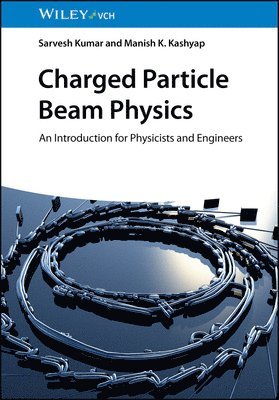
    Charged Particle Beam Physics

    An Introduction for Physicists and Engineers

    AvSarvesh Kumar,Manish K. Kashyap

    Inbunden, Engelska, 2025

    1 230 kr

    Beställningsvara. Skickas inom 5-8 vardagar. Fri frakt över 249 kr.

    Beskrivning

    Offers a clear and practical introduction to the essentials of charged particle beam physics, covers the design of accelerator machines and their basic components A cornerstone of modern accelerator technology, charged particle beam physics encompasses theoretical principles, advanced simulations, and real-world applications. Charged Particle Beam Physics: An Introduction for Physicists and Engineers provides a comprehensive foundation for understanding, modeling, and implementing beam optics components in accelerator systems. Combining essential concepts with cutting-edge techniques, such as the transfer-matrix method and numerical simulation tools, this detailed yet accessible textbook simplifies the core concepts and principles of the complex field. Reader-friendly chapters systematically address ion sources, beam optics design, advanced diagnostic and vacuum systems, and more. Authors Sarvesh Kumar and Manish K. Kashyap discuss key topics such as electrostatic, magnetostatic, and radiofrequency fields, as well as practical applications in materials science, plasma physics, and radiation biology. Bridging theoretical knowledge with practical implementation, Charged Particle Beam Physics: Provides in-depth coverage of charged particle beam physics, relevant to both single-pass configurations and standard beam transport lines across accelerator systemsCombines elements of electrodynamics, particle physics, optics, and engineering for a holistic understandingExplores state-of-the-art methods such as open-source beam optics codesIncludes end-of-chapter problems and worked solutions, along with numerical examples using open-source tools such as TRANSPORT and TRACE3dCharged Particle Beam Physics: An Introduction for Physicists and Engineers is ideal for graduate-level students in physics and engineering courses focused on accelerator physics and beam optics, as well as researchers and professionals working in accelerator design and operation. It serves as both a teaching resource and a reference for practitioners tackling fundamental calculations and developing accelerator components across various disciplines.

    Produktinformation

    • Utgivningsdatum:2025-09-24
    • Mått:170 x 244 x 15 mm
    • Vikt:680 g
    • Format:Inbunden
    • Språk:Engelska
    • Antal sidor:288
    • Förlag:Wiley-VCH Verlag GmbH
    • ISBN:9783527414048

    Utforska kategorier

    • Teknik: allmänt inom Naturvetenskap och teknik
    • Fysik inom Naturvetenskap och teknik
    • Maskinteknik och material inom Naturvetenskap och teknik

    Mer om författaren

    Dr. Sarvesh Kumar is an experimental plasma and accelerator physicist with nearly two decades of experience at the IUAC, New Delhi, India. He contributed to significant national and international projects such as the Large Hadron Collider project. He is presently working as Associate Professor in the Department of Physics & Astrophysics, University of Delhi, India. His main area of interests are plasma wakefield acceleration, plasma instabilities, particle accelerator designs, beam optics and beam-plasma interaction.Dr. Manish K. Kashyap is a Professor at the School of Physical Sciences, Jawaharlal Nehru University (JNU), India. His areas of interest are condensed matter physics, plasma physics and accelerator physics. His work integrates theoretical modeling with experimental perspectives to enhance beam quality and stability in ion accelerators. He has published around 110 research papers in international journals and conference proceedings.

    Innehållsförteckning

    • Foreword xPreface xiAbout the Authors xivAcknowledgments xviAcronyms xviiAbout the Companion Website xix1 Introduction to Charged Particle Beams 11.1 History of Particle Accelerators and the Chronological Milestones 61.2 Maxwell's Equations 91.3 Electrostatic Accelerators 111.4 Cyclotrons 181.5 Synchrotrons 211.6 Synchrocyclotron 231.7 Betatron 251.8 Particle Colliders 261.9 FFAG Accelerators 281.10 Wakefield Accelerators 301.11 Radiation Physics 361.12 Beam Conceptual Visualization 391.13 Numerical Problems 402 Ion Sources 432.1 ECR Ion Sources 442.2 SNICS Ion Source 522.3 Duoplasmatron 542.4 Electron Beam Ion Source 552.5 Penning Ion Sources 572.6 Laser Ion Sources 592.7 Vacuum Arc Ion Source 612.8 Numerical Problems 613 Beam Optics 633.1 Phase Space and Liouville's Theorem 643.2 Emittance and Acceptance 663.3 Brightness 683.4 Luminosity 693.5 Matrix Formalism 713.6 Equation of Motion in a Co-moving Coordinate System 763.7 Hill's Equation and Twiss Parameters Formalism 793.8 Horizontal and Vertical Root M ean S quare Beam Sizes in Accelerators 843.9 Betatron Phase Advance and Tune 863.10 Chromaticity 893.11 RMS Emittance 913.12 Space Charge Effects on Ion Beam 933.13 Numerical Problems 964 Motion in Magnetostatic Devices 994.1 Magnetostatic Devices 994.2 Ampere's Law for Magnet Design 1014.3 Equation of Motion in a Co-moving Coordinate System 1014.4 Drift 1044.5 Dipole Magnets 1064.6 Design of Dipole Magnets 1104.7 Quadrupole Magnets 1164.8 Beam Rotation Matrix 1204.9 Solenoid Magnets 1204.9 .2 Design of Solenoid Magnets 1264.10 Sextupole Magnets 1284.11 Magnetostatic Steerer/Deflector 1304.12 Wien Filter 1324.13 Achromatic Magnets 1344.14 Septum and Kicker Magnets 1364.15 Glaser Lens 1374.16 Undulators 1414.17 Wigglers 1454.18 Numerical Problems 1485 Electrostatic Devices 1515.1 Motion of a Charged Particle in an Electric Field 1515.2 Electrostatic Dipole 1525.3 Electrostatic Quadrupole 1555.4 Electrostatic Thin Lens and Einzel Lens 1585.5 Electrostatic Steerer/Deflector 1655.6 Electrostatic Accelerating Tube 1655.7 Electrostatic Septum 1695.8 Numerical Problems 1706 Radio Frequency Devices 1716.1 Longitudinal Beam Dynamics 1726.2 Pillbox Cavity 1756.3 Traveling Wave Structures 1756.4 Standing Wave Structures 1766.5 Phase Stability in LINACs 1816.6 Radial Impulse and Deflection in an RF Gap 1866.7 RF Chopper 1886.8 RF Buncher 1896.9 RF Acceleration 1906.10 Quarter-wave and Half-wave Resonators 1936.11 Radio Frequency Quadrupole 1956.12 Drift Tube LINACS 1976.13 Numerical Problems 1997 Beam Diagnostics 2017.1 Faraday Cups 2037.2 Beam Profile Monitor 2047.3 Beam Position Monitors 2047.4 Beam Current Transformers 2077.5 Capacitive Pick-up Probes 2087.6 Fast Faraday Cups 2097.7 Phase Detector Cavity 2127.8 Transverse Beam Emittance by Quadrupole Magnet Scan 2147.9 Longitudinal Beam Emittance by Buncher Scan 2157.10 Energy Spread Measurements 2177.11 Ion Bunch Width Using Detectors 2177.12 Numerical Problems 2198 Vacuum Devices 2218.1 Basics of Vacuum Technology 2228.2 Vacuum Accessories and Subcomponents 2318.3 Vacuum Pumps 2348.4 Vacuum Gauges 2388.5 Helium Leak Detector: Mathematical Principles 2418.6 Numerical Problems 243Appendix A: Field-induced Breakdown in Accelerator Technologies 245Appendix B: Panofsky--Wenzel Theorem in Accelerator Physics 249Appendix C: Child--Langmuir Law and Richardson's Law 253Appendix D: Larmor's Formula and Its Importance in Accelerator Physics 255Appendix E: Stefan--Boltzmann Law and Its Applications in Particle Accelerators 257Bibliography 259Index 263