• Fri frakt över 249 kr
  • •
  • Snabba leveranser
  • •
  • Billiga böcker
Kundservice

Du är på sajten för privatpersoner.

Företag, bibliotek eller offentlig verksamhet?

Du handlar på classic.bokus.com, där alla dina funktioner finns intakta.
Till classic.bokus.com
Bokus logotyp. Gå till startsidan.
  • Erbjudanden
  • Student
  • Topplistor
  • Barn & ungdom
  • Bokus Play
  • E-böcker
  • Ljudböcker
  • Pocketböcker
  • Spel och pussel

Pocketfynda! Hundratals böcker för 49 kr/st →

Sidfot

Mina sidor

    Hjälp

    • Kundservice
    • Vanliga frågor och svar
    • Frakt och leverans
    • Retur vid ångerrätt
    • Reklamera vara
    • Betalning
    • Köpvillkor
    • Allmänna villkor
    • Information om webbplatsens tillgänglighet

    Om Bokus

    • Om oss
    • Pressrum
    • För studenter
    • För företag
    • För bibliotek och offentlig verksamhet
    • För leverantörer
    • Hållbarhet

    Populärt

    • Aktuella erbjudanden
    • Presentkort
    • Studentlitteratur
    • Nya böcker
    • Topplistor
    • Signerade böcker
    • Engelska böcker

    Inspiration

    • Boktips
    • BookTok
    • Barnbokskaraktärer
    • Populära författare
    Logotyp för Bokus
    Följ oss på Facebook (extern länk)Följ oss på Instagram (extern länk)Följ oss på YouTube (extern länk)Följ oss på TikTok (extern länk)
    bokus @ CookiesAnpassa cookiesIntegritetspolicyKöpvillkor
    Till Citymail hemsida (extern länk)Till Budbee hemsida (extern länk)Till Postnord hemsida (extern länk)Till Schenker hemsida (extern länk)Till Early Bird hemsida (extern länk)Till Walleys hemsida (extern länk)
    1. Data och IT
    2. Systemvetenskap och AI

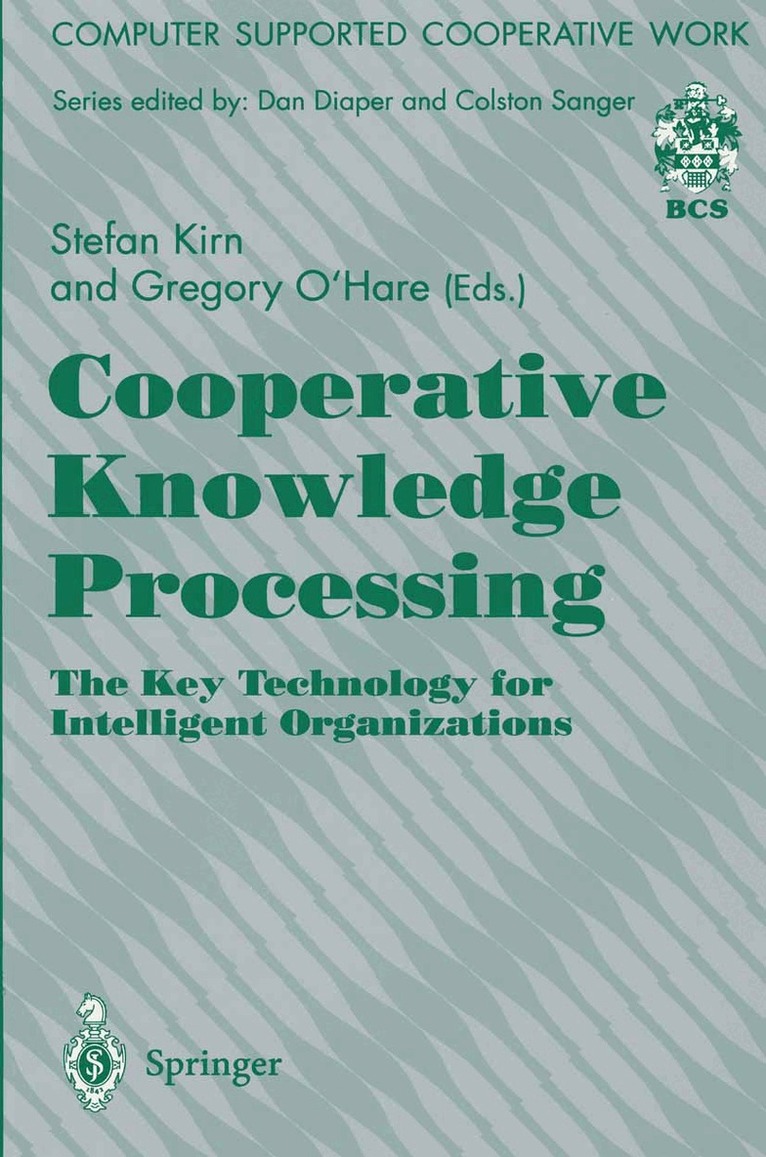
    Cooperative Knowledge Processing

    The Key Technology for Intelligent Organizations

    AvStefan Kirn,Gregory O'Hare

    Häftad, Engelska, 1996

    Del i serien Computer Supported Cooperative Work

    1 110 kr

    Beställningsvara. Skickas inom 10-15 vardagar. Fri frakt över 249 kr.

    Beskrivning

    In the light of the challenges that face today's organizations, there is a grow­ ing recognition that future market success and long term' survival of enter­ prises will increasingly depend upon the effective usage of information technology. Of late, a new generation of terminology has emerged to describe enterprises. This terminology draws heavily upon the virtual concep- virtual reality, virtual organization, virtual (working) environment, and indeed virtual product. However, developing computerized organisations for the 21st century demands serious thought with regard to the judicious integration of organizational theory, design and practice with research tools and methods from within information processing technology. Within this book, we approach this aim from the perspective of a radically decentralized (possibly virtual) enterprise. We assume that organizations are becoming increasingly process-orientated, rather than adhering to the former more traditional organizational structures based upon task oriented models. This approach has proved illuminating in that, due to the inherent autonomy of organizational subunits any approach to coordinating decentralized activ­ ities (including workflows and business processes) necessitates a cooperative style of problem solving. This book introduces the reader to a stimulating new field of interdiscipli­ nary research in cooperative problem solving. In Chapter 1 Kim presents a view of three central discip14tes, namely those of Organizational Theory, Computer Supported Cooperative Work (CSCW) and Distributed Artificial Intelligence (DAI). The applications given here demonstrate how future enterprises will benefit from recent advances in the technological arena of cooperative knowledge processing.

    Produktinformation

    • Utgivningsdatum:1996-11-26
    • Mått:155 x 235 x 18 mm
    • Vikt:493 g
    • Format:Häftad
    • Språk:Engelska
    • Serie:Computer Supported Cooperative Work
    • Antal sidor:296
    • Upplaga:96001
    • Förlag:Springer-Verlag Berlin and Heidelberg GmbH & Co. KG
    • ISBN:9783540199519

    Utforska kategorier

    • Systemvetenskap och AI inom Data och IT
    • Organisationsteori inom Ekonomi och Ledarskap
    • Affärsförhandlingar inom Ekonomi och Ledarskap

    Innehållsförteckning

    • 1 Cooperative Knowledge Processing — Research Framework and Applications.- 1.1 Introduction.- 1.2 Organizational Paradigms: Evolving Role of Information Technology.- 1.3 New Organizational Strategies: A Brief Review.- 1.4 Technology of Cooperative Knowledge Processing.- 1.5 Application Perspectives.- 1.6 Summary.- 2 Coordination in Organizations.- 2.1 Introduction.- 2.2 Organizational Coordination.- 2.3 Computers and Coordination.- 2.4 Design Issues and Applications.- 2.5 Example of a Strategy Related Coordination System.- 3 Communication-Oriented Approaches to Support Multi-User Processes in Office Work.- 3.1 Introduction.- 3.2 Office Work.- 3.3 Requirements to Support Multi-User Processes in Office Work.- 3.4 Communication Orientated Approaches for Supporting Office Work.- 3.5 Evaluation of the Approaches Presented.- 3.6 Summary.- 4 Coordinating Human and Software Agents through Electronic Mail.- 4.1 Introduction.- 4.2 Software Support Tools.- 4.3 Modes of Interaction with Adcmail.- 4.4 The Coordination Mechanism.- 4.5 Conclusions.- 5 User Control over Coordination Mechanisms in Office Information Systems.- 5.1 Introduction.- 5.2 Office Model in ECHOES.- 5.3 Collaborative Work Scenarios.- 5.4 Modeling Coordination Mechanisms in ECHOES.- 5.5 Related Research.- 5.6 The ECHOES Project.- 5.7 Summary and Conclusion.- 6 Computational Support for the Management of Social Processes within Organizational Teams.- 6.1 Introduction.- 6.2 The Cooperative Requirements Capture (CRC) Project.- 6.3 The CRC Prototype.- 6.4 Description of the CRC User Interface.- 6.5 Why Facilitation?.- 6.6 The Role of the Facilitator.- 6.7 CRC Support for the Social Process.- 6.8 Facilitator Support within CRC Prototype.- 6.9 Future Work.- 6.10 Conclusions.- 7 The Wolf in Sheep’s Clothing: HowLocks Can Gently Control Collaboration.- 7.1 Introduction.- 7.2 Concurrency Control and Cooperative Work.- 7.3 Locks in the Context of Nested Transactions.- 7.4 Rules on Locks and Notification Services.- 7.5 Object-Related Locks.- 7.6 Subject-Related Locks.- 7.7 Conclusion.- 8 Enhancing Organizational Intelligence through Cooperative Problem Solving.- 8.1 Introduction.- 8.2 Organisational Intelligence (OI).- 8.3 Incorporating Organizational Intelligence into Distributed AI Systems.- 8.4 The Contribution of Distributed AI to the Intelligence of Computerized Enterprises.- 9 Organizational Intelligence and Negotiation Based DAI Systems — Theoretical Foundations and Experimental Results.- 9.1 Introduction.- 9.2 Theoretical Foundations.- 9.3 Extension of Contract Net-Based Systems by OI Components.- 9.4 Realization in a Scenario.- 9.5 Presentation and Evaluation of the Results.- 9.6 Conclusion.- 10 Incorporating Organizational Design Principles and Experiences into the Design and Implementation of Multi Agent Systems.- 10.1 Introduction.- 10.2 Distributed Artificial Intelligence (DAI).- 10.3 Organizational Theory (OT).- 10.4 A DAI Perspective on Organisations.- 10.5 Synthesizing DAI & OT.- 10.6 Design Principles.- 10.7 Agent Oriented Programming (AOP).- 10.8 Warehouse World.- 10.9 Design and Experimental Testing of Emergent Organizations.- 10.10 Conclusions.- 11 Coordination Protocols.- 11.1 Introduction.- 11.2 From Speech Acts to Dialogs.- 11.3 Protocols.- 11.4 Conclusion.- 12 Modeling Distributed Industrial Processes in a Multi-Agent Framework.- 12.1 Introduction.- 12.2 The Application Domain.- 12.3 A Specification Framework for Multi-Agent Systems.- 12.4 Formal Model and Specification of a Multi-Agent System.- 12.5 Discussion.- 13 Utilitarian Coalition FormationBetween Autonomous Agents for Cooperative Information Gathering.- 13.1 Introduction.- 13.2 A Brief Introduction to some Related Research Areas.- 13.3 The FCSI-Agent: Functionality and Architecture.- 13.4 Coalitions of FCSI Agents.- 13.5 IDEAS — an Environment for the Implementation of FCSI Agents.- 13.6 Conclusion and Discussion.- 13.7 Appendix.- Epilogue: Computers, Networks and the Corporation.- References.- Name Index.