Inbunden, Engelska, 2004
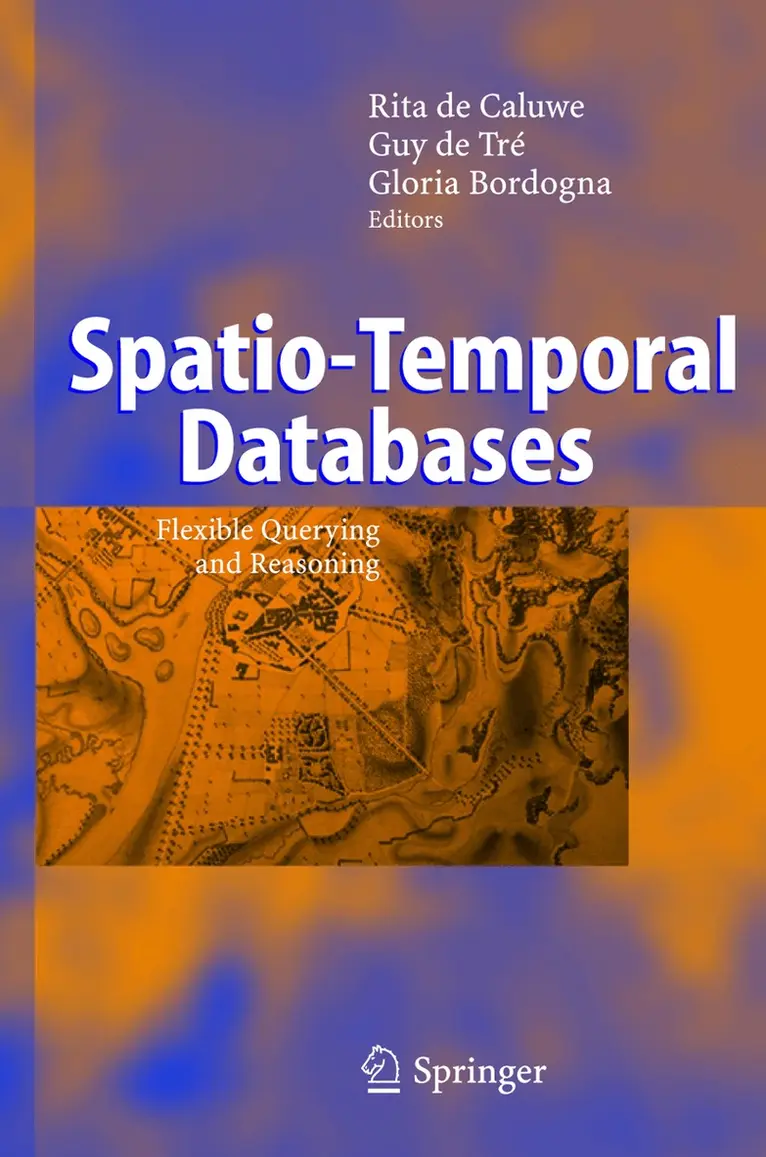
Spatio-Temporal Databases
Av Rita de Caluwe, Guy De Tré, Gloria Bordogna
1641 kr
Beställningsvara. Skickas inom 10-15 vardagar. Fri frakt över 249 kr.
Beskrivning
Spatio-Temporal Databases explores recent trends in flexible querying and reasoning about time- and space-related information in databases. It shows how flexible querying enhances standard querying expressiveness in many different ways, with the aim of facilitating extraction of relevant data and information. Flexible spatial and temporal reasoning denotes qualitative reasoning about dynamic changes in the spatial domain, characterized by imprecision or uncertainty (or both). Many of the contributions focus on GIS, while some others are more general, or focus on related application fields, presenting theoretical viewpoints and techniques that are inspiring or can be adapted for GIS. The first part bundles the contributions on advances at the theoretical level, also discussing examples and opening further perspectives. The second part presents contributions on well-developed applications. The authors explain how to handle imprecision and uncertainty, demonstrating how advanced techniques can help to solve diverse problems related to GIS.
Produktinformation
- Utgivningsdatum: 2004-08-12
- Mått: 155 x 235 x 27 mm
- Vikt: 854 g
- Format: Inbunden
- Språk: Engelska
- Antal sidor: 392
- Upplaga: 2004
- Förlag: Springer-Verlag Berlin and Heidelberg GmbH & Co. KG
- ISBN: 9783540222149
Utforska kategorier
Betyg & recensioner
0 recensioner
Inga recensioner tillgängliga.