• Fri frakt över 249 kr
  • •
  • Snabba leveranser
  • •
  • Billiga böcker
Kundservice

Du är på sajten för privatpersoner.

Företag, bibliotek eller offentlig verksamhet?

Du handlar på classic.bokus.com, där alla dina funktioner finns intakta.
Till classic.bokus.com
Bokus logotyp. Gå till startsidan.
  • Erbjudanden
  • Student
  • Topplistor
  • Barn & ungdom
  • Bokus Play
  • E-böcker
  • Ljudböcker
  • Pocketböcker
  • Spel och pussel

Pocketfynda! Hundratals böcker för 49 kr/st →

Sidfot

Mina sidor

    Hjälp

    • Kundservice
    • Vanliga frågor och svar
    • Frakt och leverans
    • Retur vid ångerrätt
    • Reklamera vara
    • Betalning
    • Köpvillkor
    • Allmänna villkor
    • Information om webbplatsens tillgänglighet

    Om Bokus

    • Om oss
    • Pressrum
    • För studenter
    • För företag
    • För bibliotek och offentlig verksamhet
    • För leverantörer
    • Hållbarhet

    Populärt

    • Aktuella erbjudanden
    • Presentkort
    • Studentlitteratur
    • Nya böcker
    • Topplistor
    • Signerade böcker
    • Engelska böcker

    Inspiration

    • Boktips
    • BookTok
    • Barnbokskaraktärer
    • Populära författare
    Logotyp för Bokus
    Följ oss på Facebook (extern länk)Följ oss på Instagram (extern länk)Följ oss på YouTube (extern länk)Följ oss på TikTok (extern länk)
    bokus @ CookiesAnpassa cookiesIntegritetspolicyKöpvillkor
    Till Citymail hemsida (extern länk)Till Budbee hemsida (extern länk)Till Postnord hemsida (extern länk)Till Schenker hemsida (extern länk)Till Early Bird hemsida (extern länk)Till Walleys hemsida (extern länk)
    1. Data och IT
    2. Programmeringsböcker
    3. Programvaruutveckling

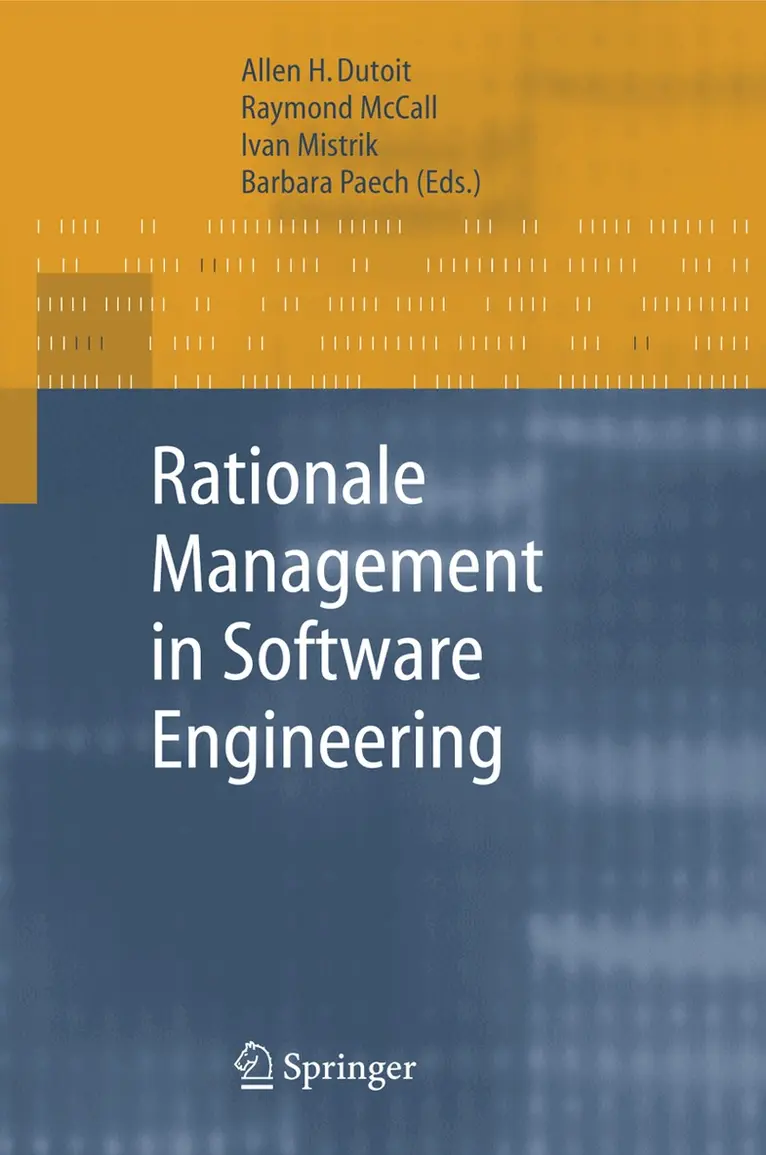
    Rationale Management in Software Engineering

    AvAllen H. Dutoit,Raymond McCall

    Inbunden, Engelska, 2006

    1 110 kr

    Beställningsvara. Skickas inom 10-15 vardagar. Fri frakt över 249 kr.

    Beskrivning

    Thirty years ago, I first entered the dark realm of software engineering, through a prior interest in documentation. In those days, documentation pretty much meant functional specifications. The idea that stakeholders in a system (its implementers, its end-users, its maintainers, and so forth) might want something other than an alphabetic list of function definitions was just taking hold. There was an exciting (to me) vision of stakeholders accessing and contributing to explanations of how and why aspects of a system work as they do, tradeoff analysis of concomitant downsides, and perhaps even accounts of why other possible approaches were not followed. There were many challenges to overcome in achieving this vision. The most formidable is the belief that people do not like to create or use do- mentation. This negative image of documentation is (unfortunately) more than just the bias of a few incorrigible system developers. It is more like a deep truth about human information behavior, about how human beings construe and act towards information. Humans are, by default, active users of information; they want to try things out, and get things done. When documentation is interposed as a prerequisite between people and a desired activity, they try to skip through it, circumvent it, or undermine it. Desi- ing information to suit the needs and interests of its users is an abiding challenge, but we have come a long way from functional specifications as the only answer.

    Produktinformation

    • Utgivningsdatum:2006-04-05
    • Mått:155 x 235 x 30 mm
    • Vikt:846 g
    • Format:Inbunden
    • Språk:Engelska
    • Antal sidor:434
    • Upplaga:2006
    • Förlag:Springer-Verlag Berlin and Heidelberg GmbH & Co. KG
    • ISBN:9783540309970

    Utforska kategorier

    • Programvaruutveckling inom Data och IT

    Recensioner i media

    Ten years ago, with Tom Moran, I edited a book entitled "Design Rationale." I think that book has held up quite well, though a decade onward it does seem a bit prefatory. It is past time for another detailed summary of research on design rationale. Allen Dutoit, Ray McCall, Ivan Mistrik and Barbara Paech have done an excellent job of this in "Rationale management in software engineering." The chapters in this volume show how design rationale can be incorporated into the heart of the software development process - into requirements engineering, software architecture, and code design. (John Carroll, School of Information Sciences and Technology, Penn State University, USA)

    Innehållsförteckning

    • Fundamentals – Rationale Representation, Capture, and Use.- Rationale Management in Software Engineering: Concepts and Techniques.- Three Studies of Design Rationale as Explanation.- Effective Design Rationale: Understanding the Barriers.- Rationale as a By-Product.- Hypermedia Support for Argumentation-Based Rationale.- Rationale Management for Requirements Engineering.- A Hybrid Approach to Upstream Requirements: IBIS and Cognitive Mapping.- From DREAM to Reality: Specificities of Interactive Systems Development With Respect To Rationale Management.- The WinWin Approach: Using a Requirements Negotiation Tool for Rationale Capture and Use.- Design Rationale in Exemplary Business Process Modeling.- Promoting and Supporting Requirements Engineering Creativity.- Design Rationale and Software Architecting.- A Framework for Supporting Architecture Knowledge and Rationale Management.- Capturing and Using Rationale for a Software Architecture.- Rationale-Based Support for Software Maintenance.- The Role of Rationale in the Design of Product Line Architectures – A Case Study from Industry.- The Role and Impact of Assumptions in Software Engineering and its Products.- Design Decisions: The Bridge between Rationale and Architecture.- Rationale for Organizing Bodies of Knowledge.- Reusable Rationale Blocks: Improving Quality and Efficiency of Design Choices.- Defining Agile Patterns.- Capturing and Reusing Rationale Associated with Requirements Engineering Process Improvement: A Case Study.- Using Patterns for Sharing Requirements Engineering Process Rationales.