• Fri frakt över 249 kr
  • •
  • Snabba leveranser
  • •
  • Billiga böcker
Kundservice

Du är på sajten för privatpersoner.

Företag, bibliotek eller offentlig verksamhet?

Du handlar på classic.bokus.com, där alla dina funktioner finns intakta.
Till classic.bokus.com
Bokus logotyp. Gå till startsidan.
  • Erbjudanden
  • Nyheter
  • Student
  • Topplistor
  • Barn & ungdom
  • Bokus Play
  • E-böcker
  • Pocketböcker
  • Spel & pussel

10% rabatt på allt med kod: NYSTART10 →

Sidfot

Mina sidor

    Hjälp

    • Kundservice
    • Vanliga frågor och svar
    • Frakt och leverans
    • Retur vid ångerrätt
    • Reklamera vara
    • Betalning
    • Köpvillkor
    • Allmänna villkor
    • Information om webbplatsens tillgänglighet

    Om Bokus

    • Om oss
    • Pressrum
    • För studenter
    • För företag
    • För bibliotek och offentlig verksamhet
    • För leverantörer
    • Hållbarhet

    Populärt

    • Aktuella erbjudanden
    • Presentkort
    • Studentlitteratur
    • Nya böcker
    • Topplistor
    • Signerade böcker
    • Engelska böcker

    Inspiration

    • Boktips
    • BookTok
    • Populära bokserier
    • Barnbokskaraktärer
    • Populära författare
    Logotyp för Bokus
    Följ oss på Facebook (extern länk)Följ oss på Instagram (extern länk)Följ oss på YouTube (extern länk)Följ oss på TikTok (extern länk)
    bokus @ CookiesAnpassa cookiesIntegritetspolicyKöpvillkor
    Till Citymail hemsida (extern länk)Till Budbee hemsida (extern länk)Till Postnord hemsida (extern länk)Till Schenker hemsida (extern länk)Till Early Bird hemsida (extern länk)Till Walleys hemsida (extern länk)
    1. Naturvetenskap och teknik
    2. Matematik och naturvetenskap
    3. Biologi
    4. Biokemi

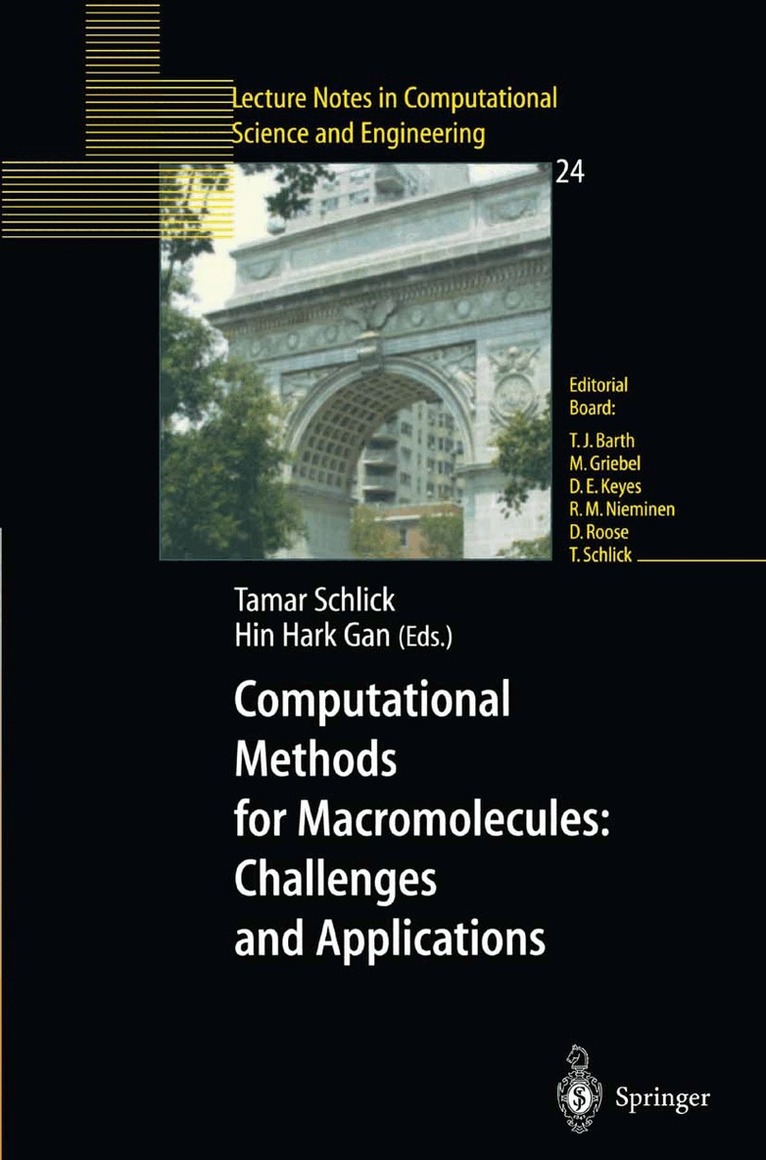
    Computational Methods for Macromolecules: Challenges and Applications

    Proceedings of the 3rd International Workshop on Algorithms for Macromolecular Modeling, New York, October 12–14, 2000

    AvB. A. Fultz,Tamar Schlick

    Häftad, Engelska, 2002

    Del 24 i serien Lecture Notes in Computational Science and Engineering

    1 625 kr

    Beställningsvara. Skickas inom 10-15 vardagar. Fri frakt över 249 kr.

    Beskrivning

    3 The workshop on Methods for Macromolecular Modeling (M ) , held at New York University on 12- 14 October 2000, attracted 187 participants from Eu- rope, Asia, the Americas, and the Middle East. (see monod.biomath .nyu.eduj rvhganjconfOO.html for more information). The exciting program was made possible by the dedicated work of the international advisory committee whose members were P. Deuflhard, J. Hermans, B. Leimkuhler, A. E. Mark, S. Reich, T. Schlick, and R. Skeel. We are indebted to the following agen- cies and institutions for their generous support: the Burroughs Wellcome Fund, Department of Energy, National Science Foundation, National Insti- tutes of Health, Computational Biomedicine Initiative at Mount Sinai School of Medicine, and NYU's Courant Institute of Mathematical Sciences, Depart- ment of Chemistry, and Science Council. This volume is a collection of 19 review and original articles by the speak- 3 ers and participants of the M workshop.The topics covered include molecu- lar dynamics methods, Monte Carlo methods, other conformational sampling methods, free energy methods, long range interactions and fast electrostatics, and statistical approaches to protein structures. A perspective article intro- duces the contributions in this volume and reflects on future prospects in macromolecular modeling.

    Produktinformation

    • Utgivningsdatum:2002-08-06
    • Mått:155 x 235 x 28 mm
    • Vikt:779 g
    • Format:Häftad
    • Språk:Engelska
    • Serie:Lecture Notes in Computational Science and Engineering
    • Antal sidor:504
    • Förlag:Springer-Verlag Berlin and Heidelberg GmbH & Co. KG
    • ISBN:9783540437567

    Utforska kategorier

    • Biokemi inom Naturvetenskap och teknik
    • Tillämpad matematik inom Naturvetenskap och teknik
    • 3D-grafik och modellering inom Data och IT

    Recensioner i media

    POLYMER NEWS REVIEW BY ANDRZEJ KLOCZKOWSKI, BAKER CENTER FOR BIOINFORMATICS AND BIOLOGICAL STATISTICS, IOWA STATE UNIVERSITY "The authors of the articles in the book are the top specialists in their fields and the book presents the current state of the art for the broad spectrum of all currently used methods and techniques of macromolecular modeling. The book might be very useful for all readers interested in the computational modeling of macromolecules. Several articles in the book cover different aspects of protein modeling, so I would highly recommend this book to all readers interested in modeling of proteins."

    Innehållsförteckning

    • Methods for Macromolecular Modeling (M3): Assessment of Progress and Future Perspectives.- I Biomolecular Dynamics Applications.- Mathematics and Molecular Neurobiology.- Structural and Dynamical Characterization of Nuclei Acid Water and Ion Binding Sites.- II Molecular Dynamics Methods.- A Test Set for Molecular Dynamics Algorithms.- Internal Coordinate Molecular Dynamics Based on the Spectroscopic B-Matrix.- The Sigma MD Program and a Generic Interface Applicable to Multi-Functional Programs with Complex, Hierarchical Command Structure.- Overcoming Instabilities in Verlet-I/r-RESPA with the Mollified Impulse Method.- III Monte Carlo Methods.- On the Potential of Monte Carlo Methods for Simulating Macromolecular Assemblies.- Structure Calculation of Protein Segments Connecting Domains with Defined Secondary Structure: A Simulated Annealing Monte Carlo Combined with Biased Scaled Collective Variables Technique.- IV Other Conformational Sampling Methods.- Hierarchical Uncoupling-Coupling of Metastable Conformations.- Automatic Identification of Metastable Conformations via Self-Organized Neural Networks.- V Free Energy Methods.- Equilibrium and Non-Equilibrium Foundations of Free Energy Computational Methods.- Free-Energy Calculations in Protein Folding by Generahzed-Ensemble Algorithms.- Ab Initio QM/MM and Free Energy Calculations of Enzyme Reactions.- VI Long Range Interactions and Fast Electrostatics Methods.- Treecode Algorithms for Computing Nonbonded Particle Interactions.- A New Reciprocal Space Based Method for Treating Long Range Interactions in Ab Initio and Force-Field Based Calculations for Surfaces, Wires, and Clusters.- Efficient Computational Algorithms for Fast Electrostatics and Molecular Docking.- VII Statistical Approaches to Protein Structures.- FoldRecognition Using the OPLS All-Atom Potential and the Surface Generalized Born Solvent Model.- Identification of Sequence-Specific Tertiary Packing Motifs in Protein Structures using Delaunay Tessellation.- Appendix: Color Plates.